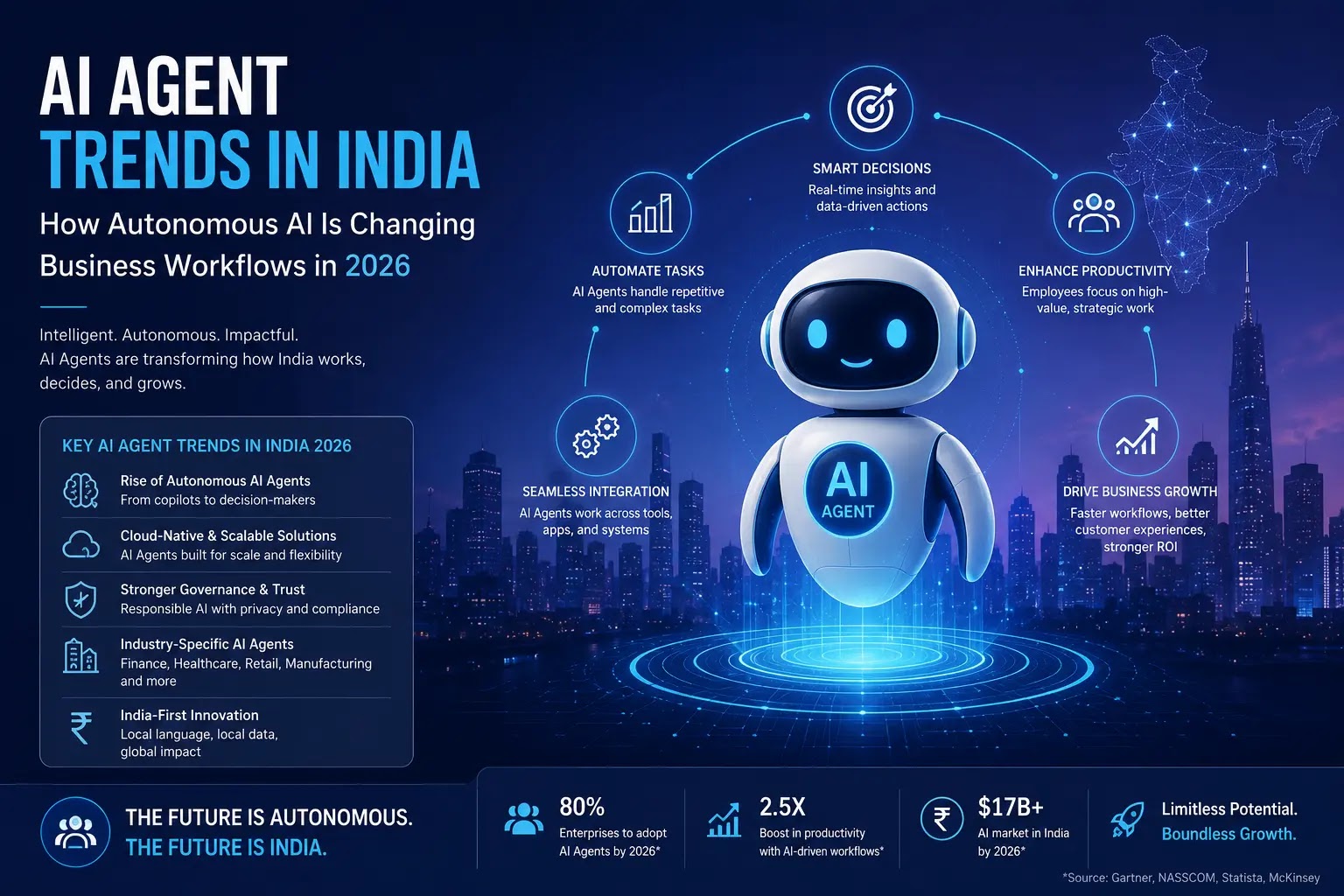
Something remarkable is happening inside Indian boardrooms, startup offices, and IT departments right now. Autonomous AI agents are quietly replacing repetitive workflows, approving invoices, responding to customer queries, scheduling meetings, and making real-time decisions — without a single human instruction for each step. This is not a future prediction. It is already happening across India in 2026, and the scale of adoption is accelerating faster than most businesses expected. We will discussed today on AI Agent Trends in India.
Over 90% of Indian organisations are expected to deploy AI agents by 2026, according to an IDC and UiPath study. EY’s AIdea of India 2026 report confirms that Indian enterprises are no longer experimenting with AI — they are building fully autonomous digital workforces. This shift from Generative AI to Agentic AI is one of the biggest technology transitions India has seen in decades, and every business owner, IT leader, and professional needs to understand what it means for them.
What Are AI Agents and Why AI Agent Trends in India?
AI agents are software systems that can perceive their environment, make decisions, and take actions to achieve a specific goal — without requiring step-by-step human input. Unlike a chatbot that simply responds to a question, an AI agent can plan a sequence of tasks, call external tools, use APIs, browse the web, write and execute code, and complete complex multi-step workflows end to end.
Think of it this way: a regular AI tool answers your question. An AI agent actually does the job for you. If you ask a regular AI “how do I process this invoice?”, it gives you steps. An AI agent logs into your ERP system, reads the invoice, matches it to the purchase order, flags any discrepancy, and either approves or escalates — all automatically.
Types of AI Agents Making Waves in India
- Task Automation Agents: Handle repetitive business processes like data entry, invoice processing, HR onboarding, and report generation.
- Customer Service Agents: Manage end-to-end customer interactions across WhatsApp, email, and web chat without human handoff for routine queries.
- Research and Analysis Agents: Continuously monitor market data, competitors, and news to generate business intelligence summaries.
- Code and DevOps Agents: Write, test, and deploy code, monitor production systems, and auto-fix known bugs.
- Sales and Lead Generation Agents: Identify prospects, personalise outreach, follow up on leads, and update CRM — all without manual input.
The Scale of Agentic AI Adoption in India in 2026
India is not just adopting AI agents — it is leading Asia in agentic AI deployment. According to Deloitte’s State of GenAI report (India perspective), more than 80% of Indian organisations are actively exploring autonomous agent development. The EY AIdea of India 2026 report goes further, showing that enterprises are now building human-AI collaboration models where agents handle execution while humans focus on governance and strategy.
Key sectors driving this adoption include:
- IT and Software Services: Companies like Infosys, TCS, and Wipro are embedding AI agents into software development pipelines, testing cycles, and client delivery workflows.
- Banking and Financial Services: HDFC Bank, ICICI, and several fintech startups are using agents for fraud detection, KYC verification, loan processing, and customer support.
- E-commerce and Retail: Flipkart, Meesho, and D2C brands are deploying agents for inventory management, dynamic pricing, and personalised customer journeys.
- Healthcare: Hospitals and healthtech companies are using agents for appointment scheduling, medical record summarisation, and insurance claim processing.
- Manufacturing and Logistics: Indian manufacturers are using agents to optimise supply chains, predict maintenance needs, and manage vendor communications.
How AI Agents Are Changing Business Workflows
The impact of AI agents on business workflows is both deep and wide. Traditional workflows required humans at every decision point. Agentic workflows are different — they are designed to operate autonomously within defined guardrails, escalating to humans only when genuinely needed.
End-to-End Process Automation
Where earlier businesses used Robotic Process Automation (RPA) to automate single steps, AI agents can now handle entire processes. A procurement workflow that once required five employees and three days can now be completed by an AI agent in hours — from supplier selection to purchase order generation to delivery tracking.
Real-Time Decision Making
AI agents process data in real time and make decisions faster than any human team. In financial services, this means fraud can be detected and blocked within milliseconds. In supply chain management, it means inventory replenishment orders are placed automatically when stock drops below threshold — without anyone opening a dashboard.
Seamless Integration Across Tools
Modern AI agents integrate with Slack, Google Workspace, SAP, Salesforce, WhatsApp Business, and virtually any enterprise tool via APIs. This means they can work across your existing tech stack without requiring a complete infrastructure overhaul — a major reason Indian SMEs are warming up to agents in 2026.
Top AI Agent Platforms Being Used in India in 2026
Several platforms are powering the agentic AI revolution in India right now:
- Google Agentspace: Google’s enterprise agent platform that helps Indian businesses build, deploy, and manage AI agents using Gemini models integrated with their existing Google Workspace tools.
- Microsoft Copilot Studio: Widely used in Indian IT and BFSI companies to create custom agents that work inside Teams, Outlook, and Power Platform.
- UiPath AI Agents: A leader in the Indian RPA market, UiPath has extended its platform to support full agentic workflows with human-in-the-loop options.
- Salesforce Agentforce: Popular in Indian sales and customer service teams, enabling autonomous customer engagement agents.
- LangChain and LangGraph: Widely adopted by Indian developers and AI startups to build custom multi-agent systems for specific business needs.
- AWS Bedrock Agents: Used by Indian cloud-native companies to deploy agents that interact with databases, APIs, and internal knowledge bases.
Challenges and Concerns Around AI Agents in India
Despite the excitement, Indian businesses face real challenges when deploying AI agents. These are not reasons to avoid agents — but they are important factors to plan for carefully.
Data Privacy and Compliance
AI agents often need access to sensitive business and customer data to function effectively. With India’s Digital Personal Data Protection Act (DPDPA) now in effect, businesses must ensure their agents are compliant with data localisation and consent requirements. Mishandling of data by an AI agent could expose companies to regulatory and reputational risk.
Hallucination and Error Risk
AI agents can make mistakes, especially when operating in ambiguous or edge-case situations. In high-stakes domains like finance, healthcare, or legal processes, an incorrect autonomous decision can have serious consequences. Businesses need robust human-in-the-loop mechanisms and audit trails.
Integration Complexity
While modern agents are designed to integrate easily, legacy Indian enterprise systems — especially in government, manufacturing, and banking — often lack the APIs or data structures needed for seamless agent deployment. Custom integration work adds time and cost.
Talent Gap
India faces a shortage of professionals who understand both the business context and technical architecture of agentic AI systems. Building effective agents requires skills in prompt engineering, API design, LLM orchestration, and domain knowledge — a combination that is still rare.
What This Means for Indian Professionals and Businesses
The rise of AI agents does not mean mass job loss — but it does mean mass job transformation. Roles that focus on executing routine tasks will evolve or diminish. Roles that focus on designing, governing, and improving agentic systems will grow significantly. The most future-proof professionals in India will be those who understand how to work with AI agents, not just alongside them.
For Indian business owners, the opportunity is clear: AI agents can dramatically reduce operational costs, improve consistency, and free up your human team to focus on strategy, creativity, and relationships. The businesses that move early on agentic AI will build significant competitive advantages over those that wait.
India’s position is uniquely strong. With one of the world’s largest pools of IT talent, a rapidly growing AI startup ecosystem, and strong government push through initiatives like IndiaAI Mission, the country is positioned to become not just a consumer but a global exporter of agentic AI solutions.
Getting Started with AI Agents for Your Business
If you are an Indian business owner or IT leader wondering where to begin, here is a practical roadmap:
- Identify one high-volume, repetitive workflow in your business — invoicing, customer onboarding, support tickets, or lead follow-up.
- Choose a no-code or low-code agent platform like Microsoft Copilot Studio or UiPath to start without deep technical knowledge.
- Define clear guardrails — specify exactly what decisions the agent can make autonomously and when it must escalate to a human.
- Pilot, measure, and improve — run a 30-day pilot on a small process, measure time saved and error rates, then scale.
- Train your team — invest in upskilling employees to collaborate with agents effectively, not fear them.
The agentic AI era in India is not coming — it is already here. The question is no longer whether your business will use AI agents, but whether you will deploy them strategically before your competitors do. Businesses and professionals who understand this shift today will lead India’s next wave of digital transformation.
Before we answer some frequently asked questions, you may also find these guides helpful:
Best AI Automation Tools for Job Hunting That Actually Work: Complete Guide for Indian Job Seekers
Can an AI Agent Handle Customer Service Without Human Backup? The Reality for Indian Businesses
Frequently Asked Questions (FAQ)
What is an AI agent and how is it different from a chatbot?
An AI agent is an autonomous software system that can plan, decide, and take multi-step actions to complete a goal — without human input at each step. A chatbot simply responds to one question at a time. An AI agent, by contrast, can browse the web, call APIs, write code, and complete entire workflows from start to finish on its own.
Why are AI agents becoming so popular in India in 2026?
Over 90% of Indian organisations are expected to deploy AI agents in 2026, driven by the need to reduce operational costs, speed up delivery, and compete globally. India’s large IT talent pool, IndiaAI Mission infrastructure, and rapid enterprise GenAI adoption have created the perfect conditions for agentic AI to scale fast.
Which Indian industries are using AI agents the most?
Banking and financial services, IT and software, e-commerce, healthcare, and manufacturing are the top adopters. Indian fintech companies use agents for fraud detection and KYC. IT firms use them in software development pipelines. E-commerce platforms use agents for dynamic pricing and inventory management.
How much does it cost to build or deploy an AI agent in India?
Costs vary widely. For Indian SMBs using no-code platforms like Zoho or Make, AI automation workflows can start from as low as ₹2,000 to ₹15,000 per month. Custom enterprise AI agent development in India typically ranges from ₹5 lakhs to ₹50 lakhs depending on complexity, integration needs, and the number of workflows automated.
Are AI agents safe to use for sensitive business data in India?
Safety depends on implementation. Under India’s Digital Personal Data Protection Act (DPDPA), businesses must ensure AI agents comply with data localisation rules and user consent requirements. Choosing vendors that offer on-premise or local cloud deployment, maintaining audit trails, and implementing role-based access controls are essential safety practices.
Will AI agents replace jobs in India?
AI agents will transform jobs more than replace them. Repetitive, rule-based roles will shrink, but roles involving AI governance, agent design, business strategy, and human-AI collaboration will grow significantly. The World Economic Forum and Indian industry reports consistently show that AI creates more new roles than it eliminates — but upskilling is critical.
What are the best AI agent platforms available for Indian businesses?
The most widely used platforms in India in 2026 include Google Agentspace, Microsoft Copilot Studio, UiPath AI Agents, Salesforce Agentforce, LangChain, and AWS Bedrock Agents. For Indian SMBs, low-code tools like n8n, Zapier, and Make offer affordable entry points without requiring deep technical expertise.
How do I start implementing AI agents in my Indian business?
Start by identifying one high-volume, repetitive process — such as invoice processing, customer support, or lead follow-up. Choose a low-code platform to build your first agent, define clear guardrails on what it can decide autonomously, run a 30-day pilot, measure results, and scale only after the system proves reliable. Always include a human-in-the-loop for high-stakes decisions.
What is the difference between RPA and AI agents?
Robotic Process Automation (RPA) automates fixed, rule-based steps in a single workflow — it follows a rigid script. AI agents are far more flexible: they can reason, adapt to new situations, handle unstructured data, make judgment-based decisions, and complete complex multi-step workflows that RPA cannot handle. In 2026, many Indian enterprises are upgrading from RPA to full agentic AI systems.
What is the future of agentic AI in India beyond 2026?
India is on track to become a global exporter of agentic AI solutions, not just a consumer. Gartner predicts that 40% of enterprise applications globally will embed task-specific AI agents by end-2026. With IndiaAI Mission investments, Bhashini integration for regional language agents, and a growing AI startup ecosystem, India’s agentic AI market is projected to contribute significantly to the country’s ambition of a $1 trillion digital economy by 2035.