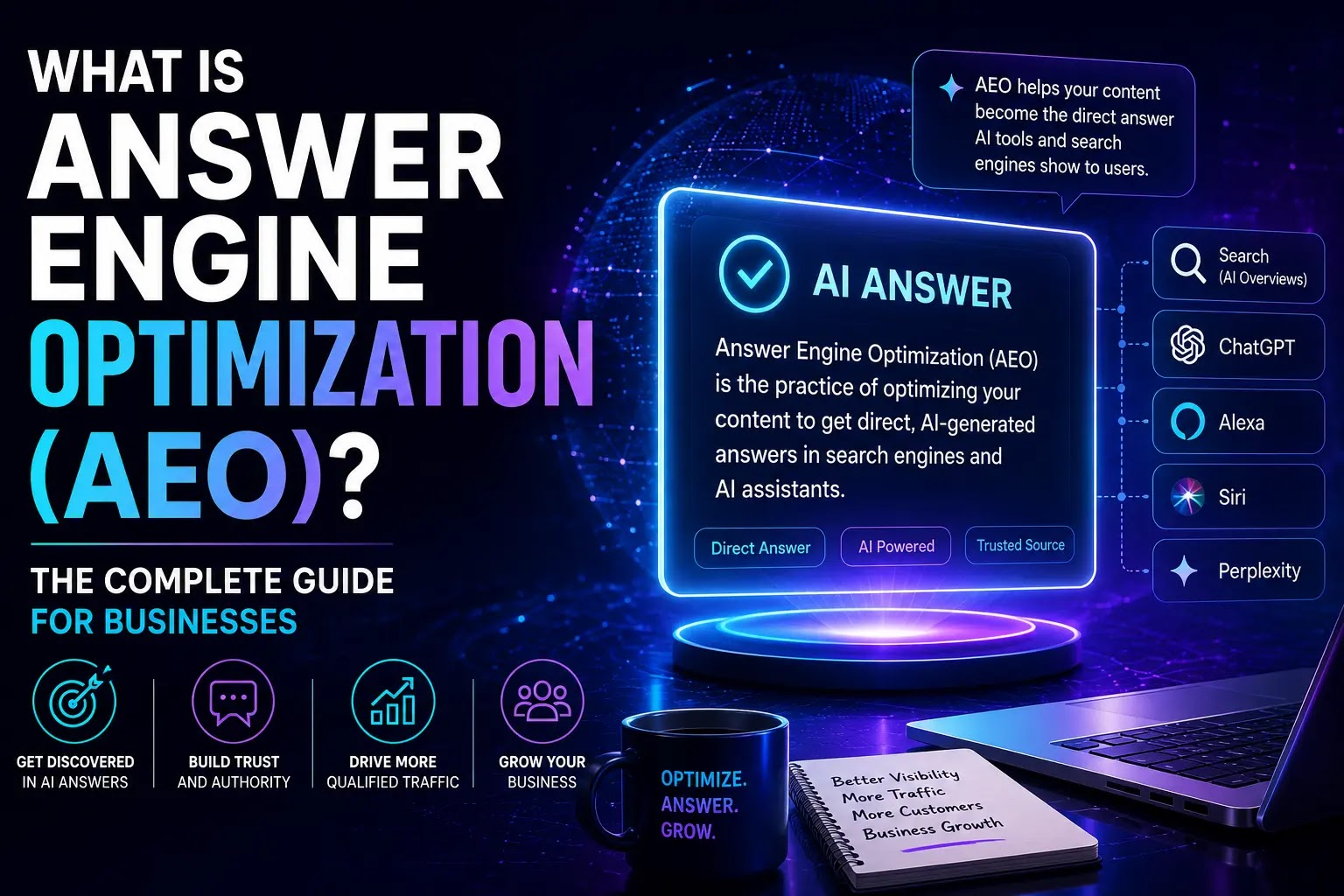
Imagine spending months building a perfect website, ranking on Google’s first page — only to discover that 65% of your potential customers never even see it. They got their answer directly from ChatGPT, Perplexity, or Google AI Overviews without ever clicking a link. This is the new reality of search in 2026, and it’s why Answer Engine Optimization (AEO) has become the most critical digital marketing skill businesses need right now.
In this complete guide, we’ll break down exactly what AEO is, how it differs from traditional SEO, and — most importantly — how your business can start showing up as the trusted answer in AI-powered search engines. Whether you run a small local business or a global B2B company, AEO is the strategy that will determine your visibility in the next era of search.
The shift is already happening. AI assistants are answering questions that used to drive traffic to websites. If your content isn’t structured to be cited by these engines, you’re losing potential customers silently — and most businesses don’t even realize it yet.
What Is Answer Engine Optimization (AEO)?
Answer Engine Optimization (AEO) is the practice of structuring and optimizing your content so that AI-powered answer engines — like ChatGPT, Google AI Overviews, Perplexity, Claude, and Gemini — cite your brand as a trusted source when answering user questions.
Unlike traditional SEO, which focuses on ranking your web page in a list of search results, AEO focuses on getting your content included inside the AI-generated answer itself. When someone asks an AI assistant “What’s the best project management tool for remote teams?”, AEO is what determines whether your brand gets named — or completely ignored.
According to Gartner, traditional organic search traffic is expected to decline by 25% by 2026 as AI assistants increasingly replace conventional search behavior. This makes AEO not a luxury — it’s survival for any business that depends on online discovery.
AEO vs SEO: What’s the Core Difference?
Both SEO and AEO share the same DNA — creating authoritative, trustworthy, well-structured content. But their goals are fundamentally different:
The smartest businesses in 2026 aren’t choosing between SEO and AEO — they’re running both strategies in parallel. SEO gets you found in traditional search; AEO gets you cited in AI answers. Together, they cover the full spectrum of modern search behavior.
Why AEO Matters More Than Ever in 2026
The numbers tell a stark story about how rapidly search behavior is changing:
- 65% of searches now end without a click — users get answers directly from AI summaries
- 73% of consumers now ask AI assistants for product and service recommendations
- Gartner predicts a 25% decline in traditional organic search traffic by end of 2026
- Google AI Overviews now appear on over 40% of all searches, absorbing clicks that once went to ranked websites
- ChatGPT alone has over 200 million weekly active users, many using it as their primary search tool
If your brand isn’t optimized for AI answer engines, you are effectively invisible to the fastest-growing segment of online searchers. The businesses that act now will build a compounding advantage that becomes harder to close over time.
How AI Answer Engines Decide What to Cite
AI engines like ChatGPT, Perplexity, and Google AI Overviews don’t rank content the way traditional Google does. Instead, they evaluate content based on a set of credibility and clarity signals:
1. E-E-A-T Signals (Experience, Expertise, Authoritativeness, Trustworthiness)
Google and other AI engines heavily weigh E-E-A-T. Content written by demonstrable experts, backed by real data, and sourced from authoritative domains gets cited more often. This means having an author bio, citing reputable statistics, and building backlinks from trusted sources all matter for AEO success.
2. Answer-First Content Structure
AI models are trained to extract direct answers. If your content buries the answer deep inside a long introduction, AI will skip it. The winning format is: Ask the question → Give a direct 2–3 sentence answer → Then expand with detail. This inverted pyramid structure is the foundation of AEO-ready content.
3. Structured Data and Schema Markup
FAQ schema, HowTo schema, and Article schema make your content machine-readable. When AI crawlers see structured data, they can extract your answers with precision and cite them accurately. Pages with proper schema markup consistently outperform unstructured pages in AI citation rates.
4. Entity Consistency
AI models build a knowledge graph of brands, people, and concepts. Consistent use of your brand name, product names, and core topics across your website, social profiles, and third-party mentions helps AI engines “understand” who you are and what you do — making them more likely to cite you confidently.
5. Content Freshness
AI engines prioritize recently updated content. Adding new statistics, updating publication dates, and regularly refreshing your key pages signals that your content is current and reliable. A page last updated 3 years ago will almost always lose to a freshly updated competitor.
The Step-by-Step AEO Strategy for Businesses
Here is a practical, actionable roadmap to start optimizing your content for AI answer engines today:
Step 1: Build Your Prompt Set
Instead of keyword lists, AEO starts with prompt lists — the natural-language questions your customers are asking AI engines. Pull these from Google Search Console queries, customer support tickets, “People Also Ask” boxes, and Reddit or Quora threads in your niche. Aim for 40–60 prompts covering top-of-funnel (“what is X”), middle-funnel (“best X for Y”), and bottom-funnel (“X vs Y”) questions.
Step 2: Restructure Content with Answer-First Blocks
For every major page on your site, rewrite the introduction so the direct answer comes first. Make every H2 and H3 heading a question your customer would actually ask an AI — “How does AEO work?” rather than “Our Methodology.” This simple change dramatically improves AI extraction rates.
Step 3: Add Schema Markup
Implement FAQPage schema for Q&A sections, HowTo schema for step-by-step content, Article schema with author and date fields, and Organization schema to establish your brand entity. These four schema types cover the majority of AEO use cases for most businesses.
Step 4: Build Topical Authority
AI engines favor sources that comprehensively cover a topic cluster. Build a content hub: a pillar page on AEO supported by cluster posts on “AEO tools”, “AEO for e-commerce”, “AEO vs GEO”, and so on. Internal linking between these pages signals deep topical expertise that AI engines reward with higher citation frequency.
Step 5: Get Cited on Third-Party Sites
AI models train on the broader web. If authoritative sites like Forbes, HubSpot, or industry publications mention and link to your brand, your citation probability in AI answers increases significantly. PR campaigns, guest posting, and digital PR are now AEO strategies, not just SEO tactics.
Step 6: Track AI Citations Weekly
Use tools like Profound, Otterly.ai, AthenaHQ, or Peec AI to monitor your brand’s appearance in AI-generated answers. Run your target prompts weekly on ChatGPT, Perplexity, Gemini, and Claude. Track which sources get cited, identify gaps, and systematically displace competitors over time.
AEO Best Practices Checklist
Use this quick checklist to audit your most important pages for AEO readiness:
- ✅ Page has a clear, direct answer in the first 100 words
- ✅ H2/H3 headings are written as questions
- ✅ FAQ section with at least 5 Q&A pairs
- ✅ FAQPage schema is implemented and validated
- ✅ Statistics are cited with sources and updated within 12 months
- ✅ Author bio with credentials is visible on the page
- ✅ Page was updated within the last 90 days
- ✅ Brand name is consistent across all pages and profiles
- ✅ Internal links connect to related topic cluster pages
- ✅ Core Web Vitals pass (LCP under 2.5s, CLS under 0.1)
AEO for Different Business Types
For E-Commerce Businesses
Focus on optimizing product category pages with answer-first descriptions. Add FAQ schema to product pages answering “Is [product] worth it?”, “What’s the difference between X and Y?”, and “How do I use [product]?” Reviews with schema markup also dramatically increase citation probability when buyers ask AI for product recommendations.
For Service-Based Businesses
Create detailed service pages structured around the questions prospects actually type into AI: “How much does [service] cost?”, “How long does [service] take?”, “What should I look for in a [service provider]?” These bottom-funnel prompts are asked millions of times daily, and being the cited answer is equivalent to a warm referral.
For B2B Companies
Invest in data-driven thought leadership. Original research reports, industry surveys, and benchmark studies make your brand the go-to citation for AI engines answering B2B decision-maker questions. A single well-cited research report can generate hundreds of AI citations across multiple platforms, building brand authority that compounds over months.
Common AEO Mistakes to Avoid
- Writing for humans only: Great prose that doesn’t lead with a direct answer will be skipped by AI parsers, no matter how well it’s written
- Ignoring schema markup: Without structured data, AI engines have to guess your content structure — and often get it wrong or skip it entirely
- Inconsistent brand mentions: Using different variations of your brand name interchangeably confuses AI entity recognition and weakens your citation probability
- No freshness signals: Content without recent updates gets deprioritized as AI engines strongly favor current, up-to-date information
- Skipping competitor analysis: Always check which sources AI cites for your target prompts — those are your real AEO competitors, not just your traditional SEO rivals
The Future of AEO: What’s Coming Next
AEO is already evolving rapidly beyond its current form. Here’s what forward-looking businesses are preparing for:
- Voice AEO: As smart speakers and voice assistants continue to grow, optimizing for spoken, conversational answers in natural language becomes increasingly critical
- Video AEO: AI engines are beginning to cite YouTube videos and video transcripts as authoritative sources, making video content a new AEO frontier
- Entity-First Indexing: AI models are moving toward prioritizing consistent, well-structured brand entities over keyword-rich pages in their citation decisions
- Sentiment-Based Inclusion: Positive brand sentiment across reviews, forums, and news will increasingly determine whether your brand appears in AI answers at all
- GEO (Generative Engine Optimization): An emerging discipline that covers optimizing for all AI-generated content experiences beyond traditional search, including AI writing assistants and AI-native platforms
Businesses that invest in AEO infrastructure today — structured content, schema markup, entity consistency, and AI citation tracking — will have a compounding advantage that becomes increasingly difficult for late movers to close.
Before we answer some frequently asked questions, you may also find these guides helpful:
Multimodal AI Explained: How AI That Sees, Hears, and Reads Is Transforming Businesses in 2026
AI Agents for E-commerce Businesses: How Autonomous AI Is Transforming Online Retail
Frequently Asked Questions
How to answer engine optimization?
Answer Engine Optimization (AEO) involves creating clear, accurate, and well-structured content that directly answers user questions. Use question-based headings, concise answers, FAQ sections, structured data, and trustworthy information to improve visibility in AI-powered search engines and featured snippets.
What is AEO vs SEO?
AEO focuses on optimizing content for AI search engines and voice assistants that provide direct answers to users. SEO focuses on improving rankings in traditional search engine results pages. While SEO targets clicks, AEO aims to become the best direct answer.
Is ChatGPT an answer engine?
Yes, ChatGPT functions as an AI-powered answer engine because it provides direct, conversational answers to user questions. Unlike traditional search engines, it generates responses instead of simply listing web pages.
What’s the best answer engine optimization tool?
There is no single best AEO tool. Popular options include Google Search Console for performance tracking, ChatGPT for content optimization, Semrush and Ahrefs for keyword research, Schema Markup generators for structured data, and tools that help optimize content for featured snippets.
How to improve AEO?
You can improve AEO by answering common user questions clearly, using descriptive headings, adding FAQ sections, implementing structured data, improving page speed, demonstrating expertise, and keeping content accurate and up to date.
How to check AEO?
You can evaluate AEO by checking whether your content appears in featured snippets, AI Overviews, voice search results, and AI chat responses. Monitoring impressions, clicks, and search visibility in Google Search Console also helps measure AEO performance.
Is AEO mandatory?
AEO is not mandatory, but it is becoming increasingly important as AI-powered search engines and virtual assistants become more popular. Combining AEO with traditional SEO provides the best chance of reaching users across modern search platforms.
How can I do AEO?
To implement AEO, research common questions, create concise and accurate answers, organize content with clear headings, include FAQ sections, use schema markup, optimize for mobile devices, and regularly update your content with reliable information.
How to rank high in AEO?
To rank well in AEO, focus on answering search intent directly, use simple language, structure content with question-based headings, add FAQ schema, improve website authority, and publish trustworthy, well-researched content that AI systems can easily understand.
Is AEO overtaking SEO?
AEO is not replacing SEO but expanding it. Traditional SEO remains essential for website rankings, while AEO helps content appear in AI-generated answers, voice assistants, and featured snippets. Using both strategies together delivers the strongest long-term search visibility.