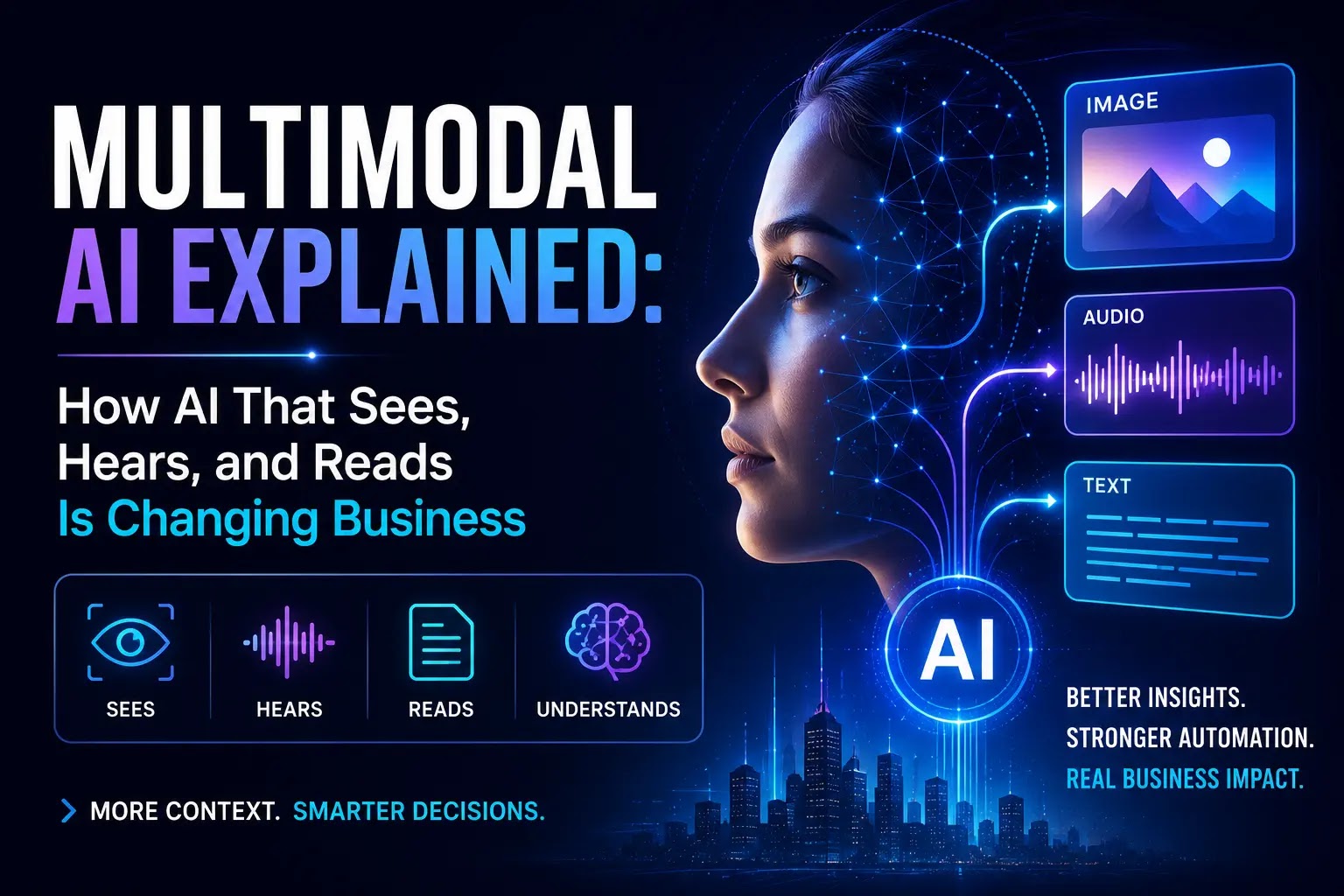
Imagine an AI that doesn’t just answer your text questions — it can look at a photo of a damaged product, listen to a customer’s voice complaint, read a scanned invoice, and solve all three problems simultaneously. That’s not science fiction. That’s Multimodal AI, and it’s the most transformative technology reshaping global businesses in 2026.
For years, AI was largely confined to one mode: text in, text out. Then came image recognition, then voice assistants. But these were siloed tools. Multimodal AI breaks those silos entirely — combining vision, language, audio, and video processing inside a single, unified intelligence. The result is AI that thinks more like a human: using all available signals at once to understand and act.
In this guide, we’ll break down exactly what multimodal AI is, which tools lead the market in 2026, how businesses across every sector are deploying it, and what you need to know to stay ahead of this wave.
What Is Multimodal AI? A Simple Explanation
Multimodal AI refers to artificial intelligence systems that can process and generate information across multiple types of data inputs — known as “modalities” — simultaneously. These modalities include:
- Text — documents, prompts, chat, code
- Images — photos, diagrams, screenshots, scans
- Audio — voice, music, ambient sound
- Video — recordings, live streams, surveillance footage
- Data/Sensors — GPS, IoT feeds, thermal, depth sensors
Traditional AI models were “unimodal” — trained and optimized for just one data type. A text model couldn’t understand images; a vision model couldn’t respond in natural language. Multimodal AI unifies these capabilities into one model that reasons across all inputs simultaneously.
Think of it like the difference between a specialist and a well-rounded professional. A specialist knows one thing deeply. A multimodal AI is the versatile expert who can see the full picture — literally and figuratively.
The Leading Multimodal AI Models in 2026
The multimodal AI landscape in 2026 is led by a handful of powerhouse models that are now deeply embedded in enterprise workflows globally:
1. GPT-4o and GPT-5 (OpenAI)
OpenAI’s GPT-4o — where “o” stands for “omni” — was the first widely available model to natively process text, images, and audio in real time. Its successor GPT-5 expands on this with stronger reasoning and longer context windows. It’s the go-to for versatile business reasoning tasks involving mixed data types.
2. Gemini 2.x (Google DeepMind)
Google’s Gemini was built multimodal from the ground up. Gemini 2.0 Ultra handles text, images, audio, video, and code within a single context window of up to 1 million tokens — making it exceptional for large document analysis paired with visual content. It’s the broadest multimodal tool available in 2026.
3. Claude 3.5 / Claude 4 (Anthropic)
Anthropic’s Claude family excels at document-heavy tasks. It handles scanned PDFs, complex formatting, and image-text combinations with particular accuracy — making it popular for legal, financial, and compliance use cases.
4. LLaMA 3.2 with Vision (Meta)
Meta’s open-source multimodal model allows businesses to deploy multimodal AI on their own infrastructure, enabling privacy-first deployments where data can’t leave the organization. This is particularly valuable for healthcare, government, and financial institutions.
5. Microsoft Copilot (GPT-5 Integration)
For organizations in the Microsoft 365 ecosystem, Copilot with GPT-5 integration handles document analysis, slide generation, and image interpretation inside familiar tools — no separate API setup required.
Why Multimodal AI Matters for Business in 2026
The global multimodal AI market is growing at a staggering 36.92% CAGR, expanding from $2.51 billion in 2024 to a projected $42.38 billion by 2034. This isn’t a niche technology trend — it’s becoming the default architecture for enterprise AI.
Here’s why businesses are making multimodal AI a strategic priority:
- Real-world problems are inherently multimodal — a factory defect is both visible and recordable; a customer complaint has both text and emotional tone
- It reduces workflow complexity — instead of routing data through three separate AI tools, one model handles the full picture
- It unlocks automation that was previously impossible — combining a photo + voice note + policy document in one AI query wasn’t feasible 18 months ago
- It improves accuracy — more context means fewer errors and more nuanced decisions
- It democratizes access — non-technical users can interact with AI using photos and voice instead of structured data or code
How Businesses Are Using Multimodal AI: Real-World Use Cases
🏭 Manufacturing: Visual Quality Control
Cameras on production lines capture images of products, and multimodal AI inspects each item against quality standards — identifying defects, measurement deviations, and labelling errors at speeds no human inspector can match. AI-powered visual quality control reduces defect escape rates while eliminating fatigue and inconsistency inherent in manual inspection.
🏥 Healthcare: Medical Imaging + Patient Records
Multimodal AI integrates medical imaging data (X-rays, CT scans, MRIs) with electronic health records and genomic data to support earlier diagnoses and more personalized treatment strategies. Radiologists use it to flag priority anomalies faster and reduce diagnostic errors.
🛍️ Retail & E-Commerce: Product Intelligence
Retailers upload product images, and multimodal AI automatically generates descriptions, extracts dimensions from packaging photos, categorizes products, and identifies quality issues — work that previously required entire manual review teams. It also enables visual search, where customers upload a photo and find matching products instantly.
⚖️ Legal & Finance: Document Analysis
Multimodal AI processes scanned contracts, PDFs with complex formatting, and mixed document sets to extract key terms, identify non-standard clauses, and compare against templates. Finance teams use it to process invoices in every format — scanned paper, PDFs, email attachments — uniformly and automatically.
🏗️ Construction & Real Estate: Site Inspection
A site inspector takes photos on a smartphone and records voice notes describing issues. The AI agent receives both simultaneously, cross-references visual defects with spoken commentary, checks against compliance standards, and generates a structured inspection report — complete with annotated images and severity ratings.
🎧 Customer Support: Visual Issue Diagnosis
Customers describe problems and share photos — a broken product, an error message screenshot, a physical symptom. Multimodal AI analyzes both the description and the image to diagnose the issue and provide targeted resolution guidance, dramatically improving first-contact resolution rates.
🌾 Agriculture: Smart Crop Management
Multimodal AI combines satellite imagery, on-field sensor data, and weather forecasts to monitor crop health, predict demand, manage water and nutrients efficiently, and help farmers maximize yield with minimal waste.
🧑💼 Meetings & Productivity: Intelligent Summaries
Record a client meeting (audio), capture documents shared on screen (vision), and include the pre-meeting brief (text). The AI processes all three to produce detailed summaries, action items, and follow-up drafts — turning 60-minute meetings into 3-minute digests.
Multimodal AI vs Traditional AI: Key Differences
| Feature | Traditional (Unimodal) AI | Multimodal AI |
|---|---|---|
| Input Types | Single (text, image, OR audio) | Multiple (text + image + audio + video) |
| Context Understanding | Limited to one data type | Full-context reasoning across all inputs |
| Workflow Integration | Requires separate tools for each task | Single model handles complex, mixed tasks |
| User Interaction | Text prompts only | Text, voice, images, video uploads |
| Accuracy on Real-World Tasks | Lower (missing context) | Higher (more signals = better decisions) |
| Accessibility for Non-Tech Users | Requires structured input | Natural: photo, speak, type — all work |
Key Multimodal AI Trends to Watch in 2026
- Smaller, efficient multimodal models — Enterprises are moving toward compact models that deliver multimodal performance on-device, without cloud dependency
- Real-time multimodal processing — Live video + voice + text analysis is becoming possible at low latency, enabling real-time customer support and live quality control
- Agent-driven multimodal workflows — Multimodal AI is increasingly paired with AI agents that can take action (book appointments, file claims, update records) based on what they see and hear
- Accessibility tools — Real-time audio descriptions of visual content for visually impaired users, making digital experiences universally inclusive
- Context engineering over prompt engineering — The competitive advantage now lies in feeding the AI the right combination of visual, audio, and text context, not just crafting clever text prompts
How to Get Started With Multimodal AI in Your Business
You don’t need to be a Fortune 500 company to benefit from multimodal AI. Here’s a practical starting roadmap:
- Identify a multimodal problem — Look for workflows where your team currently handles photos, documents, and voice data separately. That’s your first opportunity.
- Start with GPT-4o or Gemini — Both offer free and paid tiers with strong multimodal capabilities. Test your use case before committing to a full integration.
- Define your input combinations — Map out what data types your process generates (e.g., photo + text description + policy PDF) and test whether the model handles them accurately.
- Automate one workflow — Don’t overhaul everything at once. Pick one process (invoice processing, customer support, quality inspection) and automate it with multimodal AI first.
- Measure ROI before scaling — Track time saved, error rates, and customer satisfaction before expanding deployment.
- Consider privacy architecture — For sensitive industries (healthcare, finance, legal), evaluate on-premise or private cloud multimodal models like LLaMA 3.2 Vision.
Before we answer some frequently asked questions, you may also find these guides helpful:
AI Agents for E-commerce Businesses: How Autonomous AI Is Transforming Online Retail
WhatsApp AI Agents for Customer Support in India: Complete Guide
Frequently Asked Questions (FAQs)
What is a multimodal AI?
Multimodal AI is an artificial intelligence system that can understand and process multiple types of data, such as text, images, audio, video, and documents, at the same time. This allows it to perform more complex tasks and provide more accurate, context-aware responses than single-modal AI models.
Is ChatGPT a multimodal model?
Yes, modern versions of ChatGPT are multimodal AI models. They can understand and generate text, analyze images, interpret documents, and support voice conversations, making them capable of handling multiple types of input and output.
What is the difference between generative AI and multimodal AI?
Generative AI focuses on creating new content such as text, images, code, or music. Multimodal AI focuses on understanding and combining different types of data. A multimodal AI can also be generative, but not all generative AI models are multimodal.
What is an example of a multimodal AI?
Examples of multimodal AI include ChatGPT, Google Gemini, Claude, Microsoft Copilot, and Meta AI. These systems can understand combinations of text, images, voice, and documents to answer questions and complete complex tasks.
Which is the best multimodal AI?
The best multimodal AI depends on your needs. ChatGPT is excellent for writing and coding, Google Gemini integrates well with Google services, Claude is strong for long documents, and Microsoft Copilot works seamlessly with Microsoft 365 applications.
Which OpenAI model is multimodal?
OpenAI’s GPT-4o is a multimodal model that can understand and generate text, images, audio, and other forms of content. It is designed to process multiple input types within a single conversation.
Can multimodal AI understand images and text together?
Yes, multimodal AI can understand images and text together. It analyzes different types of input at the same time, allowing it to identify objects in images, interpret written content, answer questions, generate descriptions, and provide more accurate, context-aware responses.
What are the benefits of multimodal AI?
Multimodal AI offers several benefits, including better accuracy, improved understanding of complex information, faster decision-making, and more natural human-AI interactions. It can process text, images, audio, and video together, making it valuable for healthcare, education, customer support, business automation, content creation, and data analysis.