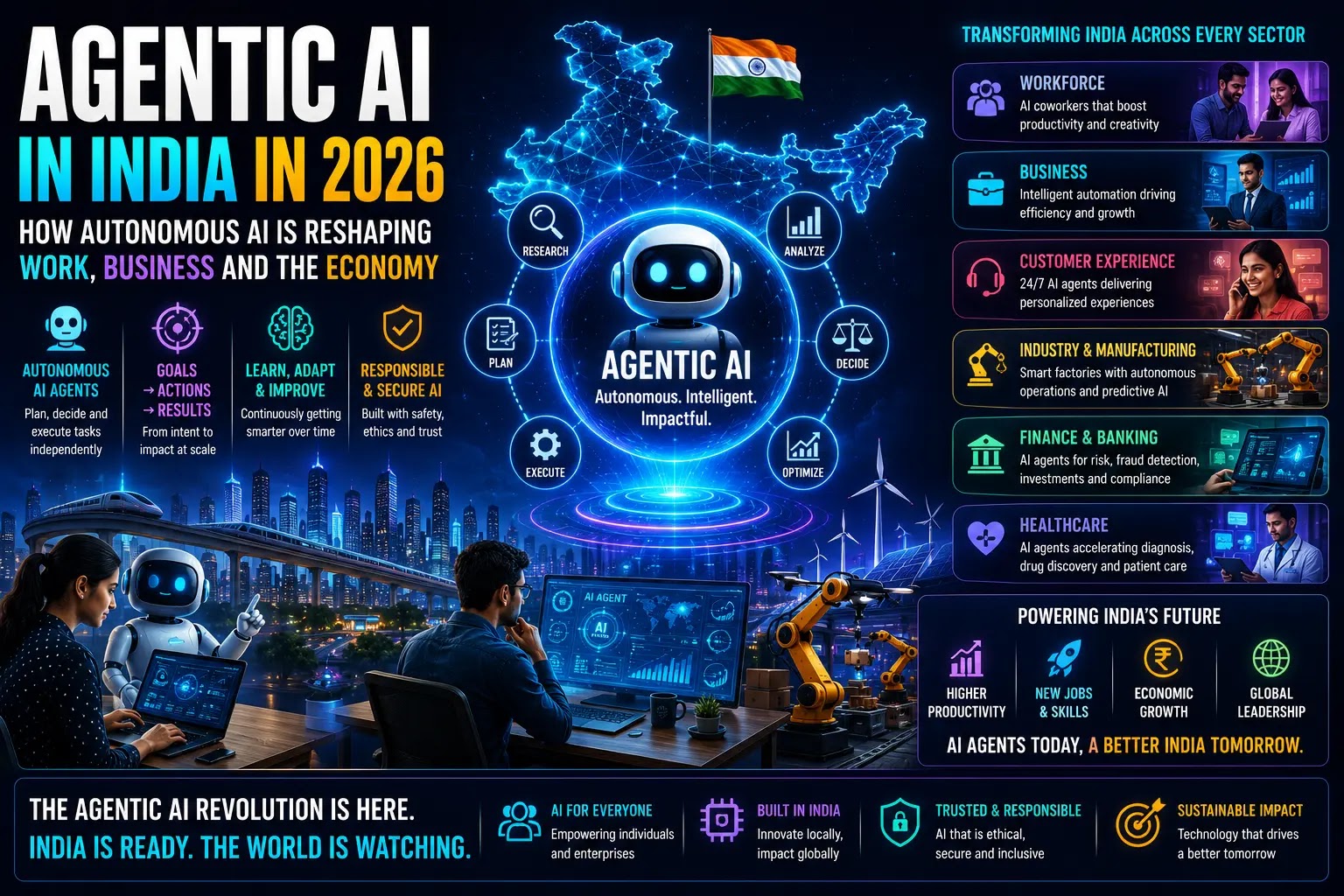
In India, agentic AI is already beginning to reshape how businesses operate, how startups are built, and how daily work gets done. From automating complex workflows to handling customer journeys end to end, autonomous AI agents are becoming a practical business reality rather than a distant experiment. This article explains what agentic AI is, how it works, where it is being used in India, and what it means for businesses and workers in 2026.
What Is Agentic AI?
Agentic AI refers to AI systems that can pursue goals over multiple steps, make decisions along the way, and use various tools or data sources to complete a task. The word agentic comes from the idea of an agent, something that acts on behalf of someone else with a degree of autonomy.
A simple AI tool might help you draft one email if you ask it to. An agentic AI system could be given the goal of following up with every lead in your CRM, reading their history, drafting personalized messages, sending them at the right time, tracking responses, and flagging the ones that need human attention. The difference is not just speed. It is the ability to handle an entire process rather than a single moment in that process.
Agentic AI systems typically combine a large language model for reasoning and communication, a set of tools such as search, code execution, and database access, a memory system to retain context across steps, and a planning layer that breaks a goal into subtasks and manages their execution. Together these components allow an AI agent to behave more like a junior colleague than a simple software tool.
Why Agentic AI Matters for India in 2026
India’s business environment is particularly well suited to benefit from agentic AI. Most Indian startups and mid-sized businesses operate with lean teams and face pressure to do more with limited resources. Agentic AI can extend the capacity of a small team by handling tasks that would otherwise require dedicated staff.
India also has a large and fast-growing digital economy, strong English language proficiency across its professional workforce, and a deep culture of software adoption in business. These factors mean that agentic AI tools built in English can be deployed quickly across Indian companies without major barriers. The startup ecosystem in cities like Bengaluru, Hyderabad, Pune, and Mumbai is already experimenting with agent-based systems in meaningful ways.
At the same time, India’s large services sector, which includes IT services, business process outsourcing, financial services, legal services, and healthcare administration, represents an enormous opportunity for agentic AI to drive efficiency. Many tasks in these sectors are rule-based, repetitive, and document-heavy, making them ideal candidates for automation through AI agents.
How Agentic AI Is Being Used in Indian Businesses
Sales and Lead Management
Sales teams in Indian startups are using agentic AI to qualify leads, research prospects, draft outreach sequences, schedule follow-ups, and update CRM systems automatically. An agent can monitor a lead’s activity, identify the right moment to reach out, and generate a personalized message based on the lead’s industry, company size, and recent news. This allows small sales teams to operate with the output of a much larger team.
Customer Support Automation
Agentic AI is being deployed in customer support to handle not just simple FAQ responses but complex multi-step interactions. An agent can check an order status, process a return request, escalate to a human when needed, and follow up with the customer after the issue is resolved. Indian e-commerce companies, fintech platforms, and SaaS businesses are already running support workflows where AI agents handle a significant portion of tickets end to end without human involvement.
Finance and Compliance
In finance, agentic AI is helping Indian businesses automate invoice processing, reconciliation, expense categorization, and compliance checks. Tasks that once required a finance team member to manually review documents and cross-check data can now be handled by agents that read documents, extract key information, verify it against rules, and flag exceptions for human review. For startups managing rapid growth, this is a meaningful efficiency gain.
Recruitment and HR
HR teams are using agentic AI to screen resumes, schedule interviews, send candidate communications, and track hiring pipelines. An agent can read a job description, evaluate hundreds of applications against defined criteria, rank candidates, draft personalized outreach to shortlisted applicants, and update the hiring manager with a summary. This is already being used by Indian IT companies and staffing firms dealing with high application volumes.
Content and Marketing Operations
Marketing teams are deploying agents that can research a topic, gather data from multiple sources, draft a long-form article, create social media variants, schedule posts, and monitor engagement. For Indian digital agencies and content businesses managing multiple clients, agentic AI is allowing them to scale output without scaling headcount at the same rate.
Agentic AI in Indian Startups
A wave of Indian startups is building products and workflows specifically around agentic AI. Some are building vertical agents for specific industries such as legal document review, medical record processing, or logistics coordination. Others are building platforms that allow businesses to create and deploy their own agents without writing code.
The startup ecosystem is also seeing a new category of AI-native companies where the entire business model is built around agents doing work that humans previously did. These companies are small in headcount but capable of delivering significant output because agents handle execution at scale while humans focus on oversight, strategy, and relationships.
Venture capital interest in agentic AI startups in India has grown substantially in 2025 and 2026. Investors are looking for companies that can demonstrate real task completion rates, measurable business outcomes, and defensible data or workflow advantages that make their agents more effective than generic tools.
Challenges and Risks of Agentic AI
Agentic AI brings real challenges alongside its benefits. The most important is reliability. When an AI agent takes multiple steps autonomously, a mistake early in the process can compound through subsequent steps. A wrong interpretation of a customer request, for example, can lead to a series of incorrect actions that are harder to undo than a single bad response. Human oversight and clear escalation rules are essential.
There are also concerns around security and data access. Agentic systems need access to tools, databases, and communication channels to function. This creates new attack surfaces and requires careful permission management to ensure agents cannot access or modify information beyond their defined scope.
For Indian businesses, practical concerns include the cost of building reliable agent workflows, the skill required to design them well, and the risk of over-automation in areas where human judgment and relationship management still matter most. Agentic AI works best when the task is well defined, the rules are clear, and there is a reliable way to check the output.
What Workers and Professionals Should Know
For professionals in India, agentic AI represents both an opportunity and a shift in what skills matter. Workers who understand how to design agent workflows, define goals clearly, set guardrails, and evaluate agent output will be valuable in organizations adopting these systems. The ability to manage AI agents, rather than simply use them, is becoming a distinct and sought-after skill.
At the same time, roles that consist primarily of executing well-defined, repetitive multi-step tasks are most at risk of being automated by agents. This includes certain data entry roles, basic research roles, routine reporting, and standard customer communication functions. Workers in these areas should focus on building skills in areas where human judgment, creativity, and relationship management remain essential.
The broader message is similar to what has been true of every major technology shift: those who learn to work with the new tools early will be better positioned than those who wait. Agentic AI is still early enough that professionals who engage with it now will develop an advantage that compounds over time.
The Road Ahead for Agentic AI in India
By the end of 2026, agentic AI is expected to move from early adoption in tech-forward companies to broader use across Indian industries. As the tools become more reliable, cheaper to deploy, and easier to configure without deep technical expertise, the barrier to adoption will fall significantly.
The Indian government’s focus on AI infrastructure through initiatives like the India AI Mission will also play a role in creating the compute capacity and regulatory environment needed for broader agent deployment. Businesses that begin experimenting now will be better prepared to scale when the tools mature further.
The most important thing for Indian businesses and professionals to understand is that agentic AI is not a future possibility. It is a present reality that is already creating advantages for early adopters and will increasingly separate high-performing organizations from those that lag in adoption.
Conclusion
Agentic AI represents a meaningful leap beyond simple AI tools. By combining reasoning, planning, tool use, and multi-step execution, AI agents can handle entire workflows rather than just individual tasks. In India, this technology is already being applied in sales, customer support, finance, HR, and marketing with measurable results.
For businesses, the opportunity is to identify high-value workflows where agent automation can create real efficiency gains. For professionals, the opportunity is to develop the skills to design, manage, and improve agent systems. For India as a whole, agentic AI is one more dimension of the country’s growing role in shaping how artificial intelligence is built and used in the world.
Before we answer some frequently asked questions, you may also find these guides helpful:
What Skills Do I Need to Start a Career in AI? Complete Guide for 2026
10 AI Jobs That Indian Companies Are Desperately Hiring For in 2026
Frequently Asked Questions (FAQ)
What is the concept of agentic AI?
Agentic AI is a type of artificial intelligence that can plan, make decisions, and complete tasks with minimal human input. Unlike traditional AI that only responds to prompts, agentic AI can analyze goals, choose actions, and adapt based on results.
Is ChatGPT an agentic AI?
ChatGPT by itself is not fully agentic AI because it mainly responds to user prompts. However, when combined with tools, memory, or automation platforms like n8n, it can function as an AI agent that performs multi-step tasks autonomously.
What is the difference between agentic AI and GenAI?
Generative AI creates content such as text, images, code, and videos from prompts. Agentic AI goes further by planning tasks, making decisions, using tools, and completing workflows with minimal human intervention.
How to build agentic AI for free?
You can build a basic agentic AI system using free tools like n8n, LangChain, CrewAI, AutoGen, Google AI Studio, or free API tiers. Combine an AI model with workflows, memory, and external tools to automate tasks.
What is the best place to learn agentic AI?
You can learn agentic AI through OpenAI documentation, Google AI Studio, LangChain documentation, CrewAI guides, Microsoft Learn, Coursera, Udemy, and by building practical projects with n8n.
What are examples of agentic AI?
Examples include AI customer support agents, research assistants, coding assistants, sales automation agents, travel planners, HR assistants, and workflow automation systems that complete tasks without constant human input.
Can agentic AI make decisions on its own?
Yes. Agentic AI can analyze information, create plans, use available tools, and make decisions within predefined rules. Human oversight is still recommended for sensitive or high-risk tasks.
What tools are used to build agentic AI?
Popular tools include OpenAI API, Google Gemini API, Anthropic Claude, LangChain, CrewAI, AutoGen, n8n, Pinecone, ChromaDB, and vector databases for memory and retrieval.
Is n8n used for agentic AI?
Yes. n8n is widely used to build agentic AI workflows by connecting AI models with APIs, databases, messaging apps, CRMs, and other business tools with little or no coding.
What is the difference between agentic AI and AI agents?
Agentic AI is the technology that enables autonomous reasoning and decision-making. An AI agent is the application built using that technology to perform specific tasks such as customer support, lead generation, scheduling, or workflow automation.