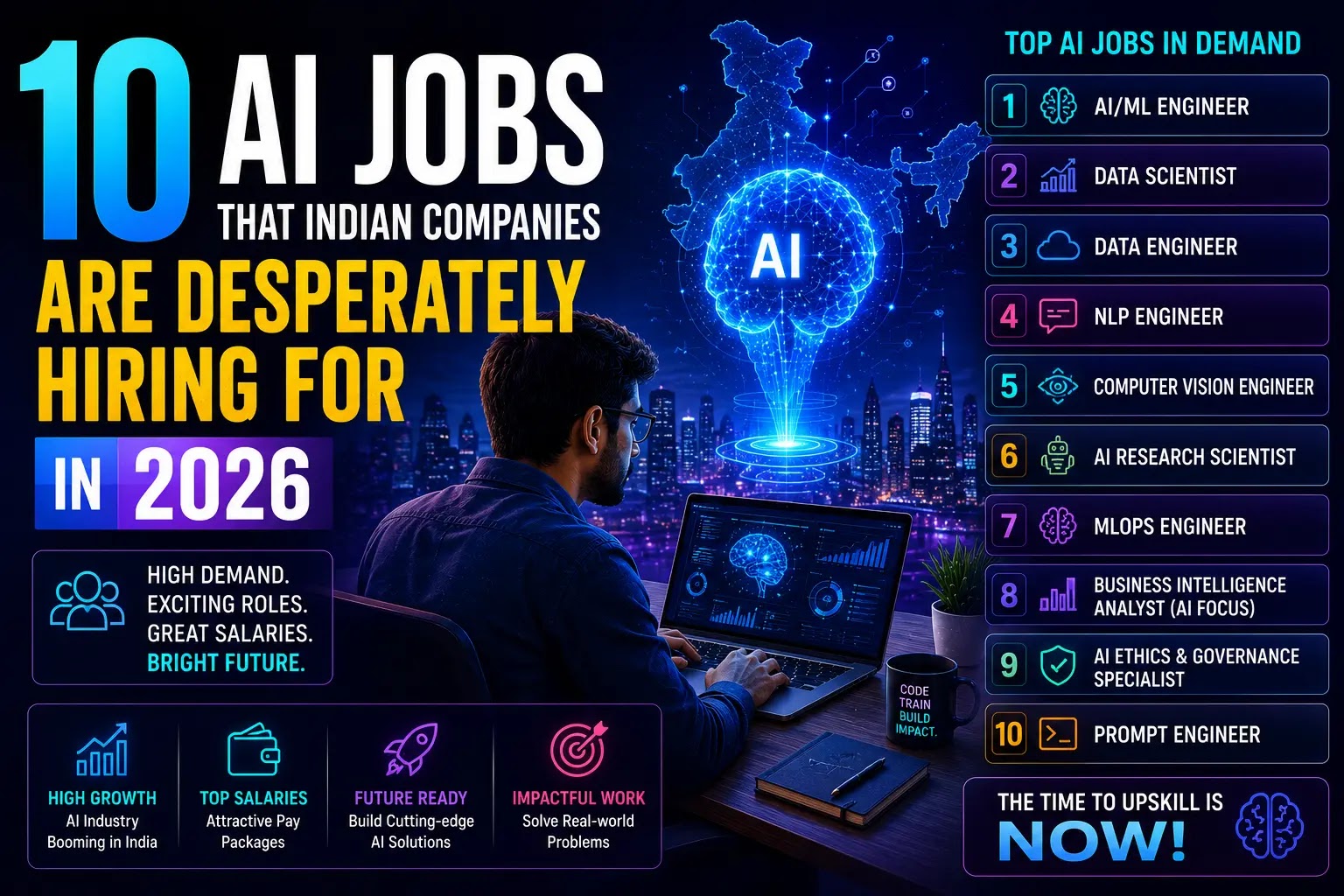
India needs 1 million AI professionals by 2026, but only 100,000 qualified candidates exist right now. That’s 10 AI Jobs in India Which Companies Are Hiring for in 2026, AI and ML job demand has already surged 40–50% in early 2026, with Indian MNCs increasing AI hiring by a staggering 82%. The window is wide open — but only if you’re chasing the right role.
In this guide, we break down the 10 AI jobs that Indian companies are actively and urgently hiring for right now, with real salary ranges, required skills, and tips on how to land these roles — whether you have a CS degree or not.
Whether you’re a fresher, a software engineer looking to switch, or someone from a completely different field — there is a role here for you. The key is knowing which door to knock on first.
Are AI Jobs in India Actually In Demand in 2026?
Absolutely yes. Over 21,000+ AI job openings are currently active on LinkedIn India alone, with 8,000+ listed on Indeed. Senior AI roles paying above ₹20 LPA grew by 55% in 2026. Cities like Bengaluru, Pune, Hyderabad, and Delhi NCR are leading the hiring boom.
Sectors actively recruiting include IT/tech, healthcare, BFSI (banking, financial services and insurance), e-commerce, manufacturing, and education. This is no longer just a big-tech trend — it’s an economy-wide transformation, and the talent gap is the biggest opportunity for job seekers right now.
10 AI Jobs Indian Companies Are Hiring in 2026
1. Machine Learning Engineer
💰 Salary: ₹30–45 LPA (Senior) | ₹6–12 LPA (Entry-level)
ML Engineers build classification systems, recommendation engines, and forecasting models. This is consistently one of the top in-demand roles in India. You’ll work with Python (NumPy, Pandas, Scikit-learn), TensorFlow/PyTorch, and SQL on a daily basis.
How to get hired: Build 5 solid ML projects on GitHub, earn a TensorFlow or AWS ML certification, and contribute to open-source projects.
2. Generative AI Developer
💰 Salary: ₹28–45 LPA
GenAI Developers build applications using large language models (LLMs) — from AI content tools to code generators and image synthesis apps. With 40% of large Indian enterprises operationalising GenAI pilots in 2026, this is one of the fastest-growing job categories.
Skills needed: Prompt engineering, Python, LangChain, OpenAI/Gemini API integration, RAG (Retrieval-Augmented Generation).
💡 You do NOT need a PhD. Many self-taught developers are getting hired in this role.
3. Data Scientist
💰 Salary: ₹20–35 LPA
Data Scientists turn raw data into business decisions using statistics, ML, and data visualisation. With over 12,000+ active openings across India, this is one of the most accessible entry points into the AI field — especially if you have a background in maths, economics, or engineering.
Skills needed: Python/R, SQL, Statistics, Tableau/Power BI, machine learning basics.
4. MLOps Engineer
💰 Salary: ₹32–48 LPA
MLOps Engineers deploy and monitor machine learning models in production environments. Only 5% of ML engineers understand MLOps, making this one of the highest-paying niches in the AI job market right now.
Skills needed: Docker, Kubernetes, CI/CD pipelines, AWS/GCP/Azure, MLflow.
💡 If you’re switching from software engineering or DevOps to AI, MLOps is your fastest path in.
5. NLP Engineer
💰 Salary: ₹28–42 LPA
NLP (Natural Language Processing) Engineers build chatbots, voice assistants, translation tools, and sentiment analysis systems. With India’s multilingual population and the rise of regional-language AI products, demand for NLP talent is skyrocketing.
Skills needed: Transformers (BERT, GPT), Hugging Face, spaCy, Python, linguistics basics.
6. AI Product Manager
💰 Salary: ₹28–45 LPA
AI PMs bridge the gap between business needs and AI engineering teams. Crucially, no deep coding is required — but you must understand ML fundamentals and product strategy. This makes it one of the best AI jobs for professionals switching from non-technical backgrounds like marketing, operations, or business consulting.
Skills needed: Product thinking, AI/ML fundamentals, stakeholder communication, roadmap planning.
7. Computer Vision Engineer
💰 Salary: ₹26–40 LPA
Computer Vision Engineers work on facial recognition systems, medical imaging analysis, autonomous vehicles, and industrial quality control automation. Manufacturing and healthcare companies in India are aggressively hiring for this role in 2026.
Skills needed: OpenCV, CNNs, PyTorch, image preprocessing, YOLO models.
8. Prompt Engineer
💰 Salary: ₹25–40 LPA
Prompt Engineers craft precise instructions for AI models, design conversational flows, and create guardrails for safe AI outputs. This is one of the newest AI roles — and one of the most accessible, even without deep programming knowledge.
Skills needed: Deep understanding of LLMs, prompt design patterns, Python basics, API integration.
💡 Can you get an AI job with just online certifications? For Prompt Engineering — yes. Several Indian professionals have landed ₹25 LPA+ roles with certifications alone.
9. AI Research Scientist
💰 Salary: ₹40–60 LPA
Research Scientists develop novel algorithms, improve model efficiency, and publish cutting-edge AI papers. Companies like Google DeepMind India, Microsoft Research, and IIT-affiliated startups hire heavily in this role.
Skills needed: Advanced mathematics (linear algebra, calculus, probability), deep learning, research writing, Python/C++.
⚠️ This role often requires a Master’s degree or PhD, though exceptional self-taught candidates with strong publication records are considered.
10. AI Testing Engineer
💰 Salary: ₹18–30 LPA
AI Testing Engineers ensure AI systems work reliably — testing for bias, accuracy, edge cases, and failure modes. This is one of the easiest AI roles to get into, particularly for those with a background in software QA or test automation.
Skills needed: Selenium/QA fundamentals, Python scripting, understanding of ML model evaluation, test automation frameworks.
💡 No GPU knowledge required. Great entry point for traditional software testers moving into AI.
What Skills Do You Actually Need for an AI Job in India?
Across all roles, here are the core skills Indian companies look for in AI candidates:
- Python — Non-negotiable for almost every AI role
- Mathematics — Linear algebra, statistics, and probability (especially for ML/research)
- Machine Learning fundamentals — Supervised/unsupervised learning, model evaluation
- Cloud platforms — AWS, GCP, or Azure experience increasingly required
- GitHub portfolio — Real projects often matter more than your degree
- Communication skills — Critical for AI PM, consulting, and product-facing roles
The good news? You don’t need a Computer Science degree for most of these roles. Bootcamp graduates, self-taught engineers, and professionals transitioning from other fields are regularly getting hired — especially in GenAI, Prompt Engineering, AI Testing, and AI PM roles.
Which Companies Are Actually Hiring AI Talent in India?
Here are the top employers actively recruiting AI professionals in India in 2026:
- Global Tech Giants: Google, Microsoft, Amazon (AWS), Meta, IBM
- Indian IT Leaders: TCS, Infosys, Wipro, HCL, Tech Mahindra
- Product Startups: Zoho, Freshworks, Razorpay, Meesho, Ola
- AI-First Companies: Fractal Analytics, Arya.ai, Persistent Systems, Tata Elxsi, Bosch India
- BFSI Sector: HDFC Bank, ICICI, Paytm — investing heavily in AI fraud detection and automation
Many of these roles are also remote-friendly, particularly for Data Scientists, Prompt Engineers, and AI Product Managers — making them ideal for professionals outside Bengaluru and Pune.
How Long Does It Take to Get an AI Job in India?
For most people switching into AI, here’s a realistic 6-month roadmap:
- Months 1–2: Master Python + statistics fundamentals
- Months 3–4: Learn core ML concepts (Scikit-learn, Pandas, model evaluation)
- Month 5: Specialise in one area — Computer Vision, NLP, GenAI, or MLOps
- Month 6: Build portfolio projects on GitHub and start applying
With consistent daily learning (2–3 hours/day), most beginners can land their first AI role within 6–12 months. Those switching from software engineering or data analytics often get hired even faster due to overlapping skills.
Before we answer some frequently asked questions, you may also find these guides helpful:
What Skills Do I Need to Start a Career in AI? Complete Guide for 2026
Agentic AI in India in 2026: How Autonomous AI Is Reshaping Work, Business and the Economy
Frequently Asked Questions (FAQ)
Are AI jobs in demand in India?
Yes, AI jobs are in high demand in India as businesses across IT, healthcare, finance, e-commerce, manufacturing, and education adopt artificial intelligence. The demand for AI engineers, machine learning engineers, data scientists, and AI automation specialists continues to grow.
How to get a job in AI in India?
To get an AI job in India, learn Python, machine learning, SQL, and AI fundamentals. Build practical projects, earn recognized AI certifications, create a GitHub portfolio, and apply for internships or entry-level AI positions to gain experience.
What is the salary of AI freshers in India?
AI fresher salaries vary by company, location, and skills. Fresh graduates with strong AI, machine learning, and programming skills generally receive competitive starting salaries, with higher packages offered by top technology companies.
Can I get a job in AI as a fresher?
Yes, freshers can get AI jobs by learning in-demand skills, completing AI projects, earning certifications, participating in internships, and demonstrating practical knowledge through a strong portfolio.
Is AI a high-paying job?
Yes, AI is one of the highest-paying career fields. AI engineers, machine learning engineers, and AI researchers are among the most sought-after professionals due to the rapid growth of artificial intelligence across industries.
How do I start a career in AI?
Start by learning programming, mathematics, machine learning, and AI fundamentals. Build hands-on projects, complete AI certifications, contribute to GitHub, and apply your skills through internships or freelance work.
Is AI a stressful career?
AI can be challenging because technology evolves quickly and requires continuous learning. However, many professionals find it rewarding due to exciting projects, career growth, and excellent salary opportunities.
What qualifications do I need for AI?
Many AI professionals have degrees in computer science, engineering, mathematics, or data science. However, employers also value AI certifications, technical skills, practical projects, and real-world experience.
Can I join AI without maths?
Yes, you can begin learning AI without advanced mathematics. Basic concepts are enough to get started with generative AI, prompt engineering, and AI automation. As you progress into machine learning, learning statistics and linear algebra becomes beneficial.
Which AI jobs are most in demand in India?
The most in-demand AI jobs include AI Engineer, Machine Learning Engineer, Data Scientist, AI Automation Engineer, Prompt Engineer, AI Consultant, NLP Engineer, Computer Vision Engineer, and MLOps Engineer.
Which companies hire AI professionals in India?
Leading recruiters include TCS, Infosys, Wipro, Accenture, IBM, Microsoft, Google, Amazon, Deloitte, Capgemini, HCLTech, Tech Mahindra, Cognizant, Oracle, and many AI startups.
Which AI course is best for getting a job in India?
Popular choices include Google AI Essentials, Microsoft AI Engineer Associate, IBM AI Engineering Professional Certificate, DeepLearning.AI courses, Coursera AI Specializations, and AWS Machine Learning certifications.
Can non-IT students get AI jobs?
Yes, non-IT students can enter AI by learning Python, machine learning, data analysis, prompt engineering, and AI automation. A strong portfolio and practical projects often matter more than your academic background.
Is coding mandatory for AI jobs?
Not all AI jobs require coding. Roles such as prompt engineer, AI trainer, AI consultant, and no-code AI automation specialist require little or no programming. However, AI engineering and machine learning roles generally require coding skills.
Which programming language is best for AI?
Python is the most popular programming language for AI because it is easy to learn and supports powerful libraries such as TensorFlow, PyTorch, Scikit-learn, and Hugging Face.
What is the future of AI jobs in India?
The future of AI jobs in India is highly promising. As AI adoption increases across industries, demand is expected to continue growing for professionals skilled in generative AI, AI agents, automation, machine learning, and cloud AI technologies.