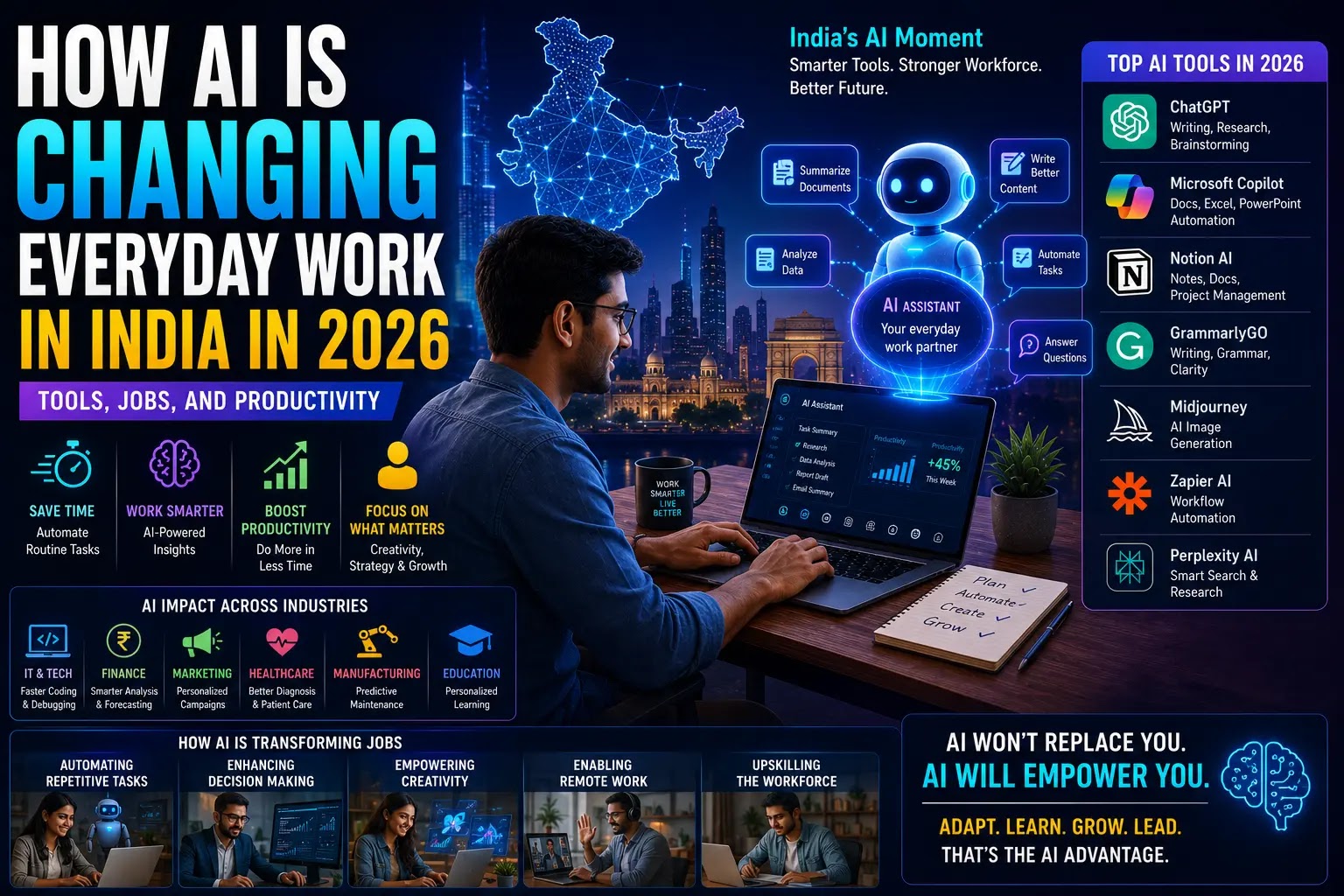
Artificial intelligence is no longer a distant idea or a topic reserved for engineers. In India, it is already changing how people write emails, manage customers, analyze data, create content, and make business decisions. What makes this shift important is not just that AI exists, but that it is becoming part of everyday work in offices, startups, agencies, and small businesses across the country.
For many professionals, AI started as a simple tool for writing or searching. Today, it is becoming a work assistant, a research partner, and in some cases a first draft creator for entire projects. This article looks at how AI is changing everyday work in India, what jobs are being affected, what tools are most useful, and what workers should do to stay relevant in 2026 and beyond.
AI at Work: The Most Visible Change
The most visible change is productivity. AI tools can now summarize long reports, draft responses, generate content ideas, and help teams move faster with fewer repetitive tasks. This matters in India because many businesses operate with lean teams and need practical ways to save time without increasing costs.
In customer support, AI can suggest replies, classify tickets, and answer routine questions before a human agent steps in. In marketing, it can generate social media captions, blog outlines, ad variations, and keyword ideas. In operations, AI helps forecast demand, organize workflows, and detect patterns that may be hard to spot manually.
The real value of AI is not that it replaces all work. It is that it removes low-value work so people can spend more time on strategy, relationships, and decision-making. That is why AI adoption is being discussed not only in tech teams but across finance, HR, sales, logistics, and content departments.
How AI Is Changing Jobs in India
One major question people ask is whether AI will take jobs. The more useful answer is that AI is already changing jobs rather than simply removing them. Roles that rely heavily on repetitive writing, sorting, reporting, or basic analysis are being reshaped first. At the same time, new opportunities are opening for people who can use AI tools well and connect them to business results.
For example, a content writer who uses AI can produce more drafts in less time, but the human edge still matters in editing, fact-checking, tone, and original insight. A sales professional using AI can prepare faster outreach messages, but still needs human judgment for trust and persuasion. A data analyst can use AI for faster summaries, but still needs to interpret the numbers in business context.
This is why AI skills are becoming valuable in India across many professions, not just in software jobs. The ability to prompt, verify, refine, and apply AI output is quickly becoming a practical workplace skill. Workers who learn to use AI well will likely move faster than those who avoid it completely.
Popular AI Use Cases in Indian Workplaces
1. Writing Assistance
People use AI to draft emails, blog posts, reports, proposals, and client messages. This saves time, especially when someone needs to produce polished text quickly. From customer communication to internal documentation, writing assistance is one of the most widely adopted AI applications in Indian offices today.
2. Research and Summarization
Instead of reading ten pages of material, professionals can ask AI to summarize the key points, compare options, or suggest next steps. This is especially useful for founders, students, consultants, and marketers who need fast context before making a decision.
3. Design and Content Generation
AI is now used to create images, rough layouts, creative concepts, and social media assets that would otherwise take longer to prepare. For small Indian businesses, this lowers the barrier to creating decent marketing material without hiring a large creative team.
4. Workflow Automation
AI can be connected to workflows that send reminders, sort leads, flag customer issues, or generate recurring reports. This is especially important for startups and service businesses that want to scale without adding too much overhead.
Why India Is Leading This Shift
India is important in this story because it has a huge workforce, a large digital economy, and a strong services sector that depends on efficiency. When AI becomes cheaper and easier to use, Indian companies can adopt it quickly in business processes where time and cost matter. That means the impact of AI in India may feel larger and faster than in some other markets.
India’s tech ecosystem is full of early adopters, freelancers, and small teams who can experiment quickly. A founder can test an AI workflow in a day. A marketer can build an AI content system in a week. A freelancer can use AI to serve more clients without scaling headcount immediately. That makes India a natural place for AI-driven productivity growth.
Skills to Learn in the AI Era
If you want to stay relevant in the AI era, the goal is not to become a machine expert overnight. The goal is to learn how to work with AI in practical ways. That includes writing better prompts, checking AI output for accuracy, editing for tone, and knowing when human judgment should override the tool.
A useful skill stack for 2026 includes prompt writing, basic data understanding, content editing, workflow automation, and AI tool selection. These are not niche technical skills anymore. They are becoming general workplace skills, similar to how spreadsheet knowledge once became essential.
For business owners, the priority should be to identify one repetitive process and see whether AI can reduce time spent on it. For employees, the priority should be to become the person who can use AI responsibly and improve output quality instead of just producing more content. For freelancers, the priority should be to use AI to deliver faster, clearer, and more scalable service.
Risks and Limits of AI at Work
AI is powerful, but it is not perfect. It can make mistakes, miss context, and produce polished output that sounds right but is still inaccurate. That is why human review remains essential, especially in professional writing, customer communication, and research.
There is also the risk of overusing AI and ending up with generic work. If everyone uses the same tool in the same way, the output starts to look similar. The best results come when AI is used as a helper, not as a replacement for thinking. AI should raise your speed and quality, not weaken your originality.
Another concern is job transition. Some workers will need time and support to adapt to AI-based workflows. That makes training and skill development important for both companies and individuals. The people who adapt first will likely benefit first.
What Businesses Should Do Now
Businesses should begin with practical use cases rather than big promises. The first step is to identify repetitive tasks that consume time but do not require full human creativity every time. Examples include first-draft writing, meeting summaries, customer FAQ responses, and basic reporting.
The second step is to set rules for quality control. AI output should be checked before it reaches customers or clients. The third step is to train employees to use AI in ways that improve productivity without creating confusion. Once this foundation exists, AI becomes a business advantage rather than just a trend.
For small businesses in India, this can be especially valuable. A small team that uses AI well can behave like a larger team in many content and support tasks. That is one reason AI is becoming part of everyday work rather than a separate technology category.
Conclusion
AI is changing everyday work in India by making writing faster, research easier, workflows smoother, and business operations more efficient. It is affecting jobs, but more importantly, it is changing how people do those jobs. The key is not to fear the tools, but to learn how to use them carefully and intelligently.
As AI tools become more affordable and accessible, the gap between those who use them well and those who do not will grow. The best time to start is now, whether you are a business owner, an employee, a freelancer, or a student. Start small, stay consistent, and treat AI as a powerful assistant rather than a magic solution.
Before we answer some frequently asked questions, you may also find these guides helpful:
Google AI Mode in India: How AI-Powered Search Is Changing the Way Indians Search in 2026
Agentic AI in India in 2026: How Autonomous AI Is Reshaping Work, Business and the Economy
Frequently Asked Questions (FAQ)
What is AI at work?
AI at work refers to the use of artificial intelligence to automate tasks, improve productivity, analyze data, and help employees make better decisions. It can assist with writing, coding, customer support, scheduling, and many other business activities.
How is AI used in the workplace?
Businesses use AI for customer service, data analysis, content creation, recruitment, cybersecurity, workflow automation, sales forecasting, and personalized marketing. AI helps employees complete tasks faster and more accurately.
Will AI replace human jobs?
AI will automate some repetitive tasks, but it is more likely to change jobs than replace them completely. Many roles will require people to work alongside AI, focusing on creativity, problem-solving, and decision-making.
What jobs are most affected by AI?
Jobs involving repetitive data entry, customer support, document processing, scheduling, and basic content creation are among the most affected. However, AI is also creating new roles in AI development, automation, and data analysis.
What are the benefits of AI at work?
AI improves productivity, reduces manual work, minimizes errors, provides faster insights, enhances customer experiences, and allows employees to focus on higher-value tasks.
What are the risks of using AI at work?
Some risks include data privacy concerns, biased AI decisions, inaccurate outputs, security issues, and overreliance on automation. Businesses should combine AI with human oversight.
Can AI improve employee productivity?
Yes. AI can automate repetitive tasks, summarize meetings, generate reports, answer common questions, and assist with research, allowing employees to spend more time on strategic work.
What industries use AI the most?
AI is widely used in healthcare, finance, retail, manufacturing, education, marketing, logistics, customer service, and information technology.
Do employees need AI skills?
Basic AI skills are becoming valuable in many industries. Learning how to use AI tools for writing, research, automation, and data analysis can improve career opportunities.
Is AI safe to use at work?
Yes, when used responsibly. Organizations should follow data security policies, protect sensitive information, and verify AI-generated content before using it for important business decisions.
How can businesses prepare for AI adoption?
Businesses should identify repetitive tasks, train employees, choose reliable AI tools, establish security policies, and gradually integrate AI into daily workflows.
Will AI create new jobs?
Yes. AI is creating demand for AI engineers, prompt engineers, AI trainers, automation specialists, machine learning engineers, data scientists, and AI governance professionals.
Can AI help small businesses?
Yes. Small businesses can use AI for customer support, email marketing, bookkeeping, appointment scheduling, lead generation, social media management, and workflow automation while reducing operating costs.
What AI tools are commonly used at work?
Popular workplace AI tools include ChatGPT, Google Gemini, Microsoft Copilot, Claude, Notion AI, Grammarly, GitHub Copilot, Canva AI, and automation platforms like n8n and Zapier.
How can employees start using AI at work?
Start by using AI for writing emails, summarizing meetings, analyzing spreadsheets, generating reports, researching information, automating repetitive tasks, and managing schedules.
Can AI replace office workers?
AI can automate routine office tasks, but human employees remain essential for leadership, creativity, communication, and complex decision-making.
Which jobs are safest from AI?
Jobs requiring empathy, leadership, creativity, critical thinking, healthcare expertise, skilled trades, and strategic management are less likely to be fully replaced by AI.
Is AI making work easier?
Yes. AI helps employees save time, reduce repetitive work, improve accuracy, and make faster decisions, making daily work more efficient.
How will AI change the future of work?
AI will transform workplaces by automating routine tasks, improving collaboration, creating new career opportunities, and increasing demand for AI-related skills across industries.
Should every employee learn AI?
Learning basic AI skills is highly recommended because AI tools are becoming part of everyday work in many professions. Employees who understand AI are likely to have better career opportunities.