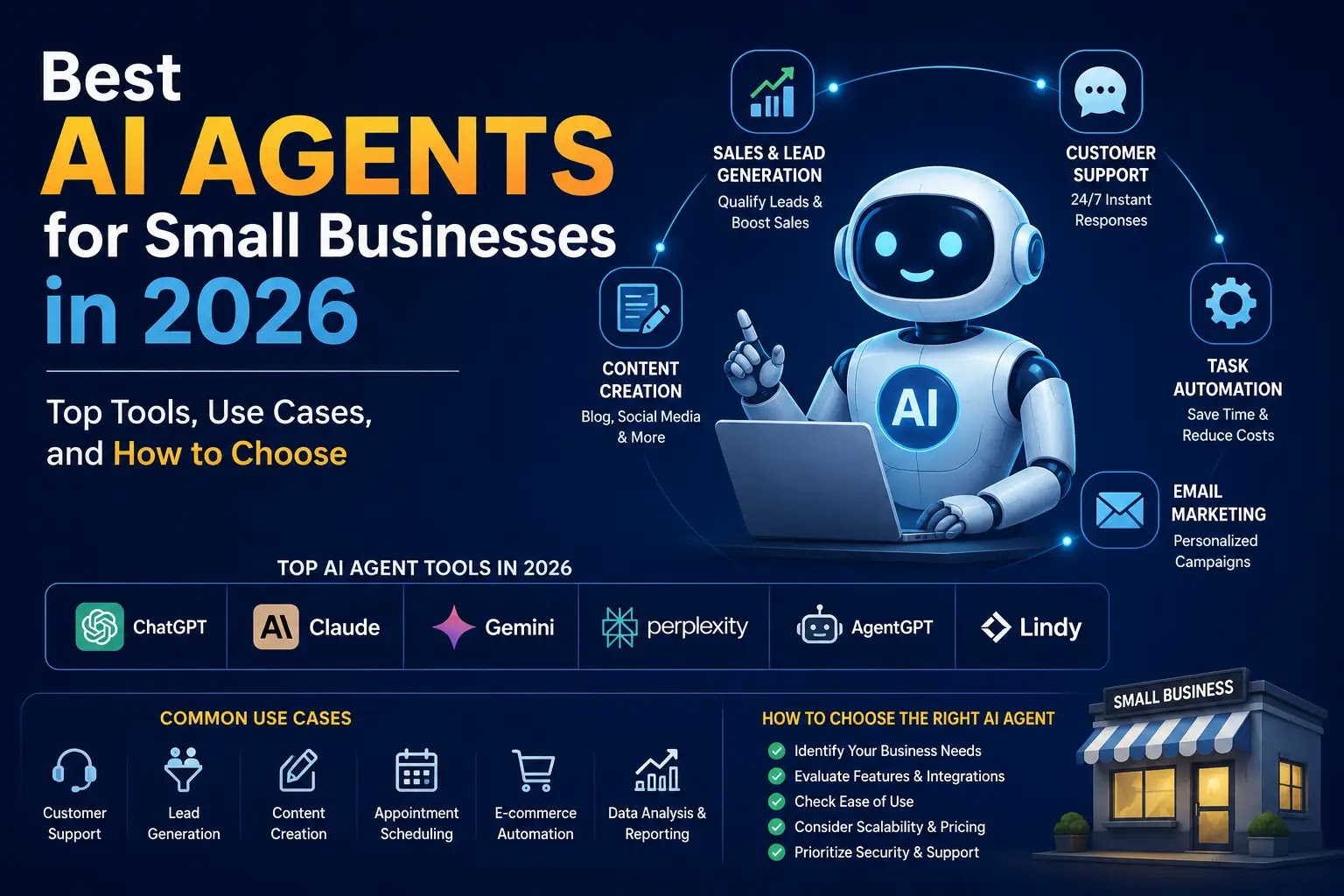
Running a small business in 2026 means wearing too many hats at once — handling customer queries, chasing leads, managing invoices, posting on social media, and somehow still finding time to actually serve your customers. The good news? AI agents are no longer a luxury reserved for enterprise companies. Today, small businesses across India and the world are deploying AI agents to automate repetitive work, respond to customers 24/7, and grow revenue without hiring additional staff.
Unlike simple chatbots or single-task tools, modern AI agents are autonomous systems that can understand context, make decisions, take multi-step actions, and even collaborate with other agents — all without constant human supervision. According to recent industry data, nearly 40% of small businesses are expected to have at least one AI agent in active use by the end of 2026. If you haven’t explored this technology yet, this guide will walk you through Best AI Agents for Small Businesses, what they can do for your business, and how to pick the right one.
What Is an AI Agent and Why Does It Matter for Small Businesses?
An AI agent is a software system powered by a large language model (LLM) or machine learning model that can perceive inputs, reason through tasks, and take actions — such as sending emails, filling forms, searching the web, updating CRMs, or booking appointments — with minimal human intervention. Unlike traditional automation tools, AI agents adapt to changing situations, handle ambiguous instructions, and can chain multiple steps together to complete complex workflows.
For small businesses, this is a game-changer. A lean team of 5 people can now operate with the output of a team of 15 when the right agents are handling support tickets, qualifying leads, scheduling calls, creating reports, and following up with prospects automatically. The cost savings and productivity gains are no longer theoretical — they are measurable and immediate in 2026.
How to Evaluate an AI Agent Before You Buy
Before jumping into specific tools, here are the key criteria you should use when evaluating any AI agent for your small business:
- Ease of setup: Does it require coding, or can a non-technical founder configure it in hours?
- Integration depth: Does it connect natively with your existing tools — Gmail, WhatsApp, Shopify, Notion, Zoho CRM, Razorpay?
- Autonomy level: Can it act on its own, or does every step need human approval?
- Pricing model: Is it per task, per month, or consumption-based? Can a small team afford it?
- Data privacy: Where is your data stored? Is it GDPR or DPDP (India’s Digital Personal Data Protection Act) compliant?
- Customer support: Does the vendor offer onboarding help, especially for first-time AI users?
The 10 Best AI Agents for Small Businesses in 2026
1. ChatGPT Operator (OpenAI)
OpenAI‘s Operator is one of the most capable general-purpose AI agents available in 2026. It can browse the web, fill forms, book appointments, send emails, and interact with websites on your behalf. For small business owners, Operator acts like a smart virtual assistant that can research vendors, draft proposals, and handle repetitive admin tasks. It integrates with GPT-4o and supports custom instructions tailored to your business context. Pricing starts at $20/month with the ChatGPT Plus plan.
2. Zapier AI Agent
Zapier has evolved from a simple automation platform into a full-fledged AI agent builder. With Zapier AI, you can create agents that trigger actions across 7,000+ apps — including Gmail, Slack, Google Sheets, HubSpot, and Shopify — based on natural language rules. You can instruct the agent in plain English: “When a new lead fills in my Typeform, add them to my CRM, send a welcome email, and notify me on Slack.” No coding required. Ideal for small businesses already using the Zapier ecosystem. Plans start at $19.99/month.
3. HubSpot AI Agent (Breeze)
HubSpot’s Breeze AI agent suite covers sales, marketing, and customer support in one unified platform. The Breeze Prospecting Agent automatically identifies potential customers, enriches contact data, and drafts personalised outreach emails. The Customer Agent handles inbound support tickets using your knowledge base. For small businesses that need an all-in-one CRM with AI superpowers, Breeze is hard to beat. The free CRM tier includes basic AI features; advanced Breeze agents are part of paid plans starting at ₹4,500/month.
4. Tidio Lyro (Customer Support Agent)
Tidio’s Lyro is purpose-built for small business customer support. It connects to your website, reads your FAQs and product pages, and then answers customer queries in real time — 24/7, without human involvement. Lyro can handle up to 70% of routine support tickets automatically, freeing your team to focus on complex issues. It supports live chat, email, and Instagram DMs. With a simple plug-and-play setup and pricing starting at $29/month, Tidio Lyro is one of the most accessible AI support agents for SMBs.
5. Lindy AI
Lindy is a versatile no-code AI agent platform that lets you build custom agents for any workflow — sales follow-ups, meeting summaries, lead qualification, inbox management, and more. You create a “Lindy” (an individual agent) by describing its job in plain language and connecting it to your tools. Lindy supports Gmail, Zoom, Salesforce, Notion, Calendly, and many others. It is particularly popular among service-based small businesses and freelancers. Pricing starts at $49/month for the Pro plan, with a generous free tier for getting started.
6. Intercom Fin AI Agent
Intercom’s Fin is an enterprise-grade AI support agent that is increasingly being adopted by growing small businesses and startups. Fin reads your help centre articles, processes customer questions, and delivers accurate, conversational answers instantly. What sets Fin apart is its resolution rate — the company claims over 50% of queries are resolved without human intervention. It supports multiple languages including Hindi and Tamil, making it highly relevant for Indian businesses. Pricing is usage-based at $0.99 per resolved conversation.
7. AgentGPT / AutoGPT (Open-Source Options)
For technically inclined small business owners or those with a developer on the team, open-source agents like AutoGPT and AgentGPT provide maximum flexibility. You can deploy these on your own server and customise them to perform almost any task — web research, data analysis, content generation, and workflow automation. While they require more setup time than commercial tools, they offer cost advantages and complete data control. AutoGPT is available for free on GitHub and supports integration with APIs and custom tools.
8. Salesforce Agentforce
Salesforce Agentforce is a powerful AI agent platform designed for businesses that manage sales pipelines, customer relationships, and service teams. In 2026, Agentforce includes pre-built agents for sales development (SDR), customer service, and field operations. For small businesses already on Salesforce or those scaling fast, Agentforce offers plug-and-play agents that work within your existing data ecosystem. It connects to Slack, Email, and WhatsApp and supports human-in-the-loop escalation. Pricing is enterprise-tier but accessible through Salesforce’s SMB Starter plans.
9. Relevance AI
Relevance AI is specifically designed for building custom AI agents and automated workflows without writing code. It allows small businesses to create multi-step agents that research prospects, write outreach copy, analyse CSV data, and generate reports. What makes Relevance AI stand out is its “Tool Builder,” which lets you add custom API integrations easily. Indian startups and agencies are increasingly using Relevance AI for marketing automation and client reporting. Pricing starts at $19/month for the Team plan.
10. Voiceflow
Voiceflow is the go-to platform for building conversational AI agents — chatbots and voice assistants — that interact with customers across WhatsApp, websites, phone, and more. For small businesses in retail, healthcare, education, and hospitality, Voiceflow makes it easy to design rich customer conversation flows without any coding. You can build a WhatsApp AI agent that collects bookings, answers FAQs, and sends order updates — all in one workflow. Free plan available; paid plans start at $50/month.
Best AI Agents by Business Type
Choosing the right AI agent often depends on your business category. Here is a quick mapping to help you decide:
- E-commerce / Retail: Tidio Lyro or Voiceflow for customer support + Zapier AI for order automation
- Service businesses / Agencies: Lindy AI for workflow management + HubSpot Breeze for CRM automation
- SaaS / Tech startups: Intercom Fin for customer support + Relevance AI for sales workflows
- Freelancers / Solopreneurs: ChatGPT Operator for admin + Zapier AI for client communication
- Local businesses (restaurants, clinics, etc.): Voiceflow for WhatsApp + Tidio Lyro for website chat
Common Mistakes Small Businesses Make with AI Agents
Adopting AI agents without a strategy leads to wasted money and frustration. Avoid these common pitfalls:
- Automating broken processes: If your sales process is unclear, an AI agent will make it messier, not better. Fix your workflow first.
- Skipping the training phase: Most agents need to be fed your business knowledge — FAQs, product docs, SOPs — before they can work accurately.
- Over-automating customer interactions: Balance is key. Give customers a clear path to reach a human when needed.
- Ignoring data privacy: Always check if the AI agent stores your customer data and where. This is especially important under India’s DPDP Act 2023.
- Choosing on price alone: A cheap agent that mishandles customer queries can cost more in lost business than a premium one.
The Future of AI Agents for Small Businesses
The trajectory of AI agents in 2026 is pointing in one clear direction: greater autonomy, deeper personalisation, and tighter integration with every layer of business operations. Multi-agent systems — where several AI agents collaborate on a single task — are already moving from experimental to practical. Within the next 12–18 months, most small businesses will likely have multiple agents handling different functions that communicate with each other to complete end-to-end workflows.
For Indian small businesses in particular, the opportunity is enormous. With a massive mobile-first customer base, WhatsApp as the dominant communication channel, and fast-growing digital payments infrastructure, AI agents designed for conversational commerce and automated customer support can create instant competitive advantages for businesses of all sizes. The cost barrier has dropped significantly in 2026, and no-code platforms mean even a solo founder can build and deploy a functioning AI agent in a single afternoon.
Conclusion
AI agents are no longer a futuristic concept — they are practical, affordable, and immediately useful for small businesses in 2026. Whether you need 24/7 customer support, automated lead follow-ups, smarter CRM management, or seamless back-office workflows, there is an AI agent on this list that fits your needs and your budget. The businesses that adopt these tools thoughtfully — starting with one clear use case, measuring results, and expanding gradually — will be the ones that outpace their competitors without burning out their teams. Start small, automate smart, and let AI agents handle the repetitive work so you can focus on growing your business.
Before we answer some frequently asked questions, you may also find these guides helpful:
AI Agent Trends in India: How Autonomous AI Is Changing Business Workflows in 2026
Can an AI Agent Handle Customer Service Without Human Backup? The Reality for Indian Businesses
Frequently Asked Questions (FAQ)
Which AI agent is best for small business?
The best AI agent depends on your business needs. ChatGPT is ideal for content creation and customer support, Google Gemini works well with Google Workspace, Microsoft Copilot boosts productivity, Salesforce Agentforce helps sales teams, and custom AI agents built with n8n are excellent for automating business workflows.
Which AI agent is best for business ideas?
ChatGPT and Google Gemini are among the best AI agents for generating business ideas. They can analyze market trends, identify profitable niches, suggest business models, and create business plans based on your goals and industry.
Can AI agents work independently?
Yes, AI agents can work independently by understanding goals, making decisions, using tools, and completing tasks without constant human guidance. However, human supervision is still important for sensitive or high-risk business activities.
How can AI agents help small businesses?
AI agents help small businesses automate customer support, manage appointments, generate leads, create content, answer customer inquiries, analyze data, and handle repetitive tasks. This saves time, reduces costs, and improves overall business efficiency.
Are AI agents worth it for small businesses?
Yes, AI agents are worth the investment for many small businesses because they improve productivity, provide 24/7 customer support, automate routine tasks, and help business owners focus on growth instead of manual work.
Which small businesses benefit most from AI agents?
AI agents are especially useful for e-commerce stores, digital marketing agencies, healthcare clinics, real estate companies, restaurants, consulting firms, law offices, and service-based businesses that handle frequent customer interactions.
Can AI agents replace employees?
AI agents can automate repetitive and time-consuming tasks, but they are designed to assist employees rather than replace them. Human workers are still essential for strategic planning, creativity, relationship building, and complex decision-making.
How much does an AI agent cost for a small business?
The cost of an AI agent varies depending on the platform, features, and level of customization. Small businesses can start with affordable subscription plans or build custom AI agents using platforms like n8n combined with AI models such as ChatGPT or Gemini.
Can I build an AI agent without coding?
Yes, many no-code and low-code platforms allow users to build AI agents without programming knowledge. Tools like n8n, Zapier, Make, and various AI agent builders provide visual workflow editors for creating automated business processes.
What tasks can AI agents automate for small businesses?
AI agents can automate customer support, email responses, appointment scheduling, invoice generation, lead qualification, social media posting, CRM updates, inventory tracking, and business reporting, helping small businesses operate more efficiently.