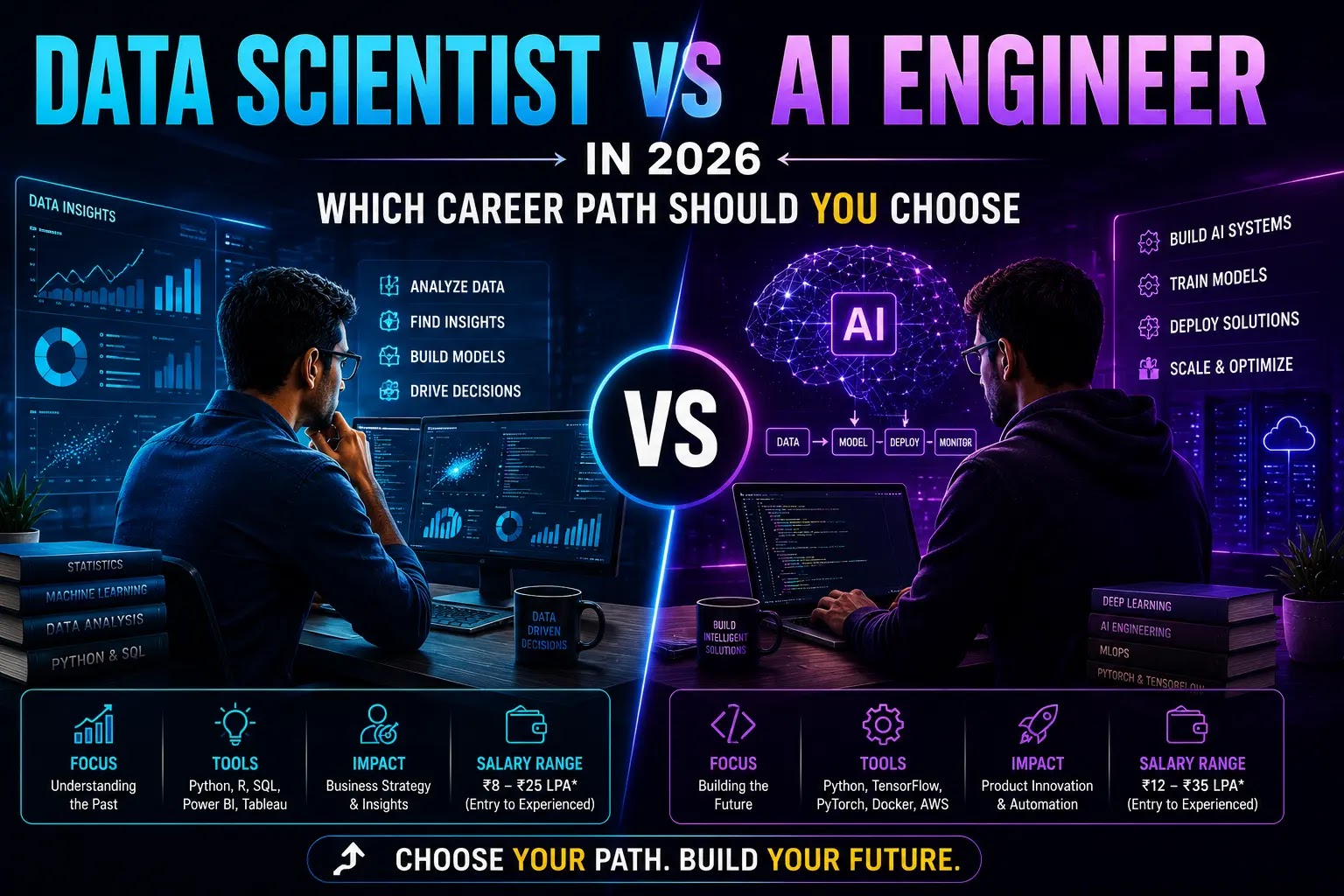
Two of the most searched career questions in 2026 are: “Should I become a Data Scientist or an AI Engineer?” and “What’s the difference between the two?” If you’re standing at this crossroads, you’re not alone. As AI reshapes every industry, both paths offer tremendous opportunity — but they demand different skills, suit different personalities, and lead to very different day-to-day work. This Data Scientist vs AI Engineer guide breaks it all down so you can make the smartest career decision for your future.
Just a few years ago, “Data Scientist” was the hottest job title on the planet. In 2026, the landscape has shifted dramatically. The explosion of large language models, generative AI tools, and real-time AI systems has created a massive surge in demand for AI Engineers — professionals who can build, deploy, and scale AI in production environments. Meanwhile, Data Scientists remain critical for companies that need deep analytical insight and research-driven decision-making.
The problem is that many job seekers — especially in India — apply for roles without truly understanding which path aligns with their skills, interests, and career goals. Choosing the wrong path can cost you months of misdirected effort. Let’s fix that right now.
What Does a Data Scientist Actually Do?
A Data Scientist’s primary job is to extract meaningful insights from data to drive business decisions. They sit at the intersection of statistics, domain knowledge, and programming. On a typical day, a Data Scientist might:
- Clean and explore large datasets using Python or R
- Build predictive models to forecast sales, churn, or risk
- Create dashboards and visualizations for leadership teams
- Run A/B tests to validate product decisions
- Communicate findings to non-technical stakeholders
Data Scientists are heavy users of tools like Jupyter Notebooks, Pandas, NumPy, Tableau, and SQL. Their output is usually a report, a trained model prototype, or a dashboard — not a deployed software product. Think of them as the people who answer the question: “What does the data tell us?”
What Does an AI Engineer Actually Do?
An AI Engineer takes AI models — whether built in-house or sourced from foundation model providers like OpenAI or Google — and integrates them into real, production-ready applications. Where a Data Scientist experiments, an AI Engineer builds and ships. A typical day for an AI Engineer might include:
- Building and deploying ML pipelines using tools like MLflow or Kubeflow
- Integrating LLMs into applications using LangChain or the OpenAI API
- Optimizing model inference speed and cost for production use
- Setting up monitoring for AI system performance and drift detection
- Containerizing AI applications using Docker and Kubernetes
AI Engineers are software engineers at heart, but with deep AI/ML knowledge layered on top. Their output is a working, scalable AI product — a chatbot, a recommendation engine, a real-time fraud detection system. They answer the question: “How do we make AI work reliably at scale?”
Skills Comparison: Data Scientist vs AI Engineer
| Skill Area | Data Scientist | AI Engineer |
|---|---|---|
| Programming | Python, R, SQL | Python, Java/Go (optional), REST APIs |
| ML Frameworks | Scikit-learn, XGBoost, basic TensorFlow | PyTorch, TensorFlow, Hugging Face, ONNX |
| GenAI/LLM Skills | Prompt analysis, model evaluation | LangChain, RAG pipelines, fine-tuning, agents |
| Cloud & DevOps | Basic cloud storage, BI tools | AWS SageMaker, GCP Vertex AI, Docker, CI/CD |
| Statistics | Deep (hypothesis testing, Bayesian stats) | Moderate (enough for model evaluation) |
| Data Tools | Tableau, Power BI, Pandas, Spark | Feature stores, data pipelines, Kafka |
Salary Comparison in India (2026)
| Experience Level | Data Scientist (₹ LPA) | AI Engineer (₹ LPA) |
|---|---|---|
| Fresher / 0–1 year | ₹5 – ₹10 LPA | ₹6 – ₹12 LPA |
| Mid-level / 2–4 years | ₹12 – ₹25 LPA | ₹15 – ₹35 LPA |
| Senior / 5+ years | ₹25 – ₹50 LPA | ₹35 – ₹80+ LPA |
AI Engineers command a premium in 2026 because production AI skills — especially GenAI deployment experience — are scarcer than analytical data science skills. However, senior Data Scientists at top product companies and hedge funds can match or exceed these numbers.
Should I Focus on AI Research or Applied AI?
This is a critical fork in the road that every aspiring AI professional faces. Here’s the honest breakdown:
- AI Research means pushing the boundaries of what’s possible — developing new algorithms, publishing papers, and working at organizations like DeepMind, OpenAI, or IIT research labs. This path typically requires an MTech or PhD, strong mathematics, and a publication record. Jobs are few, competition is fierce, and the path is long.
- Applied AI means using existing AI tools and models to solve real business problems. This is where 95% of AI jobs live in 2026. Companies want engineers who can build RAG systems, fine-tune LLMs, deploy recommendation engines, and automate workflows — not invent new neural architectures.
For most people in India targeting employment within 6–12 months, Applied AI is the clear winner. The pay is excellent, the demand is massive, and you don’t need a postgraduate degree to break in.
Which Career Path Is Right for You?
Ask yourself these questions honestly:
- Do you love building software systems and seeing things deployed? → AI Engineer
- Do you love statistics, patterns in data, and storytelling with numbers? → Data Scientist
- Do you have a software engineering background? → AI Engineer (natural transition)
- Do you have a background in economics, math, or business analytics? → Data Scientist
- Do you want faster hiring and higher starting salaries? → AI Engineer in 2026
- Do you want more domain flexibility (healthcare, finance, retail)? → Data Scientist
Neither path is wrong — they’re just different. The worst mistake is spending six months learning the wrong one because you didn’t stop to reflect on what genuinely excites you.
How to Transition From Software Engineering to AI
If you’re already a software engineer, transitioning to AI Engineering is one of the smartest moves you can make in 2026. Your existing skills in Python, APIs, version control, and system design are exactly what AI Engineering demands — you just need to add the ML layer.
Here’s a proven 90-day transition plan:
- Month 1 — ML Foundations: Complete Andrew Ng’s Machine Learning Specialization on Coursera. Understand supervised learning, model evaluation, and neural network basics.
- Month 2 — GenAI & Deployment: Learn LangChain, build a RAG-based chatbot, and deploy it using FastAPI + Docker. This single project is worth more than any certificate.
- Month 3 — Apply Smart: Target roles like “AI Backend Engineer,” “ML Platform Engineer,” or “AI Integration Developer.” These roles value your SE background and pay 30–50% more than your current package.
How Do I Know If I’m Ready for an AI Position?
A question many candidates ask — and the answer is simpler than you think. You’re ready to apply when:
- ✅ You can build and evaluate a complete ML model in Python without tutorials
- ✅ You have 2–3 GitHub projects that demonstrate real AI work
- ✅ You can explain your projects clearly in a 5-minute interview answer
- ✅ You’ve deployed at least one model or AI-powered app, even on a free tier
- ✅ You understand core concepts like overfitting, precision/recall, and transformer architecture basics
Don’t wait for perfection. Apply at 70% readiness — interview feedback will show you exactly what to improve next.
What Companies Want in AI Candidates in 2026
Based on hundreds of Indian and global AI job postings analyzed in 2026, here are the top things recruiters consistently prioritize:
- For Data Scientists: Strong SQL + Python, statistical modeling experience, business domain knowledge, clear communication skills, and Tableau/Power BI proficiency
- For AI Engineers: LLM integration experience (LangChain, OpenAI API), MLOps knowledge, cloud platform hands-on work (AWS/GCP/Azure), and a GitHub portfolio with deployed projects
- For Both: Learning agility — the AI landscape changes every 3 months, and companies want candidates who can keep up
Can Bootcamp Graduates Compete for These Roles?
Yes — particularly for AI Engineering roles at startups and mid-size companies. Bootcamp graduates from recognized programs like Scaler, upGrad, Great Learning, or IIIT-B online programs are regularly hired at companies like Freshworks, Razorpay, and fast-growing AI startups.
The key differentiator for bootcamp graduates is portfolio quality. Capstone projects must be polished, documented, and ideally deployed. Contributing to open-source AI repositories on GitHub also significantly boosts credibility beyond the bootcamp brand.
Conclusion: Make the Choice That Fits You
In 2026, both Data Scientists and AI Engineers are valuable, well-paid, and in demand — but they serve very different purposes. If you love building things and want faster entry into the job market, AI Engineering is your path. If you love data storytelling, business analysis, and statistical depth, Data Science is your calling. The most important thing is to stop waiting and start building — your first project, your first certification, your first GitHub commit. The AI job market rewards action far more than it rewards planning.
Whichever path you choose, remember: the skills you build today will define your career for the next decade. Start focused, build consistently, and let your portfolio do the talking.
Before we answer some frequently asked questions, you may also find these guides helpful:
What Skills Do I Need to Start a Career in AI? Complete Guide for 2026
10 AI Jobs That Indian Companies Are Desperately Hiring For in 2026
Frequently Asked Questions
Which is better, AI engineer or data scientist?
Neither role is universally better. AI engineers focus on building and deploying AI systems, while data scientists analyze data to generate business insights. Choose AI engineering if you enjoy developing AI applications and data science if you prefer analytics and decision-making.
Can a data scientist become an AI engineer?
Yes, many data scientists transition into AI engineering by learning machine learning deployment, deep learning, cloud platforms, MLOps, and software engineering. Their existing knowledge of data and machine learning provides a strong foundation.
Which pays more, AI or data science?
AI engineering often offers slightly higher salaries because it requires expertise in AI model development, deployment, and production systems. However, salaries for both roles depend on experience, location, company, and technical skills.
Is data science better than AI?
Data science and AI serve different purposes. Data science focuses on analyzing data and generating insights, while AI focuses on creating intelligent systems that automate tasks and make predictions. The better choice depends on your interests and career goals.
Which is tougher, AI or data science?
AI engineering is generally considered more challenging because it involves machine learning, deep learning, software engineering, and deploying AI models. Data science focuses more on statistics, data analysis, and business intelligence.
Will AI replace data science?
No, AI is unlikely to replace data science completely. Instead, AI automates repetitive tasks, allowing data scientists to focus on advanced analytics, business strategy, model evaluation, and solving complex problems.
Who earns more, CA or data scientist?
Both careers offer competitive salaries. Experienced data scientists in the technology industry often earn higher salaries than many Chartered Accountants, especially when working in AI, cloud computing, or multinational companies.
What is the difference between a data scientist and an AI engineer?
A data scientist analyzes data to discover insights, build predictive models, and support business decisions. An AI engineer develops, deploys, and maintains AI systems that automate tasks and solve real-world problems using machine learning and deep learning.
Which career has better future, AI engineer or data scientist?
Both careers have excellent future prospects, but AI engineering is expected to grow faster due to increasing demand for generative AI, automation, robotics, and intelligent applications. Data science will remain essential for data-driven decision-making.
Should I choose AI engineering or data science?
Choose AI engineering if you enjoy coding, machine learning, deep learning, and building AI applications. Choose data science if you enjoy statistics, data visualization, analytics, and solving business problems using data.
Which skills are required for AI engineers?
AI engineers typically need Python, machine learning, deep learning, TensorFlow or PyTorch, cloud computing, APIs, MLOps, mathematics, and software engineering skills.
Which skills are required for data scientists?
Data scientists should learn Python, SQL, statistics, machine learning, data visualization, Excel, Power BI, Tableau, and communication skills to analyze and present business insights effectively.
Can AI engineers become data scientists?
Yes, AI engineers can transition into data science by strengthening their knowledge of statistics, business analytics, data visualization, and exploratory data analysis.
Is AI engineering a good career in 2026?
Yes, AI engineering is expected to be one of the fastest-growing technology careers in 2026. Organizations across industries are investing heavily in AI, creating strong demand for professionals with AI development and deployment skills.