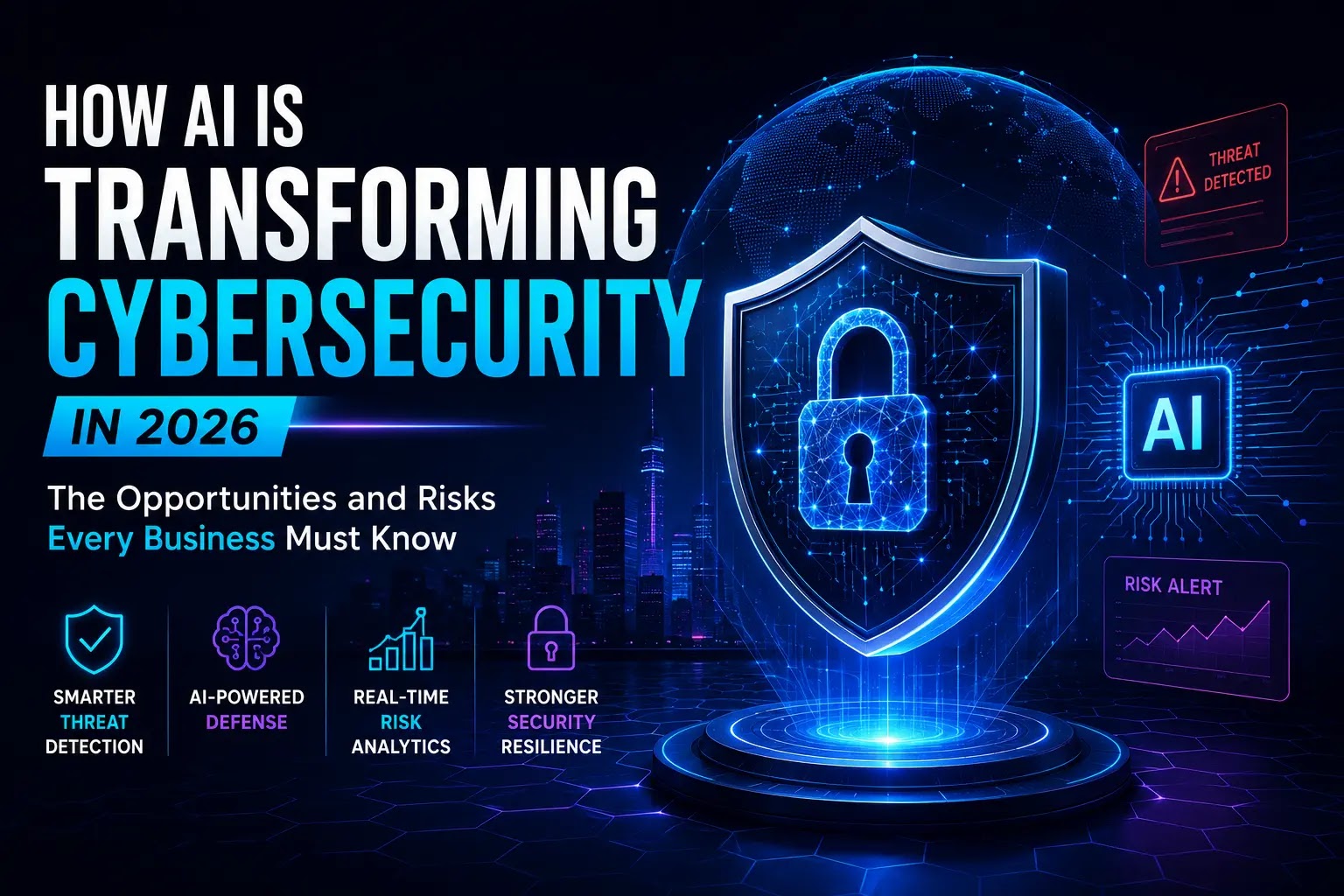
Artificial intelligence has become the most powerful force reshaping cybersecurity in 2026 — and it’s fighting on both sides. While businesses are using AI to detect threats faster, automate defenses, and predict vulnerabilities before they are exploited, cybercriminals are using the exact same technology to launch faster, smarter, and more targeted attacks.
According to a landmark report by Darktrace, 87% of security leaders say AI is significantly increasing the number and sophistication of threats their organizations face. At the same time, 96% say defensive AI significantly improves their security capabilities. The message is clear: AI is not optional in cybersecurity anymore — it’s the battlefield itself.
In this article, we break down how AI is transforming cybersecurity in 2026, the new threats businesses must prepare for, the defensive tools changing the game, and what every business owner and IT leader needs to do right now.
The Rise of AI-Powered Cyber Attacks
For years, cyberattacks followed predictable patterns — phishing emails, brute-force password attempts, and known malware strains. In 2026, AI has completely changed this dynamic. Attackers now use machine learning models to craft highly personalized phishing messages, generate deepfake audio and video impersonations of company executives, and scan entire corporate networks for vulnerabilities in seconds.
CrowdStrike’s 2026 Global Threat Report revealed an 89% increase in attacks by AI-enabled adversaries compared to the previous year. The average eCrime breakout time — the time it takes an attacker to move from initial access to full network compromise — dropped to just 27 seconds in the fastest recorded case. That is faster than most security teams can even detect an intrusion, let alone respond.
Here are the most dangerous AI-powered attack types businesses face in 2026:
- AI-Generated Phishing: Using large language models, attackers generate highly convincing phishing emails personalized to specific employees, mimicking the exact writing style of known contacts.
- Deepfake Social Engineering: Audio and video deepfakes are used to impersonate CEOs and finance executives, tricking employees into wire transfers or credential handovers.
- Automated Vulnerability Scanning: AI tools scan thousands of systems simultaneously to identify unpatched vulnerabilities before defenders can act.
- AI-Accelerated Zero-Day Exploits: Attackers use AI to discover and weaponize zero-day vulnerabilities faster than ever before.
- Malware-Free Intrusions: 82% of detections involved no malware at all — attackers simply “log in” using stolen credentials, making traditional antivirus tools useless.
The World Economic Forum’s Global Cybersecurity Outlook 2026 confirmed that cyber-enabled fraud and AI-driven phishing now rank as the top cybersecurity concern globally, surpassing even ransomware.
The Staggering Cost of AI-Enabled Breaches
The financial stakes have never been higher. IBM’s 2026 data breach report found that data breaches now cost businesses an average of $10.22 million per incident — an all-time high. This figure includes direct costs such as recovery, legal fees, regulatory fines, and ransom payments, but also indirect costs such as reputational damage and lost customers.
Small and medium-sized businesses (SMBs) are no longer safe by virtue of their size. Roughly 23% of SMBs experienced a cybersecurity incident in 2026, and because they typically have fewer defenses than enterprise organizations, they are increasingly attractive targets for AI-powered attacks. A single breach can be existential for a small business.
Beyond direct financial loss, regulatory consequences are growing. Governments worldwide are enacting stricter data protection laws, and companies that suffer breaches due to inadequate AI security practices face increasing liability. Organizations must demonstrate that they are actively managing AI-related cyber risks.
How AI Is Supercharging Cyber Defense
The good news is that AI is also the most powerful defensive weapon available to security teams in 2026. Security operations centers (SOCs) that once struggled to process thousands of daily alerts are now using AI to automate threat detection, prioritize responses, and even predict attacks before they happen.
Here’s how AI is transforming cyber defense:
- Automated Threat Detection: AI systems monitor network traffic 24/7, identifying anomalous patterns that human analysts would miss. They can flag a potential breach in milliseconds rather than hours.
- Behavioral Analytics: Instead of relying on known malware signatures, AI builds behavioral profiles of normal user and system activity. Any deviation — like an employee accessing files at 3 AM — triggers an instant alert.
- Predictive Vulnerability Management: AI scans code and infrastructure to predict which vulnerabilities are most likely to be exploited, allowing teams to patch critical issues proactively.
- AI-Powered Incident Response: When a breach occurs, AI can automatically isolate affected systems, block malicious traffic, and initiate recovery protocols — all without waiting for human authorization.
- Natural Language Threat Intelligence: AI models process millions of threat intelligence reports and dark web forums simultaneously, giving defenders early warning of emerging attack campaigns.
Organizations using AI-driven security tools detected and contained breaches significantly faster than those relying on traditional methods. The speed advantage of AI defense is the primary reason 96% of CISOs now say AI has improved their security posture.
The Biggest AI Security Concerns for 2026
While AI brings powerful defenses, it also introduces entirely new risk categories. Security leaders identified these as the top concerns heading into the second half of 2026:
- AI Agent Security (92% concerned): As businesses deploy AI agents to automate workflows, these agents have access to sensitive data and systems. Compromising an AI agent can give attackers a foothold inside a company’s entire digital operation.
- Shadow AI: Employees are using unauthorized AI tools for work tasks, often feeding sensitive company data into external AI platforms without IT’s knowledge — creating massive data leakage risks.
- LLM Prompt Injection: Attackers embed malicious instructions in data the AI processes, tricking the AI into leaking data, bypassing security controls, or executing harmful commands.
- AI Supply Chain Attacks: As companies rely on third-party AI models and APIs, attackers are targeting the AI supply chain itself — injecting vulnerabilities into models before they are deployed.
- Deepfake-Enabled Identity Fraud: Facial recognition and voice authentication systems are increasingly being bypassed using AI-generated deepfakes.
The World Economic Forum noted that 87% of respondents identified AI-related vulnerabilities as the fastest-growing cyber risk in 2026 — surpassing traditional threats like ransomware in terms of growth rate.
What Businesses Must Do Right Now
Given the escalating threat landscape, cybersecurity is no longer just an IT concern — it’s a board-level business priority. Harvard Business Review noted in April 2026 that AI is reshaping cyber risk from a technical problem into a leadership test for corporate boards. Here is a practical action plan for businesses of all sizes:
1. Adopt AI-Powered Security Tools
Traditional antivirus and perimeter-based security tools are no longer sufficient. Invest in AI-driven security platforms that offer behavioral analytics, automated threat detection, and real-time incident response. Solutions from providers like Darktrace, CrowdStrike, and Microsoft Sentinel are leading the market in 2026.
2. Implement a Zero Trust Architecture
Zero Trust means never assuming any user, device, or system is safe — even inside your own network. Every access request is verified continuously. This approach is particularly effective against credential-based, malware-free intrusions that now make up 82% of breaches.
3. Create an AI Security Policy
With 92% of CISOs worried about AI agent security, businesses must establish clear policies governing which AI tools employees can use, what data can be shared with AI platforms, and how AI agents are governed and monitored. Addressing shadow AI is a top priority.
4. Conduct Regular AI-Specific Security Assessments
Only 64% of organizations now conduct assessments of the AI tools they use — up from 37% in 2025, but still not enough. Every AI system deployed in your organization should be assessed for vulnerabilities, data access risks, and potential for misuse.
5. Train Your Workforce on AI Threats
Employees are the first line of defense and the most common point of compromise. Train staff to recognize traditional phishing as well as deepfakes, AI-generated impersonation attempts, and suspicious AI tool usage. Regular simulation exercises are essential.
6. Build a Cyber Resilience Plan
Assume that at some point, your defenses will be breached. Have a clear incident response plan, segment your networks so one breach cannot cascade through your entire system, and maintain secure offline backups of critical data.
7. Enforce Multi-Factor Authentication (MFA) Everywhere
MFA remains one of the most effective low-cost defenses against credential theft. With AI making password cracking and phishing exponentially more effective, MFA at every access point is non-negotiable in 2026.
The Road Ahead: AI Security as a Business Differentiator
In 2026, cybersecurity is no longer just about protecting assets — it’s becoming a competitive differentiator. Customers, partners, and investors are increasingly scrutinizing the security posture of companies they work with. Businesses that demonstrate robust AI security practices build trust, win contracts, and avoid the catastrophic reputational and financial damage of a public breach.
The organizations winning the AI cybersecurity arms race are those treating security not as a cost center, but as a strategic investment. They embed security thinking into every stage of AI deployment, foster a culture of cyber awareness, and use AI itself as their primary shield against AI-powered threats.
Conclusion
The dual nature of AI in cybersecurity is perhaps the defining technology challenge of 2026. It is simultaneously the most powerful weapon attackers have ever wielded and the most effective defense organizations have ever had access to. The gap between businesses that embrace AI-powered security and those that don’t is widening rapidly — and the consequences of falling behind are severe.
Whether you run a global enterprise or a small business, the time to act is now. Invest in AI-driven security tools, establish clear AI governance policies, train your people, and build resilience into every layer of your operations. The reality of 2026 is stark: attackers only need to succeed once, while defenders must succeed every single time. But with the right strategy, businesses can tilt the odds dramatically in their favor.
Before we answer some frequently asked questions, you may also find these guides helpful:
Humanoid Robots at Work: How AI-Powered Robots Are Entering the Global Workplace in 2026
What Is RPA? How Robotic Process Automation Is Transforming Business Workflows in 2026
Frequently Asked Questions (FAQ)
What is meant by cyber security?
Cybersecurity is the practice of protecting computers, networks, software, and data from cyber threats such as hacking, malware, phishing, and unauthorized access. Its goal is to keep digital information secure, private, and available only to authorized users.
What are the 7 types of cyber security?
The seven common types of cybersecurity are network security, application security, cloud security, endpoint security, information security, identity and access management, and disaster recovery and business continuity. Together, these help protect organizations from various cyber threats.
What does cyber security do exactly?
Cybersecurity prevents unauthorized access to systems and data by detecting, blocking, and responding to cyber attacks. It protects sensitive information, monitors networks for threats, and helps businesses maintain secure and reliable digital operations.
Why is cybersecurity important?
Cybersecurity is important because it protects personal information, financial data, and business systems from cybercriminals. Strong cybersecurity reduces the risk of data breaches, financial losses, identity theft, and operational disruptions.
Which country is No. 1 in cybersecurity?
Several countries are recognized for strong cybersecurity capabilities, including the United States, the United Kingdom, Singapore, and Israel. Rankings vary depending on the organization and the criteria used to evaluate cybersecurity readiness.
Is cybersecurity a high salary?
Yes, cybersecurity is generally considered a high-paying career. Skilled professionals such as security analysts, penetration testers, cloud security engineers, and cybersecurity architects often earn competitive salaries due to the growing demand for their expertise.
Is cybersecurity a 9–5 job?
Some cybersecurity roles follow a standard 9–5 schedule, while others require on-call availability or shift work to monitor systems and respond to security incidents. The working hours depend on the organization and job responsibilities.
Which Big 4 is best for cybersecurity?
All four major consulting firms—Deloitte, PwC, EY, and KPMG—offer strong cybersecurity services. Deloitte is often recognized for its extensive cybersecurity consulting practice, while the best choice depends on your career goals, preferred work environment, and area of specialization.