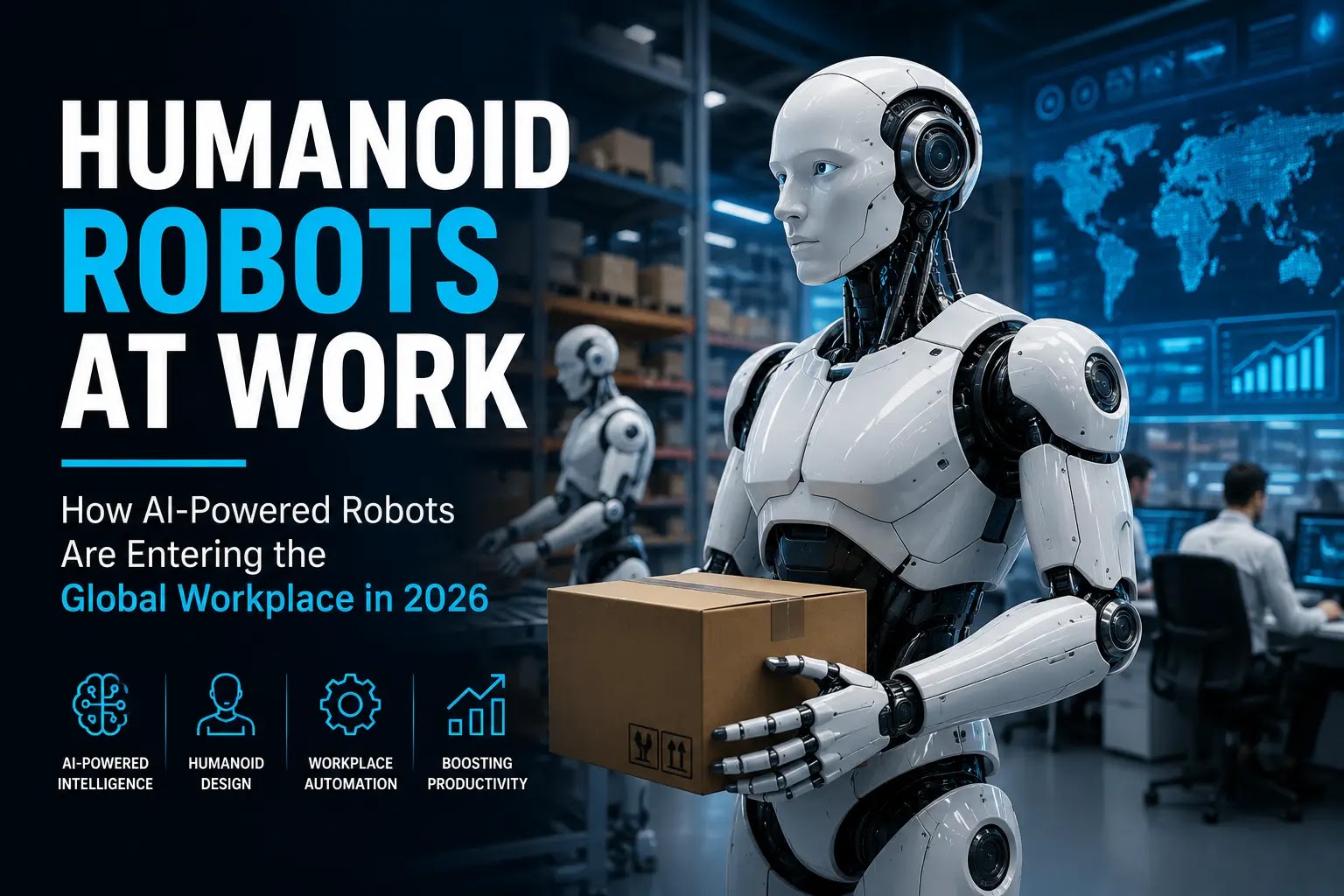
For decades, humanoid robots were a staple of science fiction movies — impressive on screen but far from ready for real-world deployment. In 2026, that narrative has completely changed. AI-powered humanoid robots are now working on factory floors, inside warehouses, at hotel lobbies, and even in healthcare facilities across the globe. From Tesla’s Optimus to Boston Dynamics’ Atlas and China’s army of 17,000 deployed units, the humanoid robot revolution is not coming — it is already here.
This article explores how humanoid robots are entering the global workplace, which industries are leading adoption, what tasks these robots are performing today, and what this means for workers, businesses, and the future of employment worldwide.
What Are Humanoid Robots?
Humanoid robots are machines designed to resemble and move like humans — with two arms, two legs, a torso, and a head. Unlike traditional industrial robots that are fixed and designed for one specific task, humanoid robots are built to operate in environments designed for humans. They can navigate stairs, open doors, pick up objects of different shapes, and perform a wide variety of tasks without needing a factory to be redesigned around them.
What makes 2026 different is the integration of advanced AI — particularly physical AI, large language models (LLMs), and computer vision — into these machines. Today’s humanoid robots don’t just follow pre-programmed instructions. They learn by watching humans, adapt to changing environments, and can even communicate with coworkers using natural language.
The Numbers Behind the Humanoid Robot Boom
The scale of deployment in 2026 is staggering. China alone shipped approximately 17,000 humanoid robots in 2025, produced by more than 140 companies nationwide. On June 9, 2026, China’s Ministry of Industry and Information Technology launched a nationwide action plan to deploy around 10,000 additional humanoid robots across more than 100 high-value scenarios by the end of the year.
Globally, 18 major companies are now racing to build and deploy humanoid robots at scale — including Tesla, Boston Dynamics, Figure AI, Agility Robotics, Unitree, and dozens of well-funded startups. Unitree is already selling humanoid units for as low as $16,000, making them increasingly accessible for small and mid-sized businesses.
According to Forrester’s State of Humanoid Robots 2026 report, early adopters in manufacturing, logistics, healthcare, and customer service are already capturing real business value — with accelerating advances in generative AI, physical AI, and cloud platforms set to expand capabilities and reduce costs further in the next 12–18 months.
Which Industries Are Adopting Humanoid Robots First?
1. Manufacturing and Automotive
The automotive sector is leading the charge. Boston Dynamics’ electric Atlas robot is being deployed in Hyundai’s Georgia factory to work alongside human workers on assembly lines. Figure AI robots are being used to build BMW cars. Tesla’s Optimus is learning tasks by watching human workers — a capability that dramatically speeds up training and deployment. Toyota has deployed Agility Robotics’ Digit at its Canadian plant to move totes and handle repetitive logistics tasks inside its manufacturing facility.
Other automakers investing heavily in humanoid robotics include Volkswagen, Ford, Mercedes-Benz, and Hyundai. The key reason? Humanoid robots can integrate into existing “brownfield” factories without requiring expensive redesigns, making them a practical automation solution even for older facilities.
2. Warehouse and Logistics
Amazon is running Agility Robotics’ Digit in its fulfillment centers to handle repetitive picking and packing tasks. GXO Logistics, one of the world’s largest logistics companies, has also deployed Digit robots at scale. The startup Robot.com (formerly Kiwibot) launched its R-noid wheeled humanoid robot in June 2026, targeting food service, logistics, and healthcare — capable of packaging orders, loading/unloading boxes, and prepping workstations, with deployment possible within just 8–12 weeks.
3. Hotels and Hospitality
In China and parts of Asia, humanoid robots have begun working in hotels — greeting guests, delivering room service, and handling front desk inquiries. These deployments are in controlled environments where the robot’s appearance and communication skills create a memorable customer experience while reducing labor costs.
4. Healthcare
While still emerging in this sector, humanoid robots are being evaluated for tasks such as assisting nurses with patient transport, delivering medications within hospital corridors, and supporting elderly care in aging societies. With global labor shortages in healthcare becoming a critical issue, robots offer a promising supplemental workforce.
5. E-commerce and Retail
E-commerce fulfillment is one of the top categories seeing inbound interest, according to Agility Robotics. The combination of high-volume repetitive tasks, predictable indoor environments, and acute labor shortages makes fulfillment centers an ideal early deployment ground for humanoid robots.
What Tasks Can Humanoid Robots Actually Do in 2026?
Here are the proven use cases that are working in real deployments today:
- Tote and box handling — moving containers from point A to B in warehouses and factories
- Light pick-and-place — sorting items on conveyor belts and packing boxes
- Inspection routes — walking through facilities to monitor equipment and report anomalies
- Assembly line support — handing parts to human workers, holding components in place
- Restaurant and food service assistance — prepping workstations, loading food into delivery systems
- Customer-facing interactions — greeting guests, answering basic questions in hospitality settings
Tasks that are still not ready at scale include complex welding, high-speed precision assembly, and unstructured outdoor environments. Most current deployments operate at around 70% autonomy, with human oversight and teleoperation support as backup during early stages.
The AI Brain Behind the Robot Body
What separates 2026’s humanoid robots from their predecessors is not just better hardware — it’s the AI powering their decision-making. Companies like Physical Intelligence are developing “foundation models for robotics” — essentially the equivalent of ChatGPT but for robot movement and task completion. These models allow robots to learn new tasks from demonstrations rather than requiring hundreds of hours of manual programming.
Microsoft and Hexagon’s partnership is being described as a turning point — combining enterprise cloud AI with precision robotics hardware to create scalable deployment systems for industrial customers. NVIDIA’s physical AI platforms are also helping robots understand and reason about 3D environments in real time. The convergence of generative AI, computer vision, and physical robotics is what makes 2026 the true inflection point for this technology.
What Does This Mean for Workers?
The most pressing question on everyone’s mind: will humanoid robots take human jobs? In the short term, these robots are primarily being deployed to fill labor gaps, not replace existing workers. Agility Robotics explicitly targets industries suffering from vacant positions and an aging workforce. In manufacturing, there are thousands of unfilled positions globally that humans simply aren’t applying for — often because the work is dangerous, repetitive, or physically taxing.
In the medium to long term, the impact will be more significant. However, history shows that automation tends to shift the nature of work rather than eliminate it entirely. New roles are already emerging — robot trainers, teleoperation specialists, deployment engineers, and AI maintenance technicians are in high demand. Workers who adapt and upskill will find themselves working alongside robots rather than being replaced by them.
Challenges Still Holding Back Mass Adoption
- High costs — While Unitree offers units at $16,000, enterprise-grade robots from Figure AI or Boston Dynamics cost significantly more
- Regulatory uncertainty — Governments are still developing safety standards and liability frameworks for robots working alongside humans
- Deployment complexity — Customizing robots for specific environments and tasks requires significant time and expertise
- Battery life and durability — Current humanoid robots have limited operational hours before needing recharging or maintenance
- Public trust and acceptance — Employees and customers need time to adjust to working or interacting with humanoid machines
Global Competition: Who Is Leading the Race?
China currently holds approximately 80% of the global humanoid robot market share in 2026, driven by massive government support, a large manufacturing base, and competitive pricing. The US is home to the most advanced AI and robotics startups, with companies like Figure AI, Agility Robotics, and Boston Dynamics pushing the frontier of capability. Europe is focusing on regulatory frameworks and ethical guidelines while selectively adopting robots in automotive and logistics. The global race is intensifying — and the winners will shape how work is done worldwide for the next several decades.
The Road Ahead: What to Expect by 2027 and Beyond
The next 12–18 months will see significant cost reductions, broader task capabilities, and wider deployment across new industries. Analysts expect humanoid robots to move from controlled factory environments into more complex, unstructured settings — including retail stores, hospitals, and eventually homes. The convergence of falling hardware costs, more powerful AI models, and proven business ROI will likely trigger an adoption wave in 2027 that makes today’s deployments look like small-scale pilots.
For businesses globally, the message is clear: now is the time to evaluate, experiment, and prepare. Companies that start piloting humanoid robots today will have a significant competitive advantage as the technology matures and scales over the next three to five years.
Conclusion
Humanoid robots are no longer a future concept — they are a present reality reshaping the global workplace in 2026. From BMW factories in Germany to Amazon warehouses in the US to hotel lobbies in China, AI-powered humanoid robots are proving their value across industries worldwide. The technology is still maturing, challenges remain, and mass-scale deployment is still a few years away — but the trajectory is unmistakable. Businesses and workers alike need to understand, prepare for, and embrace this transformative shift in how work gets done across the globe.
Before we answer some frequently asked questions, you may also find these guides helpful:
What Is RPA? How Robotic Process Automation Is Transforming Business Workflows in 2026
What Is Edge AI and Why Every Business Should Care About It Right Now
Frequently Asked Questions (FAQs)
What is a humanoid robot?
A humanoid robot is a robot designed to resemble the human body with features such as a head, torso, arms, and legs. It uses artificial intelligence, sensors, and advanced software to perform tasks, interact with people, and move in human-like ways.
What is currently the best humanoid robot?
Several humanoid robots are considered among the best today, including Tesla Optimus, Figure 02, Unitree G1, and Boston Dynamics Atlas. Each excels in different areas such as mobility, AI capabilities, industrial automation, or research.
Which is India’s first humanoid robot?
Vyommitra is India’s first humanoid robot developed by the Indian Space Research Organisation (ISRO). It was created to assist with space missions by performing tasks and interacting with mission control during unmanned space flights.
Is Elon Musk making humanoid robots?
Yes, Elon Musk’s company Tesla is developing a humanoid robot called Optimus. It is designed to perform repetitive, dangerous, and everyday tasks in factories, businesses, and homes using artificial intelligence.
Which country is No. 1 in robotics?
Japan is widely recognized as a global leader in robotics due to its advanced technology, strong manufacturing industry, and continuous innovation. Other leading countries include South Korea, Germany, the United States, and China.
How much will Tesla’s robot cost?
Tesla has stated that its Optimus humanoid robot could eventually cost between $20,000 and $30,000, although the final price may vary depending on features, production costs, and market conditions when it becomes commercially available.
Can I buy a robot from Elon Musk?
Not yet. Tesla Optimus is still under development and is not widely available for public purchase. Tesla plans to release it commercially after further testing and large-scale production.
How much did Kim Kardashian’s robot cost?
Kim Kardashian showcased Tesla’s Optimus robot in promotional content, but there is no confirmed public information about purchasing a personal robot or the price she paid. Tesla has not announced consumer sales of Optimus.