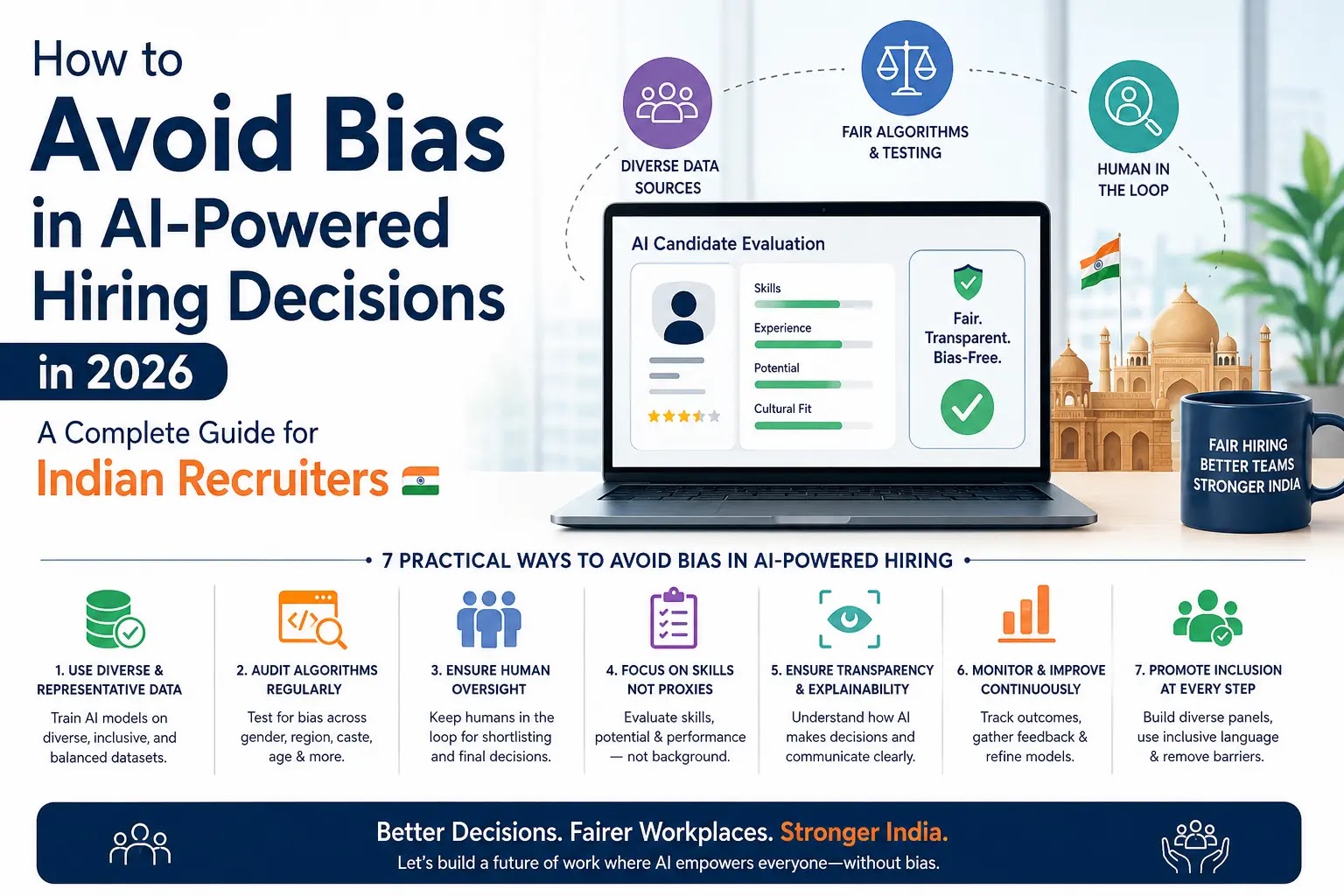
Artificial Intelligence has transformed recruitment in India — from resume screening to interview scheduling. But there’s a growing concern that these AI tools, when not implemented carefully, can replicate and even amplify existing human biases. In 2026, avoiding bias in AI-powered hiring is no longer optional — it’s a business, ethical, and social imperative.
If you’re an HR professional, recruiter, or business owner using AI tools to hire, this guide will show you exactly what AI bias looks like, why it happens, and — most importantly — how to prevent it.
What Is Bias in AI Hiring — And Why Should You Care?
AI hiring bias occurs when an algorithm systematically disadvantages certain groups of candidates based on characteristics like gender, caste, ethnicity, educational background, or geography. This isn’t always intentional — most AI systems inherit bias from the historical data they’re trained on.
Consider this: A recent investigation found that 40% of AI-driven rejections in India disproportionately affected women and marginalized groups due to flawed training data. Another alarming report revealed that 60% of qualified Indian candidates were eliminated before ever reaching a human recruiter when applying for Gulf-based roles — because the AI failed to recognize Indian credentials.
In India specifically, biases can be compounded by:
- Caste-based disparities in historical hiring data
- Preference for urban, English-speaking candidates from elite institutions
- Penalizing women for career breaks or part-time work history
- Algorithms favoring certain regional or institutional backgrounds
How AI Bias Enters the Hiring Process
1. Biased Training Data
AI tools learn from historical hiring decisions. If your company historically hired more men for technical roles, the AI will “learn” to prefer male resumes — and continue that pattern automatically. The algorithm doesn’t know it’s being unfair; it’s simply optimizing based on what worked before.
2. Proxy Variables
Sometimes AI systems use seemingly neutral variables — like the name of a college, a ZIP code, or the name of a sports club — that correlate with race, caste, or gender. Amazon famously had to scrap its AI recruitment tool after it was found to penalize resumes containing the word “women” (as in “women’s chess club”). This shows how even well-intentioned data can carry hidden bias.
3. Speech and Video Analysis Bias
AI video interview tools that analyze tone, speech patterns, or facial expressions can disadvantage non-native English speakers, people with accents, or individuals with disabilities. HireVue’s algorithms were found to disadvantage non-white and deaf applicants when analyzing spoken English — a critical concern for India’s linguistically diverse workforce.
4. Feedback Loop Bias
When AI systems continuously learn from recruiter feedback — which may itself be biased — the bias compounds over time. Each “yes” from a recruiter reinforces the AI’s preference for similar profiles, creating a self-reinforcing cycle of exclusion.
7 Practical Ways to Avoid Bias in AI-Powered Hiring
1. Conduct Regular Bias Audits
Schedule periodic algorithmic audits to analyze who your AI is rejecting and why. Apply the EEOC’s “four-fifths rule” as a benchmark: if one group is recommended at less than 80% of the rate of the most-recommended group, your system likely has a bias problem. In India, where there’s currently no legal mandate for such audits, doing so proactively sets your organization apart as a fair employer.
2. Use Diverse and Representative Training Data
Ensure your AI is trained on data that reflects a diverse talent pool — across gender, region, caste, educational background, and language. Regularly review and update datasets to include underrepresented groups. Garbage in, garbage out — the quality of your training data directly determines the fairness of your AI outputs.
3. Implement Resume Anonymization
Strip names, gender indicators, photos, and educational institution identifiers from resumes before AI screening. This forces the algorithm to focus on skills, experience, and competencies. One staffing firm saw a 21% increase in female tech hires after introducing anonymized AI screening — a compelling proof of concept for Indian companies.
4. Define “Merit” Carefully and Inclusively
Before automating hiring, ask hard questions: What skills and experiences actually predict success in this role? Are we rewarding credentials that are only accessible to privileged groups? Redefine job requirements to focus on demonstrable skills rather than pedigree markers like college name or previous employer brand.
5. Keep Humans in the Decision Loop
AI should assist recruiters — not replace their judgment. Ensure that every final hiring decision involves human review. AI can shortlist; humans should select. This is especially critical for borderline cases where context, nuance, and empathy matter most.
6. Test AI Outputs Regularly for Demographic Disparities
Track your hiring funnel data by demographic group: How many women applied vs. progressed? What percentage of candidates from Tier-2 cities made it past screening? If you see significant drop-offs at the AI screening stage for specific groups, investigate immediately and recalibrate your tool.
7. Choose AI Vendors That Prioritize Fairness
When selecting an AI recruiting tool, ask vendors directly:
- How was your model trained, and on what data?
- Do you conduct third-party fairness audits?
- What safeguards exist against demographic bias?
- Can we see your bias testing results?
Transparent vendors who welcome these questions are far more trustworthy than those who deflect or give vague answers.
The Legal Landscape in India: What You Need to Know
Currently, India has no specific legislation mandating bias audits of AI hiring tools (Automated Employment Decision Tools or AEDTs). However, this doesn’t mean companies are free of obligation. The Equal Remuneration Act, the Rights of Persons with Disabilities Act, and general constitutional protections against discrimination all apply to the outcomes of hiring processes — including AI-assisted ones.
With India’s Digital India initiative accelerating AI adoption and the country aiming for developed-nation status by 2047, experts expect regulatory frameworks around algorithmic hiring to tighten significantly in the coming years. Getting ahead of compliance now is not just ethical — it’s smart business strategy.
India-Specific Challenges and Opportunities
India’s diversity makes AI bias particularly complex. The country has:
- 22 official languages — AI tools trained primarily on English may miss talented vernacular-background candidates
- Deep caste and socio-economic stratification — historical data often reflects and reinforces these inequalities
- Massive Tier-2 and Tier-3 city talent pools — frequently overlooked by metro-centric algorithms
- High gender employment gap — especially persistent in tech and senior leadership roles
However, this complexity also creates a massive opportunity. By building fairer AI hiring systems, Indian companies can access untapped talent pools, increase workforce diversity, drive innovation, and contribute to a more equitable economy — all while gaining a competitive edge in the global talent market.
Real-World Examples of AI Hiring Bias
- Amazon (Global): Scrapped its AI recruitment tool after it systematically downgraded resumes containing the word “women.”
- HireVue (Global): Used by 700+ companies including Goldman Sachs; speech analysis algorithms disadvantaged non-white and deaf applicants.
- Gulf Recruitment Platforms (India-specific): AI systems failed to recognize Indian credentials, eliminating 60% of qualified candidates before human review.
- Indian IT Sector: Studies found AI screening tools favoring candidates from IITs/NITs, filtering out equally capable engineers from lesser-known institutions.
- Stanford Study (2026): The first large-scale study of hiring algorithms found that 26% of Black applicants and 15% of Asian applicants faced discriminatory AI screening — highlighting that bias is a global crisis, not just a local one.
Building a Fair AI Hiring Framework: Quick Checklist
- ✅ Define role requirements based on skills, not pedigree
- ✅ Audit training data for demographic representation
- ✅ Anonymize resumes before AI screening
- ✅ Test hiring funnel outcomes by demographic group quarterly
- ✅ Require human sign-off on all final hiring decisions
- ✅ Ask AI vendors for third-party bias audit reports
- ✅ Train your HR team to recognize and question algorithmic outputs
- ✅ Document your AI usage policies for transparency with candidates
Conclusion
AI-powered hiring is here to stay — and in India’s rapidly growing job market, it offers genuine advantages in speed, scale, and consistency. But technology is only as fair as the data and decisions behind it. The biases that have long existed in human hiring don’t disappear when you automate the process — they get embedded in code and executed at scale.
The good news is that bias in AI hiring is detectable, measurable, and fixable. With regular audits, diverse training data, resume anonymization, and human oversight, Indian companies can harness the full power of AI recruiting while building a workplace that truly reflects the country’s extraordinary talent diversity.
Fair hiring isn’t just the right thing to do — it’s a competitive advantage. The organizations that get this right in 2026 will be the ones attracting the best talent, building the strongest teams, and leading India’s next decade of growth.
Before we answer some frequently asked questions, you may also find these guides helpful:
AI Chatbots vs Human Recruiters: Which One Makes Better Hiring Decisions in 2026?
How Recruiters Use AI to Screen Applications in India in 2026: What Every Job Seeker Must Know
Frequently Asked Questions (FAQ)
1. What is AI hiring bias?
AI hiring bias occurs when artificial intelligence recruitment tools systematically favor or disadvantage candidates based on characteristics like gender, caste, race, or geography — often because the AI was trained on historical data that already reflected these biases.
2. Is AI always biased in hiring?
Not always, but the risk is significant. AI tools can reduce certain types of human bias (like personal favoritism), but they can amplify systemic historical bias at scale. Proper design, diverse training data, and regular auditing can dramatically reduce — though not fully eliminate — bias.
3. How does AI bias specifically affect women in Indian hiring?
AI tools often penalize women for career breaks, part-time work history, or association with women’s organizations. Studies show 40% of AI-driven rejections in India disproportionately affected women and marginalized groups. Resume anonymization and structured screening can directly counter this trend.
4. Is it legal to use AI in hiring in India?
Yes, using AI in hiring is currently legal in India, and there are no specific laws mandating bias audits for AI hiring tools. However, hiring outcomes — including those driven by AI — must comply with India’s anti-discrimination principles under existing labor and constitutional law.
5. What is a bias audit in AI recruiting?
A bias audit is a systematic review of an AI tool’s decisions to identify whether the system unfairly disadvantages certain demographic groups. It involves statistical analysis of rejection rates across gender, caste, region, language background, and other characteristics.
6. How can small businesses in India avoid AI hiring bias?
Small businesses should choose AI vendors with transparent bias testing, use structured job descriptions focused on demonstrable skills, review hiring funnel data regularly, and always keep humans in the loop for final decisions — even when using automated screening tools.
7. Can AI actually reduce bias compared to human recruiters?
AI can reduce certain subjective biases like interviewer affinity or “gut feeling” decisions. However, it introduces new risks through algorithmic bias. The ideal approach is a human-AI partnership: use AI for efficiency and consistency, but preserve human oversight for fairness, context, and empathy.
8. What questions should I ask an AI recruiting vendor about bias?
Ask: How was your model trained? What data was used? Do you conduct independent fairness audits? What demographic disparities have you observed? Can you share third-party audit results? A trustworthy vendor will answer these questions openly and confidently.
9. How do I measure if my AI hiring tool is biased?
Track your hiring funnel by demographic group (gender, region, educational background). Apply the “four-fifths rule” — if any group is recommended at less than 80% the rate of the most-recommended group, investigate for bias. Run quarterly reports and compare against your full applicant pool demographics.
10. What is the future of fair AI hiring in India?
India is expected to develop stronger regulatory frameworks for algorithmic hiring in the coming years, following trends in the EU AI Act and US EEOC guidelines. Companies that proactively build audited, fair AI hiring systems now will be better positioned for regulatory compliance, talent access, employer branding, and long-term business success.