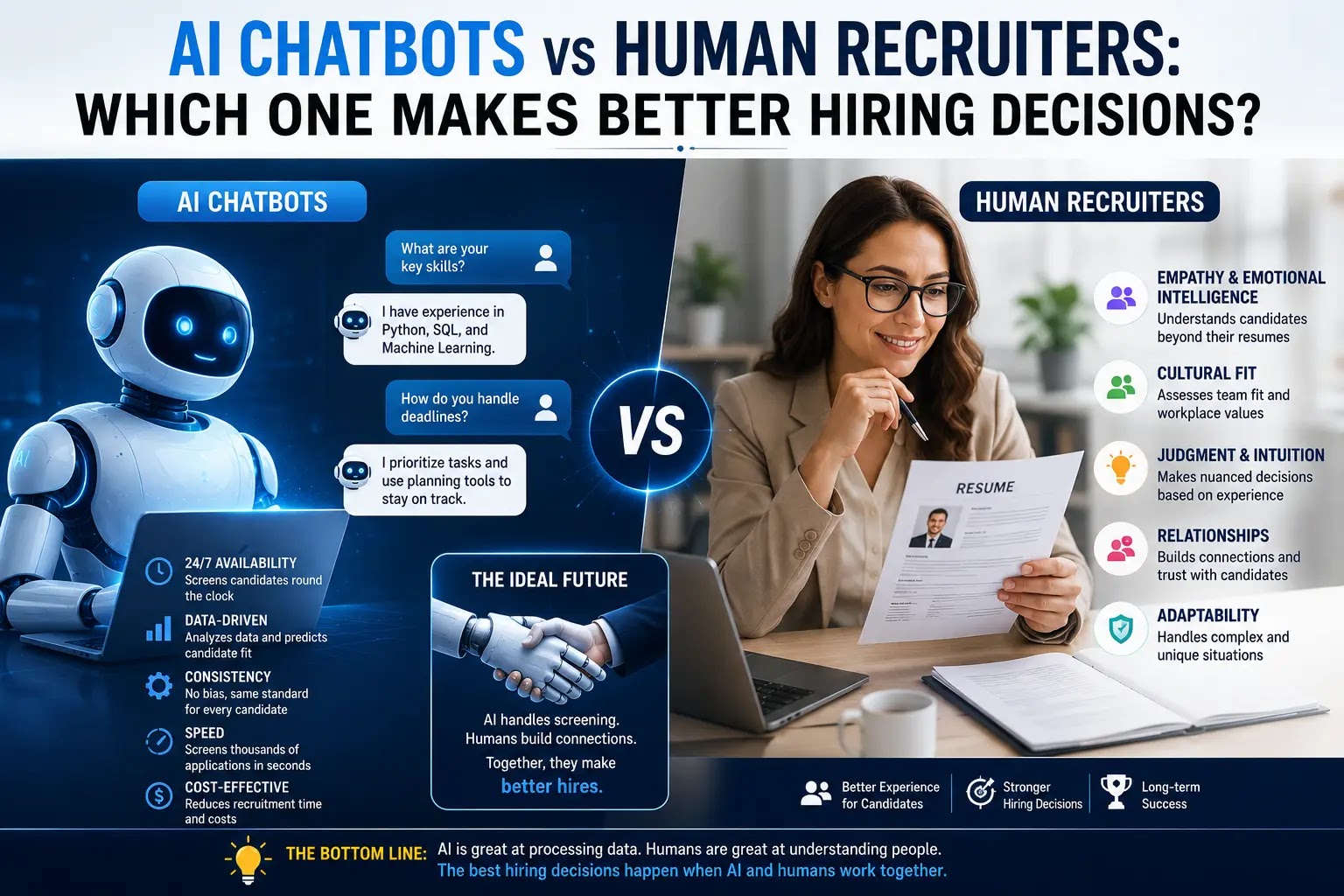
Imagine applying for your dream job and never speaking to a single human being during the entire screening process. No phone call, no informal chat, no chance to explain that gap in your resume — just a chatbot asking you structured questions and an algorithm deciding whether you make the cut. For millions of job seekers in 2026. Here is the complete guide on AI Chatbots vs. Human Recruiters.
AI-powered recruitment chatbots are now handling the first — and sometimes second — round of candidate screening at companies ranging from early-stage Indian startups to global Fortune 500 firms. Platforms like HireVue, Paradox (Olivia), iCIMS, and homegrown Indian solutions are processing hundreds of thousands of applications every day with minimal human involvement. The efficiency gains are real and measurable. But so are the concerns about fairness, bias, and whether a machine can truly evaluate human potential.
This article takes an honest, evidence-based look at both sides: where AI chatbots genuinely outperform human recruiters, where human judgment remains irreplaceable, and what the rise of AI hiring means for job seekers in India and globally in 2026.
What AI Chatbots vs Human Recruiters
Before comparing AI to human recruiters, it helps to understand exactly what AI recruitment chatbots are designed to do. They are not general-purpose AI assistants — they are purpose-built screening tools trained specifically on hiring data.
A typical AI recruitment chatbot in 2026 handles tasks including: initial application acknowledgement and candidate engagement, screening questions based on job requirements, scheduling interviews automatically, answering candidate questions about the role and company, collecting structured data about qualifications and experience, and ranking or shortlisting candidates based on predefined criteria. The most advanced systems, like those powered by large language models, can also analyse tone and language patterns in written or video responses — though this capability remains controversial.
Where AI Chatbots Outperform Human Recruiters
There are specific dimensions where AI genuinely does the job better than a human recruiter — and acknowledging this honestly is important for both employers and job seekers.
Speed and Scale
A human recruiter can meaningfully review perhaps 50–100 applications per day before fatigue and cognitive overload start degrading the quality of their decisions. An AI chatbot can process 50,000 applications in the same timeframe with perfectly consistent energy and attention. For high-volume hiring — seasonal retail positions, large IT services firms hiring freshers, BPO companies recruiting at scale — this speed advantage is not just convenient, it is transformative. In India, where companies like TCS, Infosys, and Wipro hire tens of thousands of graduates annually, AI screening has become operationally essential.
Consistency and Standardisation
Human recruiters are inconsistent — not because they are bad at their jobs, but because they are human. A recruiter who has just interviewed an exceptional candidate will unconsciously rate the next candidate lower by comparison. A recruiter who is tired at 4 PM on a Friday makes different decisions than the same recruiter at 10 AM on Monday. AI chatbots ask every candidate the exact same questions in the exact same way and apply the same scoring criteria every single time. For roles where consistent evaluation of specific, measurable qualifications matters, this is a genuine advantage.
Availability and Candidate Experience
AI chatbots are available 24 hours a day, 7 days a week. A candidate in Guwahati applying for a role at a Bengaluru company at 11 PM gets an immediate, professional response rather than waiting until the next business day. Studies consistently show that candidates who receive fast responses to applications have significantly higher engagement and completion rates. In a competitive talent market, this responsiveness gives companies a measurable advantage in securing top candidates before competitors do.
Reducing Certain Types of Bias
Human recruiters carry unconscious biases — toward candidates from prestigious colleges, certain cities, specific names, or familiar communication styles. When properly designed, AI systems can evaluate candidates purely on their responses to standardised questions, blind to factors that should not affect hiring decisions. Several Indian companies have reported more diverse shortlists after implementing AI screening, particularly from tier-2 and tier-3 city candidates who might previously have been unconsciously filtered out.
Where Human Recruiters Outperform AI Chatbots
The limitations of AI in recruitment are significant — and in many cases, they are fundamental rather than technical problems that better algorithms will eventually solve.
Reading Context and Nuance
A human recruiter reading a resume with a two-year gap can ask: “I see you took time off — can you tell me about that?” and genuinely understand the answer. A candidate who left a job to care for an ill parent, launch a startup that ultimately failed, or deal with a health challenge deserves the opportunity to provide context. AI systems — even sophisticated LLM-powered ones — struggle to evaluate these contextual, human narratives with the nuance they deserve. They optimise for pattern matching, not for understanding human life.
Assessing Culture Fit and Interpersonal Skills
Some of the most important qualities in a new hire — curiosity, collaborative instinct, communication warmth, the ability to handle ambiguity gracefully — are extraordinarily difficult to quantify in a structured chatbot interaction. An experienced human recruiter can sense within minutes of a conversation whether someone will thrive in a specific team culture. This is not mysticism — it is pattern recognition built from thousands of human interactions, combined with genuine empathy and social intelligence that current AI systems do not possess.
Handling Unusual or Exceptional Candidates
AI systems are trained on historical data — which means they are optimised to identify candidates who look like successful hires from the past. This creates a systematic disadvantage for exceptional candidates who don’t fit historical patterns: the self-taught engineer without a formal degree, the career changer with unconventional experience, the candidate from an underrepresented background whose resume doesn’t match the template the system was trained on. Some of the most valuable hires a company ever makes are the ones that break the pattern — and AI is structurally poor at recognising them.
Building Relationships and Employer Branding
Recruitment is not just about finding the right candidate — it is also about representing the company positively to every person who applies. A skilled human recruiter, even when delivering a rejection, can leave a candidate with a positive impression of the company. An AI chatbot that abruptly ends an interaction after a candidate fails a screening question can permanently damage that person’s perception of the employer brand. In India’s tightly connected professional communities, this reputational impact spreads quickly through word of mouth and platforms like Glassdoor and LinkedIn.
The Bias Problem: AI Is Not Neutral
One of the most important and frequently misunderstood aspects of AI recruitment is the assumption that AI is objective. It is not. AI systems learn from historical hiring data — and if that historical data reflects biased human decisions (which it almost always does), the AI will learn and perpetuate those biases at scale. Amazon famously scrapped an AI recruiting tool in 2018 after discovering it systematically downgraded resumes that included the word “women’s” — because it had been trained on 10 years of predominantly male hires. Similar issues have been documented with systems that downgrade candidates from certain zip codes, universities, or language backgrounds.
In the Indian context, this is particularly significant. AI systems trained predominantly on hiring data from metro cities may systematically disadvantage candidates from smaller cities. Systems trained on data from large IT firms may be poorly suited for evaluating candidates for startups or non-tech roles. The bias is invisible, consistent, and scalable — which makes it significantly more dangerous than the inconsistent, visible bias of individual human recruiters.
How AI Chatbots Evaluate Candidates: What Job Seekers Need to Know
If you are applying for jobs in 2026, understanding how AI screening systems evaluate you is practically important. Here is what most systems look for:
- Keyword matching: Your responses are scanned for specific terms that match the job description. Use the exact language from the job posting naturally in your answers.
- Structured data completeness: Systems heavily weight whether you have filled in all fields completely. Incomplete profiles are often automatically deprioritised.
- Response quality signals: Advanced systems analyse response length, specificity, and structure. Vague, short answers score lower than detailed, specific ones.
- Qualification thresholds: Hard filters — years of experience, specific certifications, location — are applied as binary pass/fail criteria before any nuanced evaluation occurs.
- Engagement timing: Some systems track how quickly you respond to chatbot prompts, treating faster responses as a positive signal of interest.
The 2026 Reality: Hybrid Is Winning
The most effective recruitment processes in 2026 are not purely AI-driven or purely human-driven — they are hybrid systems that use AI for what it does best and humans for what they do best. The emerging standard looks like this: AI handles initial screening, scheduling, and candidate communication at scale; humans conduct meaningful interviews with shortlisted candidates; AI provides structured data and scoring to inform (but not replace) human judgment; and human recruiters make final hiring decisions with full accountability for the outcome.
Companies that have gone fully AI-driven in their hiring have frequently reported higher efficiency but lower quality of hire in roles requiring strong interpersonal skills, creativity, or cultural fit. Companies that have resisted AI entirely are struggling with the volume and speed demands of modern hiring. The hybrid model is not a compromise — it is a recognition that AI and human judgment are genuinely complementary rather than competitive.
What This Means for Job Seekers in India
For Indian job seekers navigating this landscape, a few practical implications stand out. First, optimise for AI screening without losing your human voice — use relevant keywords from job descriptions, fill every field completely, and give specific, detailed answers to screening questions. Second, understand that getting past the AI is just the first step — the human interview that follows requires a completely different set of skills. Third, if you suspect you have been unfairly filtered by an AI system, many companies now have human review processes for candidates who request reconsideration — ask for it. Fourth, build your professional presence on LinkedIn comprehensively, since many AI screening systems pull public profile data as part of their evaluation.
Conclusion
Neither AI chatbots nor human recruiters are universally better at making hiring decisions — they are better at different things. AI wins on speed, scale, consistency, and availability. Humans win on nuance, relationship-building, contextual judgment, and the ability to recognise exceptional candidates who break the pattern. The companies getting recruitment right in 2026 are those that have figured out how to combine both intelligently — using AI to handle volume efficiently while preserving meaningful human judgment where it matters most. For job seekers, the practical takeaway is clear: learn how AI screening systems work, optimise your applications accordingly, and save your human best for the conversations that matter.
Before we answer some frequently asked questions, you may also find these guides helpful:
What Certifications Actually Help You Get an AI Job in 2026? Complete Guide for India
10 AI Jobs That Indian Companies Are Desperately Hiring For in 2026
Frequently Asked Questions (FAQ)
Do recruiters use AI bots?
Yes, many recruiters use AI bots to automate resume screening, schedule interviews, answer candidate questions, and identify qualified applicants. AI helps recruiters save time, but final hiring decisions are typically made by human recruiters.
What is the difference between AI chatbots and humans?
AI chatbots provide instant responses, work 24/7, and handle repetitive tasks efficiently. Humans offer emotional intelligence, critical thinking, creativity, and the ability to understand complex situations. Together, they often provide the best customer or recruitment experience.
What is the difference between recruiters and AI?
Human recruiters evaluate soft skills, cultural fit, and interpersonal qualities that AI may not fully understand. AI focuses on automating repetitive tasks such as resume screening, candidate matching, interview scheduling, and initial communication, making the hiring process faster and more efficient.
What 3 jobs will not be replaced by AI?
Jobs requiring creativity, emotional intelligence, and complex decision-making are less likely to be replaced by AI. Examples include psychologists, teachers, healthcare professionals, senior managers, and creative professionals such as designers and writers.
Which AI tool is best for recruiters?
Popular AI recruiting tools include LinkedIn Recruiter AI, HireVue, Paradox Olivia, Eightfold AI, and ChatGPT. The best choice depends on whether you need candidate sourcing, resume screening, interview automation, or recruitment analytics.
How are recruiters using AI?
Recruiters use AI to source candidates, screen resumes, rank applicants, schedule interviews, generate job descriptions, answer candidate questions, and analyze recruitment data. This reduces manual work and improves hiring efficiency.
Which ATS is used in India?
Several Applicant Tracking Systems (ATS) are widely used in India, including Zoho Recruit, Freshteam, Darwinbox, Greenhouse, Workday, and Lever. The right ATS depends on the company’s size, hiring volume, and recruitment needs.
Can AI chatbots replace human recruiters?
AI chatbots can automate repetitive recruitment tasks such as resume screening, interview scheduling, and answering candidate questions. However, human recruiters remain essential for evaluating soft skills, building relationships, negotiating offers, and making final hiring decisions.
Are AI chatbots better than human recruiters?
AI chatbots are better at handling repetitive, high-volume tasks quickly and consistently. Human recruiters are better at assessing personality, cultural fit, emotional intelligence, and complex hiring decisions. Most organizations benefit from using both together.
What are the benefits of AI chatbots in recruitment?
AI chatbots improve recruitment by providing 24/7 candidate support, reducing response times, automating interview scheduling, screening resumes, answering common questions, and helping recruiters focus on high-value hiring activities.
What are the limitations of AI chatbots in hiring?
AI chatbots may struggle to understand emotions, evaluate cultural fit, detect nuanced communication, and handle unusual situations. They also depend on the quality of their training data and should be used alongside human recruiters.
Should companies use AI chatbots and human recruiters together?
Yes, combining AI chatbots with human recruiters creates a more efficient hiring process. AI handles repetitive administrative tasks, while recruiters focus on interviews, relationship building, and making informed hiring decisions. This hybrid approach often delivers the best recruitment outcomes.