OpenAI is one of the most sought-after employers in the world right now. With ChatGPT changing how billions of people work, study, and create, landing a job at OpenAI has become the dream of countless engineers, researchers, and product thinkers globally — including in India. But what does the OpenAI interview process actually look like in 2026? How many rounds are there? What do they test? And what separates the candidates who get in from the ones who don’t?
This guide breaks it all down — from the moment you submit your application to the day you (hopefully) receive an offer. Whether you’re a software engineer in Bengaluru, a product manager in Mumbai, or an ML researcher anywhere in the world, this is the most complete and up-to-date walkthrough of the OpenAI hiring process you’ll find.
OpenAI isn’t just another tech company. It’s the organization behind ChatGPT, GPT-4o, DALL·E, Sora, and some of the most impactful AI research in history. Getting hired here means joining a team that is actively shaping the future of artificial intelligence — and that comes with an exceptionally high bar for talent.
Why OpenAI Is One of the Hardest Companies to Get Into
OpenAI operates with a lean team philosophy. Despite being one of the most valuable AI companies in the world, it deliberately keeps headcount low and hires only exceptional people. Every candidate is expected to make a direct, measurable impact on building safe and beneficial artificial general intelligence. That’s not a marketing line — it’s embedded into how they interview and evaluate talent.
Competition is fierce. For engineering roles, thousands of applicants compete for a handful of spots. For research positions, most hires come from top universities or have published papers in major ML conferences like NeurIPS, ICML, or ICLR. Understanding this reality is step one in preparing seriously for the OpenAI interview process.
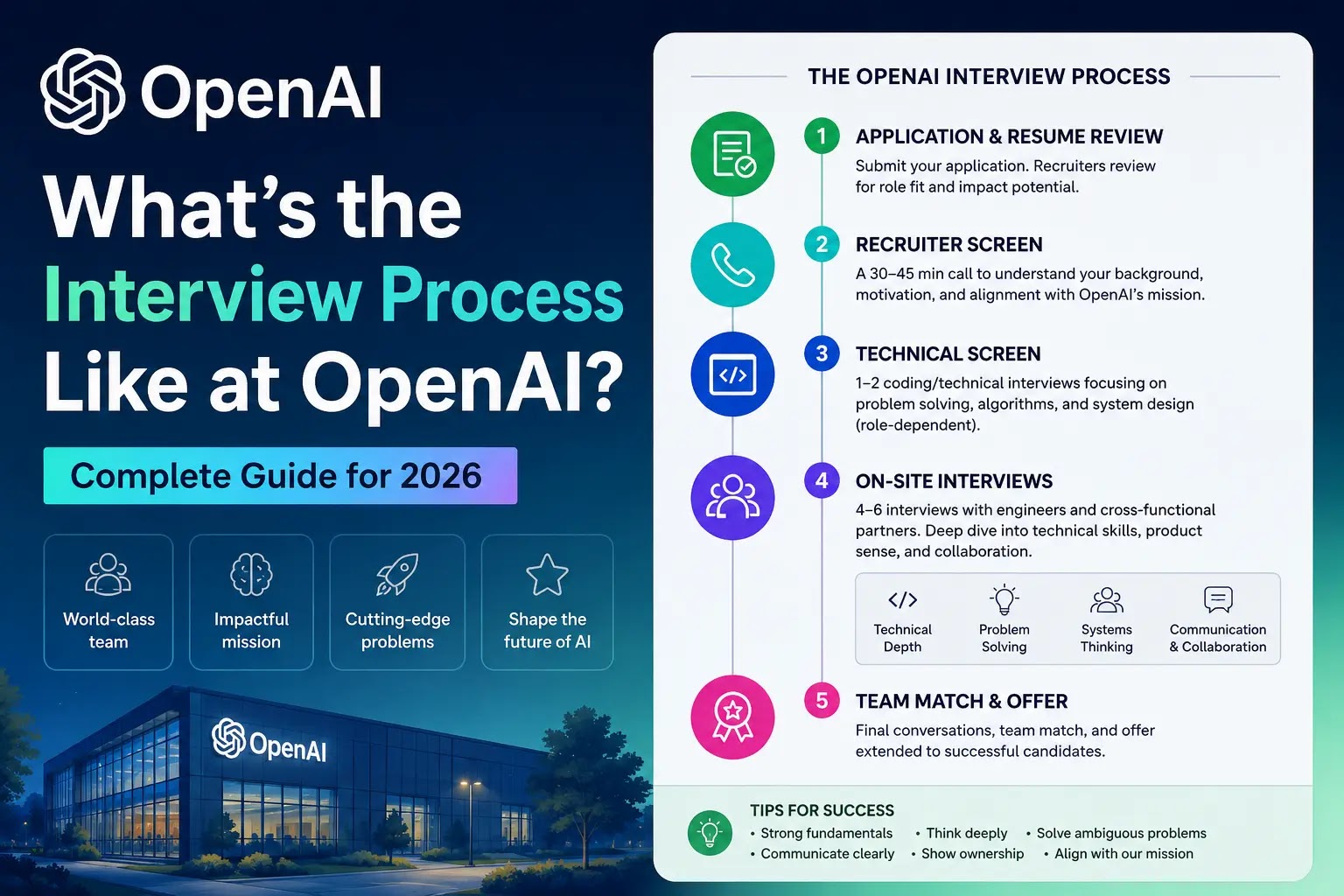
Step 1: Application and Résumé Review
The first step is submitting your application at openai.com/careers. OpenAI’s recruiting team typically takes about one week to review résumés and respond. The process is selective from the very first step — a generic résumé will not get through.
To stand out at this stage:
- Tailor your résumé specifically to the role you’re applying for
- Highlight measurable impact — not just job duties, but outcomes (e.g., “reduced latency by 40%”)
- Include relevant open-source contributions, GitHub projects, or research papers
- Demonstrate familiarity with OpenAI’s products and mission
- For ML/AI roles, publications or novel projects carry significant weight
Step 2: Recruiter / Introductory Call
If your résumé clears the initial review, a recruiting coordinator will reach out to schedule an introductory call — usually 20–30 minutes. This is not a casual chat. It’s an evaluative conversation from the first minute.
You’ll be expected to clearly articulate:
- Why OpenAI specifically — “AI is the future” won’t cut it. You need a specific, authentic reason tied to OpenAI’s work, mission, or products
- Your relevant experience — Not a résumé walkthrough, but a compelling narrative that maps your background to the specific role
- Your unique edge — What do you bring that others don’t? This requires genuine self-awareness
The recruiter also uses this call to answer your questions and set expectations for the rounds ahead.
Step 3: Skills-Based Assessment
Within a week of the intro call, OpenAI shares details about a skills-based assessment. This varies significantly by role:
- Software Engineers: Pair coding interviews, take-home coding projects, or timed technical tests
- ML/Research Engineers: Deep learning concepts, model design, mathematical reasoning
- Product Managers: Product sense questions focused on AI capabilities, market rollout strategy, and ethical considerations
- Operations/GTM roles: Case studies, analytical exercises, or writing tasks
You may be asked to complete more than one assessment depending on the role. OpenAI provides prep guidance to help candidates succeed — take it seriously and use it.
Step 4: Final Interview Loop (The Main Event)
This is the most intensive stage of the OpenAI interview process. Candidates who make it here typically go through 4–6 hours of final interviews with 4–6 people, conducted over 1–2 days. Interviews are virtual by default, but candidates may choose to interview onsite in San Francisco.
What to expect in the final loop:
- Technical depth: Interviews are designed to push you beyond your comfort zone. For engineering roles, expect questions on system design, algorithm optimization, code quality, and test coverage
- Behavioral/leadership rounds: OpenAI evaluates collaboration, communication, and how you approach ambiguous problems
- Mission alignment: A unique component where they assess whether you genuinely understand and care about AI safety and beneficial AI development
- Strategy thinking (for PMs): Not theoretical frameworks — actual opinions on product strategy and what you’d genuinely do
For all roles, OpenAI values clear problem-solving explanations. Walking through your reasoning aloud, considering trade-offs, and showing intellectual honesty when you’re uncertain are all things interviewers look for.
Step 5: Decision and Offer
After final interviews, you should expect to hear back within one week. Your recruiter may request references at this stage. If selected, you’ll receive a compensation package that is widely regarded as among the most competitive in the industry.
If you don’t get an offer, OpenAI recruiters generally provide feedback and candidates can reapply after a cooling period. Many successful hires took multiple attempts before landing the role.
Can You Get Into OpenAI Without a PhD?
Yes — but it requires exceptional alternative credentials. OpenAI values talent from diverse educational backgrounds, including self-taught individuals. However, for research and ML engineering roles, most hires have advanced degrees or a track record of notable technical work that substitutes for one.
For non-ML roles — such as software engineers focused on infrastructure, backend systems, or full-stack development — a PhD is generally not expected. Strong coding performance and system design skills matter more here. OpenAI also offers a Residency program (6 months, full salary) for brilliant researchers transitioning from fields like mathematics, physics, or neuroscience who want to move into AI.
OpenAI Emerging Talent: The Entry-Level Path
OpenAI’s Emerging Talent program is the primary entry point for early-career candidates. It offers internships, residencies, and full-time roles for people with 0–3 years of experience across research, engineering, and product. Applications are competitive, but this is a realistic and structured pathway for students and recent graduates aiming to break into the world’s top AI organization.
Tips to Stand Out as an Indian Candidate
OpenAI is increasingly focused on India as a key market and talent source. Here’s how Indian candidates can position themselves effectively in the OpenAI interview process:
- Build and publish open-source ML projects on GitHub with real, clear documentation
- Contribute to established AI/ML repositories or write research-quality technical blog posts
- Compete in Kaggle competitions and aim for top rankings in notable challenges
- Read OpenAI’s published research papers — especially those relevant to the team you’re targeting
- Prepare to discuss AI ethics and safety with genuine nuance, not rehearsed talking points
- Use ChatGPT actively in your own workflow — and be able to articulate specific, insightful observations about its capabilities and limitations
- Practice mock interviews in English, focusing on articulating your thought process clearly
How Long Does the Entire OpenAI Hiring Process Take?
From application submission to offer, the OpenAI hiring process typically takes 4–8 weeks. Each stage has roughly a 1-week turnaround for feedback. The timeline can vary for specialized research roles, which sometimes move faster due to urgent team needs, or slower due to the depth of evaluation required.
OpenAI Salary and Compensation in 2026
OpenAI is known for offering some of the highest compensation packages in the tech industry. Software engineers at mid-to-senior levels typically see total compensation well above industry medians, including base salary, equity (profit participation units), and performance bonuses. For research scientists, compensation can be significantly higher. The OpenAI Residency pays $18,333 per month. For Indian candidates relocating to the US, visa sponsorship and relocation support are commonly provided for qualified roles.
Final Thoughts
The OpenAI interview process is rigorous, but it’s fair. Every stage is designed to evaluate genuine capability — not just your ability to memorize interview scripts. The best preparation isn’t grinding LeetCode for six months in isolation. It’s building real things, engaging deeply with AI systems, thinking seriously about the future of the field, and being able to communicate your thinking with clarity and honesty.
If OpenAI is your dream employer, start preparing now — read their research, use their products with a critical eye, build projects that demonstrate your skills, and engage with the broader AI community. The path is hard, but it’s well-defined for those willing to walk it seriously.
Before we answer some frequently asked questions, you may also find these guides helpful:
https://blog.rindax.com/2026/06/how-to-avoid-bias-in-ai-powered-hiring.html
How Recruiters Use AI to Screen Applications in India in 2026: What Every Job Seeker Must Know
Frequently Asked Questions (FAQ)
How many rounds of interview does OpenAI have?
The OpenAI interview process typically includes multiple rounds, such as an initial recruiter screening, technical or role-specific assessments, behavioral interviews, and final interviews with hiring managers or team members. The exact number of rounds depends on the position and level of experience.
How hard is the OpenAI interview process?
The OpenAI interview process is considered challenging because it evaluates technical expertise, problem-solving skills, communication, collaboration, and alignment with the company’s mission. Candidates are expected to demonstrate both strong technical knowledge and practical experience.
How long does OpenAI take to respond to an interview?
Response times vary depending on the role and hiring stage. Some candidates receive feedback within a few days, while others may wait several weeks. The timeline can also depend on the number of applicants and the interview schedule.
What are the 4 stages of the interview process?
The four common stages of an interview process are application screening, recruiter interview, technical or role-specific interviews, and final interviews or hiring decisions. Some roles may include additional assessments or practical exercises.
Does a 2nd interview mean I got the job?
No, a second interview does not guarantee a job offer. However, it usually indicates that you are a strong candidate and the employer wants to evaluate your skills, experience, and cultural fit in greater detail.
What is the 30-60-90 rule in an interview?
The 30-60-90 rule refers to a plan outlining what a new employee aims to accomplish during the first 30, 60, and 90 days of a job. Interviewers may ask candidates to explain how they would approach learning, contributing, and achieving goals during this period.
What is a red flag in a job interview?
Common interview red flags include poor communication, lack of preparation, negative comments about previous employers, inconsistent answers, dishonesty, and an inability to explain past work or accomplishments clearly.
What are the 5 C’s of interviewing?
The five C’s of interviewing are confidence, communication, competence, curiosity, and cultural fit. Demonstrating these qualities helps candidates create a positive impression and improve their chances of success.
Is a 30-minute interview good or bad?
A 30-minute interview is generally normal and does not indicate success or failure. The duration depends on the role, interview format, and the questions being discussed. What matters most is the quality of the conversation rather than its length.
Is a short interview a red flag?
Not necessarily. A short interview may simply mean the interviewer gathered the information they needed quickly. However, if the discussion feels rushed or lacks meaningful interaction, it could indicate that the role or candidate is not the right fit.
What questions are asked in an OpenAI interview?
OpenAI interviews often include questions about problem-solving, system design, machine learning, coding, AI concepts, previous projects, teamwork, and behavioral scenarios. Candidates may also be asked to explain their reasoning and decision-making process.
How can I prepare for an OpenAI interview?
Prepare by practicing coding problems, reviewing machine learning and AI concepts, studying system design, understanding OpenAI’s products and mission, and practicing behavioral interview questions using real examples from your experience.
Does OpenAI ask coding questions?
Yes, technical roles at OpenAI usually include coding assessments and algorithm-based questions. Candidates may also be evaluated on system design, debugging, optimization, and practical software engineering skills.
What skills does OpenAI look for in candidates?
OpenAI looks for strong technical skills, problem-solving ability, effective communication, collaboration, curiosity, and a genuine interest in artificial intelligence. Practical experience and the ability to learn quickly are also highly valued.
How long is the OpenAI hiring process?
The OpenAI hiring process can take anywhere from a few weeks to several months, depending on the position, interview stages, and scheduling. The timeline varies based on the role and hiring requirements.
Is it difficult to get hired at OpenAI?
Yes, getting hired at OpenAI is competitive because the company receives applications from highly qualified candidates worldwide. Strong technical expertise, relevant experience, and excellent communication skills can significantly improve your chances of success.