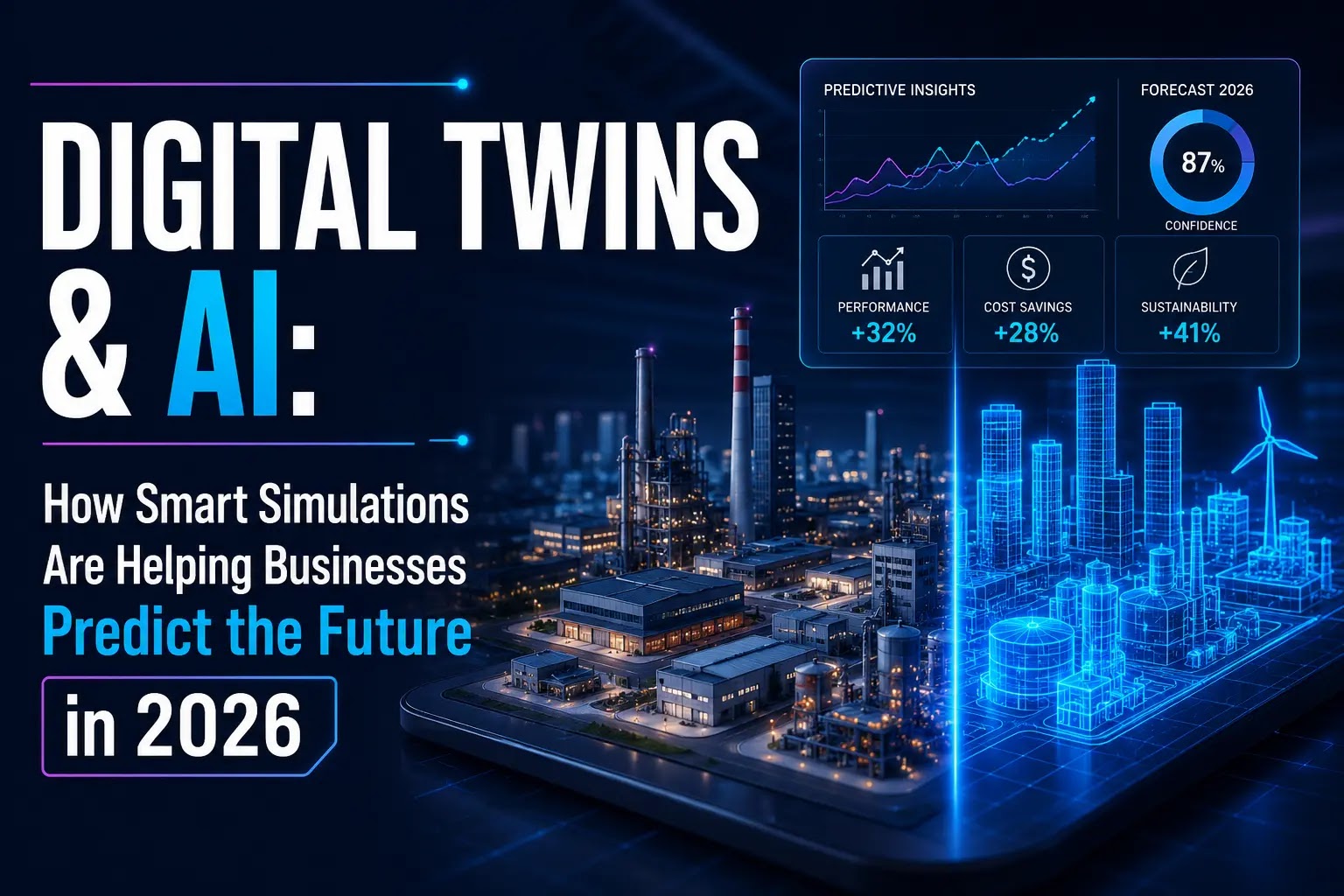
Imagine being able to create an exact virtual copy of your factory, hospital, city, or supply chain — and then run thousands of simulations to predict failures, optimize operations, and test new strategies, all without touching the real world. That’s exactly what Digital Twins and AI are doing for businesses in 2026.
Digital Twins have evolved from a futuristic concept into a mainstream business tool. According to a 2026 market report, the global AI-powered simulation and Digital Twin market was valued at $3.88 billion in 2024 and is projected to reach $62.16 billion by 2034, growing at a CAGR of over 30%. Already, 75% of enterprises are investing in digital twin technology, and 92% report ROI above 10%.
In this post, we’ll break down what Digital Twins are, how AI supercharges them, which industries are being transformed, and what businesses need to know to stay ahead in 2026.
What Is a Digital Twins and AI?
A Digital Twin is a real-time virtual replica of a physical object, process, system, or environment. It mirrors the real-world counterpart by continuously ingesting data from sensors, IoT devices, and external feeds — and uses AI and machine learning to simulate, predict, and optimize behavior.
There are three main types of Digital Twins:
- Product Digital Twins – Virtual models of individual products or components (e.g., a jet engine or medical device)
- Process Digital Twins – Simulations of workflows and production processes
- System Digital Twins – Large-scale models of entire systems (e.g., a smart city, power grid, or supply chain)
What makes 2026 different is the integration of Autonomous Digital Twins — AI-driven virtual models that don’t just monitor reality but actively make decisions, self-optimize, and initiate corrective actions without human intervention.
How AI Powers Digital Twins
Traditional Digital Twins were essentially smart dashboards — they showed you what was happening. AI-powered Digital Twins go several steps further:
- Predictive Analytics – AI models analyze historical and real-time data to forecast failures before they happen
- Machine Learning – Twins continuously learn from new data and improve their accuracy over time
- Generative AI – Introduced in 2024, GenAI allows twins to simulate complex “what-if” scenarios instantly
- Edge Computing + 5G – Enables real-time data processing with ultra-low latency for autonomous decision-making
- Natural Language Interfaces – Operators can now query their digital twin in plain language and get actionable insights
The result? Businesses can now predict the future — not perfectly, but with significantly higher accuracy than ever before.
Real-World Industry Use Cases of Digital Twins and AI in 2026
1. Manufacturing
Manufacturing is the leading sector, accounting for 29.10% of the global Digital Twin market. In January 2026, at CES Las Vegas, Siemens, PepsiCo, and NVIDIA announced a landmark collaboration where PepsiCo deployed Siemens Digital Twin Composer (built on NVIDIA Omniverse) at a Gatorade manufacturing plant. The result? A 20% increase in throughput within just 3 months and an estimated 10–15% reduction in capital expenditure (CAPEX).
Across the industry, digital twins are helping manufacturers:
- Detect equipment failures before they occur (predictive maintenance)
- Compress design cycles from months to days
- Identify up to 90% of issues before making any physical changes
- Reduce operating costs by 18–28%
2. Healthcare
Healthcare is the fastest-growing sector for Digital Twins, with a projected CAGR of 35.76% through 2029. AI-powered patient digital twins simulate individual responses to treatments, enabling personalized medicine at scale. Hospitals use process twins to optimize resource allocation, manage patient flow, and simulate emergency scenarios — reducing bottlenecks and improving care outcomes.
3. Energy & Smart Grids
Energy companies like Siemens are deploying autonomous twins to optimize power grid performance, balance renewable energy sources, and predict outages before they cascade. Digital twins help energy operators run thousands of grid simulations per day, improving grid resilience and reducing energy waste significantly.
4. Smart Cities
Cities around the world are building Digital Twins of their entire urban infrastructure — traffic systems, water networks, buildings, and public services. These city-scale twins help urban planners simulate the impact of new policies, manage disaster response, and optimize infrastructure investment before committing a single dollar of public funds.
5. Logistics & Supply Chain
Post-pandemic supply chain disruptions made it clear that reactive management is no longer enough. Digital Twins allow logistics companies to simulate disruptions (port delays, demand spikes, geopolitical events) and automatically reroute shipments or adjust inventory levels in real time — moving supply chain management from reactive to proactive.
6. Construction & Real Estate
Builders use digital twins of structures to monitor structural integrity, energy consumption, and maintenance needs throughout a building’s lifecycle. Smart buildings equipped with digital twins can automatically adjust heating, cooling, and lighting systems to reduce energy costs by up to 30%.
The Business Case: Why Companies Are Investing Now
The numbers speak for themselves. As of 2026:
- 64% of manufacturers have planned or active digital twin deployments
- 92% of companies report ROI above 10% from digital twin investments
- 30% increase in adoption expected among Fortune 500 companies this year
- Digital twins can reduce operating costs by 18–28% and accelerate root-cause analysis by nearly 50%
- Most organizations achieve ROI in less than one year
Beyond cost savings, digital twins unlock innovation velocity. Companies can test new products, processes, or strategies in the virtual world at near-zero cost, then implement only what works in the physical world. This dramatically reduces the risk of costly failures.
Autonomous Digital Twins: The Next Frontier
The most exciting development in 2026 is the rise of Autonomous Digital Twins — AI systems that don’t just advise humans but actively make operational decisions. These twins can:
- Schedule maintenance work orders automatically when a sensor anomaly is detected
- Adjust production parameters in real time to maintain quality standards
- Reroute supply chain flows when disruptions are predicted
- Recommend treatment adjustments for patients based on real-time vital signs
According to futurist Ian Khan’s Top 50 Technology Trends 2026 Report, autonomous digital twins are shifting organizations from reactive monitoring to proactive, intelligent management — a fundamental change in how businesses operate. In the next 12 months, experts predict autonomous twins will handle up to 20% of routine operational decisions in early-adopter organizations, freeing human teams to focus on strategic, high-value work.
Challenges and Risks to Watch
Despite the enormous opportunity, implementing Digital Twins comes with real challenges:
- Data Quality – 54% of organizations cite data quality and availability as the primary barrier to adoption
- Cybersecurity – Interconnected twins create larger attack surfaces; a breach of the virtual twin could potentially affect the physical system
- High Initial Costs – Enterprise-grade twin infrastructure requires significant upfront investment in sensors, connectivity, and cloud platforms
- Skills Gap – Organizations need professionals who understand both domain expertise (engineering, healthcare) and AI/data systems
- Ethical Governance – Especially in healthcare and critical infrastructure, autonomous decision-making requires robust oversight frameworks
Businesses are advised to start with pilot projects in high-impact areas (like predictive maintenance) to demonstrate value before scaling enterprise-wide deployments.
How to Get Started with Digital Twins in 2026
If you’re a business leader exploring Digital Twins, here is a practical roadmap:
- Define the use case – Start with a specific, high-value problem (e.g., reducing machine downtime in one production line)
- Audit your data infrastructure – Digital twins are only as good as the data feeding them; assess your IoT and sensor coverage
- Choose the right platform – Leading platforms include NVIDIA Omniverse, Siemens Xcelerator, Microsoft Azure Digital Twins, and AWS IoT TwinMaker
- Start small, scale fast – Run a 90-day pilot, measure ROI, and use the results to build internal business cases for wider adoption
- Invest in talent – Upskill your team in AI, IoT, and digital twin tools; consider partnerships with technology vendors who offer managed services
- Build governance frameworks – Especially for autonomous decision-making, establish clear rules for when humans must be in the loop
Key Platforms and Tools Leading the Market
- NVIDIA Omniverse – Industry standard for physics-accurate industrial digital twins
- Siemens Xcelerator / Digital Twin Composer – Widely used in manufacturing and energy
- Microsoft Azure Digital Twins – Cloud-native platform for building scalable twin infrastructure
- AWS IoT TwinMaker – Amazon’s solution for building real-world digital twins from IoT data
- GE Digital (Predix) – Industrial IoT platform with strong digital twin capabilities for energy and aviation
Conclusion: The Future Is Already Being Simulated
In 2026, Digital Twins are no longer a futuristic experiment — they are a competitive necessity. Businesses that embrace AI-powered virtual replicas gain the ability to predict the future, reduce risk, cut costs, and innovate at unprecedented speed. Those that delay risk falling behind in efficiency, resilience, and customer experience.
The question is no longer whether to implement Digital Twins — it’s how fast you can do it. The companies that move first will set the standard that others must scramble to match.
Start your digital twin journey today — the future of your business may depend on simulating it first.
Before we answer some frequently asked questions, you may also find these guides helpful:
What Is Answer Engine Optimization (AEO)? The Complete Guide for Businesses
Multimodal AI Explained: How AI That Sees, Hears, and Reads Is Transforming Businesses in 2026
Frequently Asked Questions (FAQ)
Are digital twins related to AI?
Yes, digital twins are closely related to AI. A digital twin is a virtual model of a physical object or system, while AI analyzes the data collected from the digital twin to predict outcomes, detect problems, and optimize performance in real time.
What are the 4 types of digital twins?
The four main types of digital twins are component twins, asset twins, system twins, and process twins. These represent individual parts, complete assets, interconnected systems, and entire business or industrial processes.
How to make digital twins with AI?
To create a digital twin with AI, first collect real-time data from sensors or IoT devices, build a virtual model of the physical object, integrate AI algorithms to analyze the data, and continuously update the model to monitor performance and predict future outcomes.
Is AI a mandatory component for digital twins?
No, AI is not a mandatory component of a digital twin. A digital twin can function by using real-time data and simulations alone. However, adding AI makes it more intelligent by enabling predictive maintenance, automated decision-making, and advanced analytics.
Who is the father of digital twins?
Dr. Michael Grieves is widely recognized as the father of the digital twin concept. He introduced the idea in 2002 to improve product lifecycle management through virtual representations of physical assets.