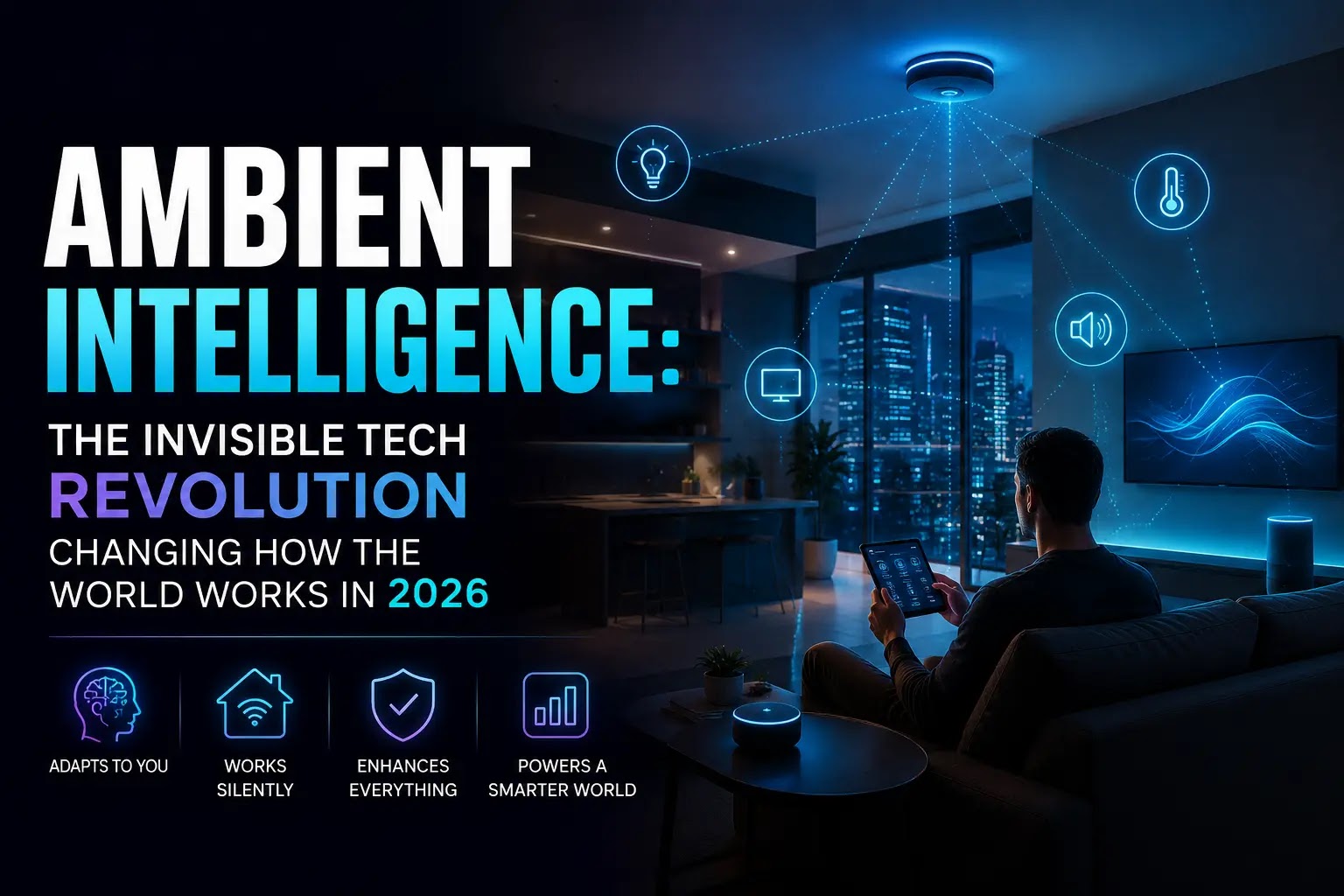
What if the most powerful technology in 2026 is one you never have to touch, tap, or talk to? Welcome to the era of Ambient Intelligence (AmI) — a revolutionary shift where smart technology fades silently into your environment, anticipating your needs and responding before you even ask.
Unlike traditional AI that requires you to open an app, type a command, or click a button, ambient intelligence is embedded into your surroundings — in walls, lights, hospital ceilings, factory floors, and retail stores. It observes, learns, and acts automatically. The global ambient intelligence market was valued at $28.65 billion in 2024 and is projected to reach $182.23 billion by 2032, growing at a staggering CAGR of 26%.
If you haven’t heard of it yet, you’re about to. Because this invisible tech revolution is already happening — and it will change how businesses operate, how cities function, and how people live.
What Is Ambient Intelligence? A Simple Explanation
Ambient Intelligence refers to electronic environments that are sensitive, adaptive, and responsive to the presence of people. Think of it as a room, building, or city that “thinks” — using sensors, edge AI, and interconnected devices to understand context and respond intelligently.
In practical terms, an ambient intelligent environment:
- Senses your presence, mood, and behavior through embedded sensors
- Processes that data locally using edge computing (near the source, not the cloud)
- Responds automatically — adjusting lighting, temperature, workflow, alerts, or services
- Learns from patterns over time to become smarter and more personalized
The key difference from older “smart home” or IoT tech? Ambient intelligence is proactive, contextual, and holistic. It doesn’t just respond to commands — it anticipates them. It doesn’t manage individual devices — it orchestrates entire environments.
Ambient Intelligence vs. Smart Home vs. Traditional AI
It’s easy to confuse Ambient Intelligence with smart home technology or general AI. Here’s a clear breakdown:
How Does Ambient Intelligence Actually Work?
Ambient Intelligence is powered by a combination of several cutting-edge technologies working together:
1. Sensor Networks
Tiny, inexpensive sensors embedded in floors, walls, ceilings, clothing, and equipment continuously collect data — motion, temperature, sound, light, biometrics, and more. The falling cost of sensors is a major growth driver for this technology.
2. Edge Computing
Rather than sending all data to a distant cloud server, edge computing processes information locally — right where it’s collected. This enables near-instant responses with ultra-low latency, which is critical for real-time ambient environments.
3. AI and Machine Learning
AI models embedded at the edge analyze sensor data, recognize patterns, and make decisions. Over time, they learn user behaviors and optimize responses accordingly — getting smarter without human intervention.
4. Spatial Computing and Digital Twins
Ambient intelligence systems often use digital twins — virtual replicas of physical spaces — to simulate and optimize environments before changes are deployed in the real world.
5. Interoperability Protocols
For an entire environment to behave as one intelligent system, all devices and platforms must communicate seamlessly. Standardized protocols are enabling this at scale in 2026, reducing the fragmentation that slowed earlier IoT adoption.
Real-World Examples of Ambient Intelligence in 2026
🏥 Healthcare: The Ward That Watches Over You
Hospitals are among the biggest beneficiaries of ambient intelligence. Ceiling-mounted sensors monitor patient movement, breathing patterns, and even subtle signs of distress — without wires, wearables, or constant nurse check-ins. If a patient’s gait changes (indicating a fall risk) or their breathing rhythm shifts, the system alerts staff instantly. This reduces alarm fatigue, improves response times, and enhances patient dignity.
🏭 Manufacturing: Self-Optimizing Factories
In smart factories, ambient intelligence monitors worker ergonomics, machine performance, temperature, vibration, and energy usage simultaneously. If a machine shows signs of stress, it schedules its own maintenance before breaking down. This is the heart of Industry 5.0 — AI and humans co-existing in intelligent environments.
🛒 Retail: Stores That Respond to Shoppers
Retail stores embedded with ambient intelligence adjust lighting, music, temperature, and even shelf displays based on shopper flow patterns. No facial recognition, no personal tracking — just behavioral analytics at the aggregate level. The result: better shopping experiences, reduced energy costs, and increased conversions.
🏢 Smart Office Buildings
Offices in 2026 are becoming ambient-intelligent environments. The building knows when meeting rooms are truly occupied vs. just booked, adjusts HVAC and lighting accordingly, and reroutes foot traffic during peak hours. Energy savings from this alone can reach 30–40% in large commercial buildings.
🏙️ Smart Cities
Traffic systems, waste management, and public safety infrastructure in forward-thinking cities now operate through ambient intelligence layers. Streetlights brighten only when pedestrians are present. Waste bins signal when they need collection. According to research, ambient intelligence has a total potential global economic value creation of $4.21 trillion.
Key Industries Being Transformed by Ambient Intelligence
Ambient intelligence is not limited to one sector — its impact cuts across virtually every industry:
- Healthcare: Continuous passive monitoring, fall detection, remote patient care
- Manufacturing: Predictive maintenance, worker safety, production optimization
- Retail: Dynamic store environments, loss prevention, shopper experience
- Real Estate: Intelligent buildings that self-manage utilities and occupancy
- Transportation: Adaptive vehicles and airports that respond to passenger states
- Education: Classrooms that detect student engagement and adjust accordingly
- Agriculture: Smart farms using soil and weather sensors to optimize yields autonomously
Business Opportunities Unlocked by Ambient Intelligence
1. Environment-as-a-Service (EaaS)
Companies are beginning to monetize intelligent environments as a service — charging clients for outcomes (energy saved, incidents prevented, conversions improved) rather than selling hardware. This is a fundamentally new business model unlocked by ambient intelligence.
2. Competitive Moats Through Data
Organizations that deploy ambient systems earliest accumulate the richest environmental datasets — giving them AI training advantages that latecomers cannot replicate quickly.
3. Workforce Productivity Gains
By reducing cognitive load and automating environmental adjustments, ambient intelligence allows workers to focus on creative, high-value tasks. Early estimates suggest productivity gains of 15–25% in ambient-optimized workplaces.
4. Energy and Sustainability Goals
With rising energy costs and global ESG pressures, ambient intelligence offers a direct path to carbon reduction. Buildings managed by ambient AI consistently cut energy use by 20–40%, delivering measurable ROI alongside environmental impact.
Risks and Ethical Concerns to Consider
Like all powerful technologies, ambient intelligence comes with serious responsibilities:
- Privacy: Always-on sensing raises genuine surveillance concerns. Transparent design and opt-out mechanisms are essential.
- Security: A network of millions of sensors is a massive attack surface. Cybersecurity must be embedded at every level.
- Accountability: When an ambient system causes harm, responsibility must be clearly assigned across the stack.
- Equity: Access to ambient intelligence is not equal globally — there’s a real risk of widening the digital divide.
- Over-automation: Environments that are too prescriptive can reduce human agency and choice.
Best practice: deploy ambient intelligence with privacy-by-design principles — where transparency, user control, and data minimization are built in from the start.
What to Expect in the Next 12 Months
Based on current market momentum, here’s what the ambient intelligence landscape will look like through mid-2027:
- 📌 Standardized AmI frameworks will emerge, reducing integration complexity across industries
- 📌 Ambient-first workplace design will become a premium feature in new commercial construction
- 📌 Regulatory frameworks for always-sensing environments will be introduced across major economies
- 📌 Cross-industry partnerships between tech companies, real estate developers, and healthcare providers will accelerate
- 📌 SME-accessible ambient tools will emerge, making the technology viable for small and mid-size businesses
How to Get Started With Ambient Intelligence in Your Business
You don’t need to transform your entire operation overnight. Here’s a practical roadmap:
- Audit your environment: Identify 2–3 specific pain points where passive sensing could add value
- Start small: Pilot in one controlled space — a single floor, one factory zone, or a single store
- Choose interoperable platforms: Avoid proprietary silos and select systems using open standards
- Prioritize privacy architecture: Define your data governance policy before deploying sensors
- Measure outcomes: Track energy savings, incident reductions, or productivity gains from day one
Conclusion: The Invisible Is the Future
The next great leap in technology won’t look like a gadget or a screen. It will look like nothing — because it will be everywhere. Ambient Intelligence represents the most human-centric vision of AI yet: technology that serves you completely in the background, improving your life and your business without demanding your attention.
The companies, cities, and individuals who understand and embrace this shift early will be the ones who thrive in the next decade. The question is no longer if ambient intelligence will reshape your world — it’s how fast you’ll be ready for it.
Before we answer some frequently asked questions, you may also find these guides helpful:
How AI Is Transforming Cybersecurity in 2026: The Opportunities and Risks Every Business Must Know
Humanoid Robots at Work: How AI-Powered Robots Are Entering the Global Workplace in 2026
Frequently Asked Questions (FAQ)
What is ambient intelligence with an example?
Ambient intelligence is a technology that uses artificial intelligence, sensors, and connected devices to understand a person’s environment and respond automatically. For example, a smart home can detect when you enter a room and automatically turn on the lights, adjust the temperature, and play your preferred music.
What is the ambient AI concept?
Ambient AI is the idea of embedding artificial intelligence into everyday environments so it can work quietly in the background. It continuously collects information from sensors and devices to provide personalized, context-aware assistance without requiring constant user interaction.
Is ambient AI agentic AI?
Ambient AI and agentic AI are related but not the same. Ambient AI focuses on understanding the environment and providing seamless assistance, while agentic AI can make decisions, plan actions, and complete tasks independently to achieve specific goals.
What is AMI in AI?
AMI stands for Ambient Intelligence. It is an AI-driven environment where smart devices, sensors, and software work together to recognize user needs and automatically provide helpful services while remaining largely invisible to the user.
What are the 4 types of AI?
The four commonly recognized types of AI are reactive machines, limited memory AI, theory of mind AI, and self-aware AI. Most modern AI systems, including ChatGPT and Gemini, are classified as limited memory AI.