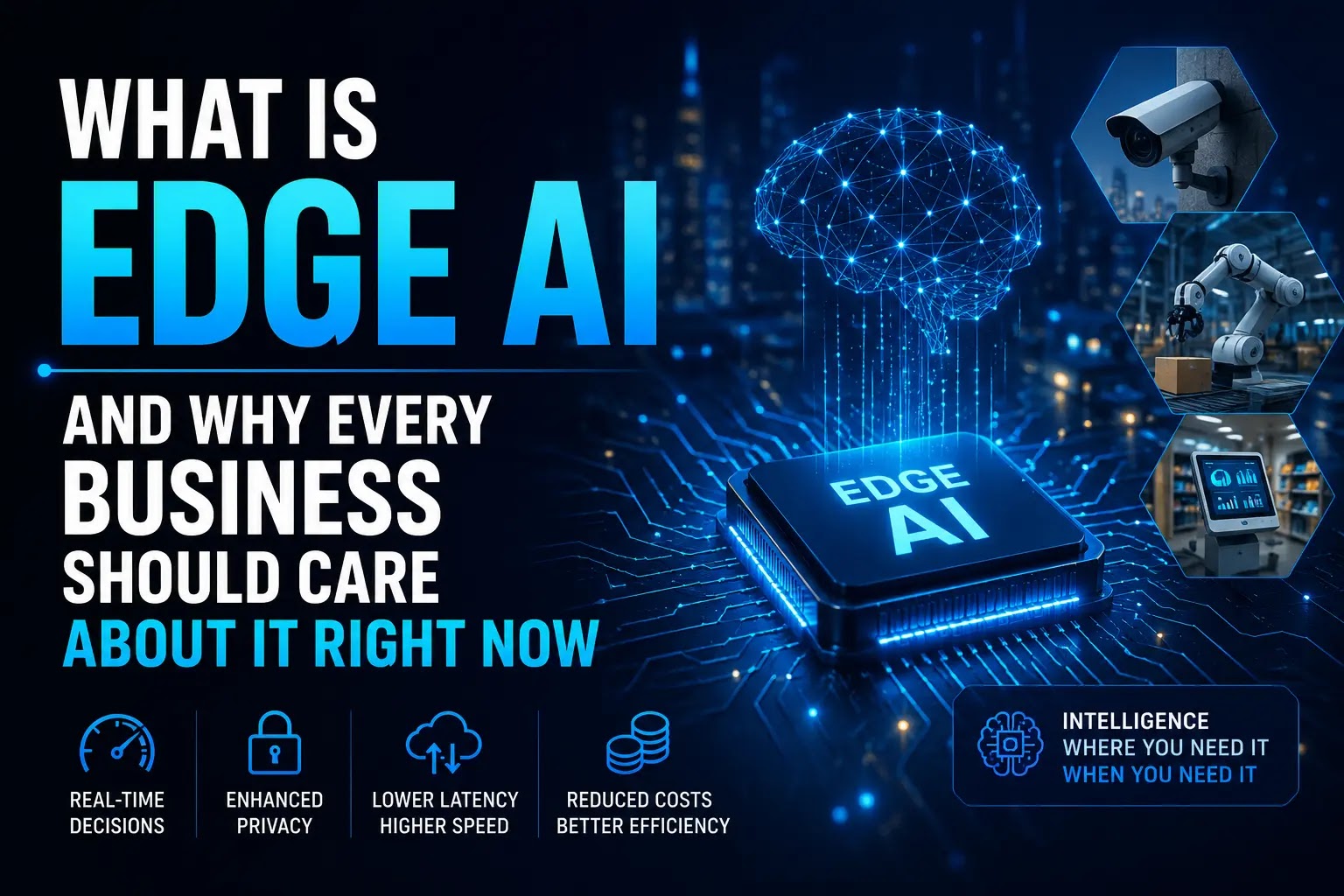
Artificial intelligence used to live far away — in massive data centers, humming servers, and cloud infrastructure owned by tech giants. You sent your data there, it got processed, and the result came back. That model worked fine for a while. But in 2026, businesses are discovering that “far away” is no longer fast enough, safe enough, or affordable enough. Enter Edge AI — a shift that is quietly rewriting how intelligent systems work and where they run.
Edge AI moves the intelligence closer to where data is created. Instead of sending everything to a remote cloud server, processing happens on-device — on a smartphone, a factory sensor, a retail camera, or a hospital monitor. The result is faster decisions, stronger privacy, and lower operating costs. For businesses of every size, understanding Edge AI is no longer optional. It is quickly becoming a competitive requirement.
This guide breaks down what Edge AI is, how it works, why it outperforms cloud-only approaches for specific tasks, and how your business can start thinking about it today.
What Is Edge AI?
Edge AI refers to artificial intelligence models that run directly on local devices or nearby hardware — the “edge” of a network — rather than in a centralized cloud. The term combines two concepts: edge computing (processing data near its source) and artificial intelligence (using machine learning models to analyse and act on that data).
A simple example: your smartphone’s face unlock feature does not send your face to Google or Apple’s servers every time you unlock your phone. The recognition model runs locally on the device’s dedicated AI chip. That is Edge AI in everyday use.
In a business context, Edge AI looks like this:
- A manufacturing plant’s robotic arm detecting defects in real time without waiting for cloud analysis
- A retail store’s smart camera tracking foot traffic and managing inventory on-site
- A hospital monitor alerting nurses to abnormal patient vitals instantly, without sending sensitive health data to external servers
- A bank’s fraud detection system flagging suspicious transactions at the point of origin
In each case, the intelligence is embedded where the action happens — not housed remotely and accessed over the internet.
How Edge AI Is Different from Cloud AI
To understand why Edge AI matters, it helps to see clearly how it differs from traditional cloud-based AI.
Latency: Milliseconds Matter
Cloud AI introduces a round-trip delay. Your device sends data to a server, the server processes it, and the result comes back. For a user in Southeast Asia querying a model hosted in a US data center, that network round-trip alone can add 150–300 milliseconds before any actual processing occurs. For applications where real-time response is critical — self-driving vehicles, industrial robotics, emergency medical alerts — that delay is unacceptable. Edge AI eliminates the network component entirely. Local inference on modern hardware runs in 50–200 milliseconds end-to-end.
Privacy and Data Security
Cloud AI requires transmitting data to external infrastructure. For businesses handling health records, financial data, biometric information, or proprietary manufacturing processes, this creates significant legal and regulatory exposure. Edge AI processes data locally. Raw data never leaves the device or the premises. Compliance teams can approve edge AI deployments far more simply — the data handling model is straightforward because the data stays in-house. The EU’s AI Act, now in effect, mandates rigorous audits for high-risk AI systems, and edge deployments satisfy these audits more readily by limiting data movement.
Cost at Scale
Cloud AI pricing is typically token- or usage-based. At low usage volumes, cloud costs are manageable. But as workloads scale — customer service applications, content generation pipelines, high-frequency analytics — the costs compound quickly. At 100 million tokens per month, cloud AI at standard pricing costs over $1,000 per month. Edge AI, once hardware is deployed, runs at a fraction of that cost. For high-volume, low-latency workloads, edge infrastructure can be 30–50% cheaper over a five-year horizon.
Connectivity Dependence
Cloud AI requires reliable internet connectivity. In remote manufacturing sites, offshore facilities, rural areas, or during network outages, cloud-dependent AI simply stops working. Edge AI operates independently of internet connectivity. It runs on local compute resources and continues functioning even when the network goes down.
Industries Where Edge AI Is Already Delivering Results
Healthcare
Patient monitoring systems use Edge AI to analyse vitals continuously and trigger alerts instantly. Medical imaging devices use on-device models for faster diagnostic support. The sensitivity of health data makes edge deployment especially attractive — patient information never needs to leave the hospital’s systems to benefit from AI analysis.
Manufacturing and Industrial Operations
Edge AI is transforming factory floors. Quality control cameras detect product defects in real time, rejecting faulty items before they leave the line. Predictive maintenance systems monitor equipment vibration, temperature, and performance data on-site, flagging failures before they cause downtime. Industrial robots make split-second adjustments without cloud round-trips.
Retail
Retail stores use Edge AI-powered cameras to track foot traffic, analyse customer movement patterns, monitor shelf inventory, and optimise energy use — all in real time, without sending camera feeds to external servers. This protects customer privacy and reduces cloud infrastructure costs simultaneously.
Financial Services
Banks and payment processors deploy Edge AI at transaction terminals to detect anomalous behaviour instantly. Fraud signals are caught at the point of origin, reducing exposure and meeting compliance requirements around local data handling.
Agriculture and Remote Operations
Smart agricultural sensors use Edge AI to monitor soil conditions, crop health, and weather patterns in fields with limited connectivity. Decisions about irrigation, fertilisation, and harvesting can be made locally without depending on cloud access.
What Hardware Does Edge AI Run On?
Edge AI runs on specialised hardware designed for efficient on-device inference. Key hardware categories include:
- Neural Processing Units (NPUs) — dedicated AI chips now built into most flagship smartphones and laptops (Apple Silicon, Qualcomm Snapdragon, Intel Core Ultra)
- Edge GPUs — compact graphics processors optimised for inference workloads in industrial and enterprise settings (NVIDIA Jetson series)
- FPGAs (Field-Programmable Gate Arrays) — flexible, low-power chips used in industrial and medical devices
- Microcontrollers with AI acceleration — ultra-low-power chips for IoT sensors and embedded devices
The hardware landscape has advanced rapidly. Small language models built for edge deployment now deliver 80–90% of large model capabilities while running entirely on-device. The gap between cloud AI capability and edge AI capability is narrowing every quarter.
The Hybrid Strategy: Edge and Cloud Working Together
The most effective enterprise AI deployments in 2026 are not choosing between edge and cloud — they are using both in a coordinated hybrid architecture. The logic is straightforward: use edge AI for tasks that require speed, privacy, or offline reliability, and use cloud AI for tasks that require frontier-level reasoning, large-scale model training, or batch processing.
A typical hybrid architecture works like this: a routing layer classifies each AI request and directs it to the appropriate inference target. Routine, high-volume, privacy-sensitive tasks go to local edge models. Complex reasoning tasks, novel problem-solving, and multimodal generation go to cloud models. Some organisations route 80% of their AI workload locally and 20% to the cloud. Others route 95% locally. The trend is clear — as edge hardware improves and local model capability grows, the percentage handled locally keeps rising.
Businesses that build edge infrastructure now are positioning themselves for a future where local AI handles the vast majority of their compute needs, with cloud access reserved for the genuinely complex tasks where frontier capability is necessary.
Can Small Businesses Use Edge AI?
Yes — and the barriers are lower than most small business owners assume. Edge AI does not always mean custom hardware or large infrastructure investment. Many accessible entry points exist:
- On-device AI features in existing smartphones, tablets, and laptops (already available through operating system AI features)
- Edge AI software platforms that run on standard hardware (tools from companies like Edge Impulse, now part of Qualcomm)
- Smart cameras and IoT devices with embedded AI for retail, security, and operations monitoring
- Local AI models running on standard business computers for document processing, customer support, and workflow automation
The key shift in thinking for small businesses: not every AI task needs to go to the cloud. Running a local language model for internal document summarisation, customer query drafting, or data extraction eliminates per-query cloud costs while keeping sensitive business data off external servers.
Why Businesses Cannot Afford to Ignore Edge AI in 2026
Three forces are converging to make Edge AI a business priority right now:
- Regulation is tightening. Data localisation laws, privacy regulations, and AI governance frameworks are making cloud-first architectures harder to justify for sensitive workloads. Edge AI offers a cleaner compliance path.
- Hardware costs are falling. AI-capable chips are now standard in consumer and enterprise hardware. The incremental cost of running AI at the edge is declining every year.
- Model capability is rising. Small, efficient models now perform tasks that previously required massive cloud infrastructure. The capability gap is closing.
Businesses that wait for edge AI to become mainstream before exploring it will find themselves playing catch-up. The organisations building edge AI competency now — understanding the architecture, deploying pilot projects, training their teams — are building durable operational advantages that will compound as the technology matures.
Conclusion
Edge AI is not a future technology. It is running in hospitals, factories, retail stores, and financial institutions today. It is already inside the smartphones your team uses every day. The question is not whether Edge AI is relevant to your business — it almost certainly is. The question is whether you are thinking strategically about where intelligence should live in your systems: on the device, in the cloud, or in a smart hybrid of both. Understanding that distinction and acting on it is one of the clearest competitive advantages available to business leaders in 2026.
Before we answer some frequently asked questions, you may also find these guides helpful:
What Is Quantum Machine Learning? How It’s Set to Revolutionize AI in 2026
Digital Twins and AI: How Smart Simulations Are Helping Businesses Predict the Future
Frequently Asked Questions (FAQ)
What exactly is Edge AI?
Edge AI is a technology that runs artificial intelligence directly on local devices such as smartphones, cameras, sensors, and IoT devices instead of relying on cloud servers. This allows data to be processed faster, improves privacy, and reduces internet dependency.
Does Edge AI have a future?
Yes, Edge AI has a strong future as more businesses adopt smart devices, autonomous systems, and real-time automation. It is expected to play a major role in industries such as healthcare, manufacturing, retail, transportation, and smart cities.
What is Edge AI vs cloud AI?
Edge AI processes data directly on the device where it is generated, providing low latency and better privacy. Cloud AI processes data on remote servers, offering greater computing power and scalability but requiring an internet connection. Many modern applications combine both approaches for the best performance.
What is an example of Edge AI?
A smart security camera that detects people or vehicles without sending video to the cloud is a common example of Edge AI. Other examples include self-driving cars, wearable health devices, smart speakers, and industrial robots that make decisions locally.
Is Edge AI free?
Edge AI is not a product but a technology. Many open-source frameworks and tools for Edge AI are available for free, while commercial hardware, software, and enterprise platforms may require licensing or subscription fees.