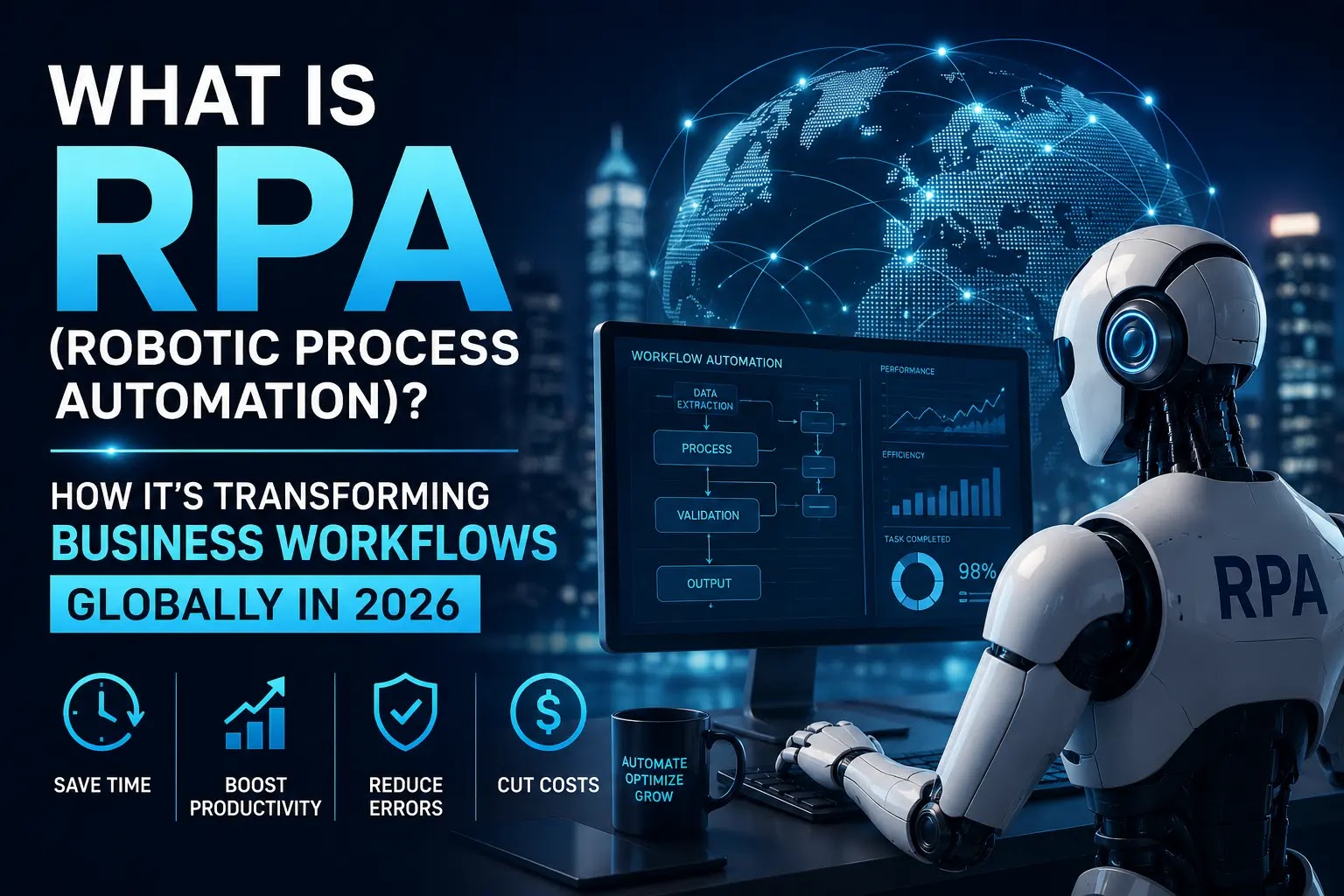
Imagine a tireless digital employee that works 24/7, never makes data-entry mistakes, and completes in seconds what takes a human hours. That’s exactly what Robotic Process Automation (RPA) offers businesses in 2026. From banking to healthcare to e-commerce, RPA is quietly powering the back offices of the world’s most efficient companies — and it’s now more accessible than ever before.
In this guide, we’ll break down exactly what RPA is, how it works, which tools lead the market, and why it’s more relevant than ever in an era of AI agents and intelligent automation.
What Is RPA (Robotic Process Automation)?
RPA stands for Robotic Process Automation — a technology that uses software “bots” to mimic human actions on a computer. These bots can log into applications, fill out forms, copy and paste data, process transactions, extract information from documents, and trigger workflows — all without human intervention.
Unlike physical robots, RPA bots are purely software-based. They work at the user interface (UI) level, interacting with applications the same way a human would — by clicking, typing, and reading on-screen data.
Key characteristics of RPA:
- Automates repetitive, rule-based tasks
- Works across multiple applications without deep system integration
- Operates 24/7 with consistent accuracy
- Requires no changes to existing IT infrastructure
- Can be deployed quickly compared to traditional automation
How Does RPA Work?
An RPA bot follows a predefined script — a sequence of instructions created by a developer or, increasingly in 2026, by a business user using low-code/no-code tools. Here’s a simplified flow:
- Trigger: A process is initiated (e.g., a new invoice arrives in an email inbox)
- Data Extraction: The bot reads the email and extracts key details (vendor name, amount, date)
- Processing: The bot logs into the ERP system and enters the invoice data
- Validation: It cross-checks against purchase orders and flags discrepancies
- Completion: The invoice is approved or routed to a human for review
The entire process that might take a human 10–15 minutes per invoice is completed by an RPA bot in under 60 seconds — at scale, handling thousands of invoices simultaneously.
Why RPA Is More Relevant Than Ever in 2026
Some predicted that AI would kill RPA. The reality in 2026 is quite the opposite. RPA has evolved and is now being supercharged by AI, creating what experts call Intelligent Process Automation (IPA) or Hyperautomation.
Here’s what’s driving RPA’s continued relevance:
- Cost pressures: Businesses worldwide are under intense pressure to reduce operational costs without reducing output quality
- Digital transformation: Companies migrating legacy systems need a bridge technology — RPA provides that without requiring complete system overhauls
- AI integration: Modern RPA platforms now embed machine learning, NLP, and generative AI to handle unstructured data and exceptions
- Low-code democratization: Tools in 2026 allow non-technical business users (citizen developers) to build automations themselves
- Compliance and auditability: In regulated industries, RPA bots leave detailed audit trails that satisfy compliance requirements
According to Gartner, by the end of 2026, 40% of enterprise applications will embed task-specific AI agents — and the vast majority of these deployments will use RPA as the execution layer beneath the AI reasoning layer.
Top RPA Tools in 2026
The RPA market has matured significantly. Here are the leading platforms businesses are using globally:
1. UiPath
Consistently ranked #1 by Gartner, Forrester, and IDC, UiPath is the gold standard for enterprise RPA. In 2026, its AI-powered Autopilot feature allows users to describe a task in plain language and have the bot built automatically. Best for: Large enterprises needing end-to-end automation with strong governance.
2. Automation Anywhere
A cloud-first platform with an exceptional user interface, Automation Anywhere excels at making RPA accessible to business users. Its AI + RPA combination handles both structured and unstructured data. Best for: Cloud-native organizations and teams prioritizing ease of use.
3. Microsoft Power Automate
Built into the Microsoft 365 ecosystem, Power Automate is the go-to choice for businesses already using Office 365, Teams, SharePoint, or Dynamics 365. With deep integration and Copilot AI features, it’s highly accessible and cost-effective. Best for: SMEs and Microsoft-centric organizations.
4. SS&C Blue Prism
Known for enterprise-grade security, compliance, and scalability, Blue Prism is the preferred choice in highly regulated industries like banking, insurance, and healthcare. Best for: BFSI (Banking, Financial Services & Insurance) and healthcare sectors.
5. Kofax RPA
Kofax specializes in intelligent document processing combined with RPA, making it ideal for paper-heavy industries. Best for: Organizations dealing with high volumes of documents, forms, and contracts.
Real-World RPA Use Cases Across Industries
RPA is being applied across virtually every industry. Here are some powerful examples:
Banking & Finance
- Automated loan application processing and credit checks
- Fraud detection alert generation
- Account reconciliation and regulatory reporting
- KYC (Know Your Customer) document verification
Human Resources
- Employee onboarding — generating offer letters, setting up accounts, enrolling in benefits
- Payroll processing and timesheet validation
- Resume screening and interview scheduling
Healthcare
- Patient appointment scheduling and reminders
- Insurance claims processing and eligibility verification
- Medical record updates across systems
E-Commerce & Retail
- Order processing and inventory updates
- Customer returns and refund processing
- Price monitoring and catalog updates
IT Operations
- Automated system monitoring and incident ticket creation
- User access provisioning and deprovisioning
- Software patch deployment tracking
RPA vs AI Agents: What’s the Difference in 2026?
This is the most common question business leaders are asking in 2026. Here’s a clear breakdown:
The 2026 verdict? The most successful enterprises are using both together — AI agents act as the reasoning layer (reading, deciding, handling exceptions) while RPA bots act as the execution layer (clicking, entering, submitting). This hybrid architecture is what Gartner calls Hyperautomation.
How to Get Started with RPA for Your Business
Starting with RPA doesn’t require a massive investment or a team of developers. Here’s a practical roadmap for businesses in 2026:
- Identify the right process: Start with high-volume, repetitive, rule-based tasks with low exception rates — payroll, data entry, report generation are classic starting points
- Choose a platform: For most SMEs, Microsoft Power Automate is the easiest entry point. For enterprises, evaluate UiPath or Automation Anywhere
- Map the process: Document every step of the process before automating — this is called Process Discovery
- Build a pilot bot: Start with one process, build, test, and measure ROI before scaling
- Train your team: All major RPA platforms offer free certification courses — UiPath Academy, Automation Anywhere University, and Microsoft Learn are great resources
- Scale gradually: Once your pilot delivers results, expand to more processes and departments
The Future of RPA: What’s Coming Next
RPA is not standing still. In 2026 and beyond, expect to see:
- GenAI-powered bot building: Describe a process in plain English and the platform auto-generates the bot
- Process Mining + RPA: AI analyzes your processes and automatically recommends what to automate
- Attended RPA evolution: Bots that work side-by-side with employees in real time, assisting rather than replacing
- Edge RPA: Bots running on edge devices for industries with limited connectivity
- RPA + IoT: Bots that respond to physical-world triggers from sensors and connected devices
According to SS&C Blue Prism, by 2030, over 80% of humans will interact with smart robots daily — a future being built right now on the foundation of RPA.
Conclusion
RPA has moved far beyond its origins as a simple screen-scraping tool. In 2026, it is a cornerstone of enterprise digital transformation — turbocharged by AI, democratized by low-code platforms, and proven across every major industry globally. Businesses that embrace RPA today are not just cutting costs — they are building the automation foundation that will power their next decade of growth.
Whether you’re a business owner looking to streamline operations, a professional looking to upskill, or a tech enthusiast tracking the automation wave, understanding RPA is no longer optional — it’s a competitive necessity. Start small, pilot one process, measure the results, and scale from there. The bots are ready. The question is: are you?
Before we answer some frequently asked questions, you may also find these guides helpful:
What Is Edge AI and Why Every Business Should Care About It Right Now
What Is Quantum Machine Learning? How It’s Set to Revolutionize AI in 2026
Frequently Asked Questions (FAQ)
What is robotic process automation?
Robotic Process Automation (RPA) is a technology that uses software bots to automate repetitive, rule-based tasks such as data entry, invoice processing, report generation, and file transfers. It helps businesses improve efficiency, reduce errors, and save time.
Is RPA a good career?
Yes, RPA is a good career choice because many organizations use automation to improve productivity. Professionals with skills in RPA tools, AI, and business process automation are in demand across industries such as banking, healthcare, manufacturing, and IT.
What is RPA with an example?
RPA automates repetitive digital tasks that normally require human effort. For example, an RPA bot can automatically read emails, extract invoice details, enter the data into an accounting system, and send a confirmation email without manual intervention.
Is RPA a form of AI?
No, RPA is not a form of artificial intelligence. Traditional RPA follows predefined rules and workflows. However, when combined with AI technologies such as machine learning or natural language processing, it becomes intelligent automation capable of handling more complex tasks.
What is the RPA salary?
RPA salaries vary depending on experience, location, and employer. Entry-level professionals earn competitive salaries, while experienced RPA developers, architects, and consultants can earn significantly higher pay due to the growing demand for automation expertise.
Which is better, RPA or Python?
RPA and Python serve different purposes. RPA is ideal for automating business processes with minimal coding, while Python offers greater flexibility for automation, data analysis, artificial intelligence, and software development. Learning both provides the best career opportunities.
Is RPA in demand in 2026?
Yes, RPA is expected to remain in demand in 2026 as businesses continue adopting automation to improve efficiency, reduce operational costs, and integrate AI into business processes. Demand is especially strong for professionals skilled in both RPA and AI-powered automation.
Does RPA need coding?
Most modern RPA platforms are low-code or no-code, allowing users to build automation workflows without extensive programming knowledge. However, coding skills in languages like Python, Java, or C# can be valuable for developing advanced automation solutions.
Is RPA still in demand?
Yes, RPA continues to be in demand across industries because organizations rely on automation to streamline repetitive tasks and improve productivity. The integration of RPA with AI has further increased its value for digital transformation projects.
How to get an RPA job?
To get an RPA job, learn popular RPA tools such as UiPath, Automation Anywhere, or Blue Prism, understand business processes, build automation projects, earn relevant certifications, and create a portfolio showcasing your skills. Knowledge of Python, SQL, and AI can further improve your career prospects.