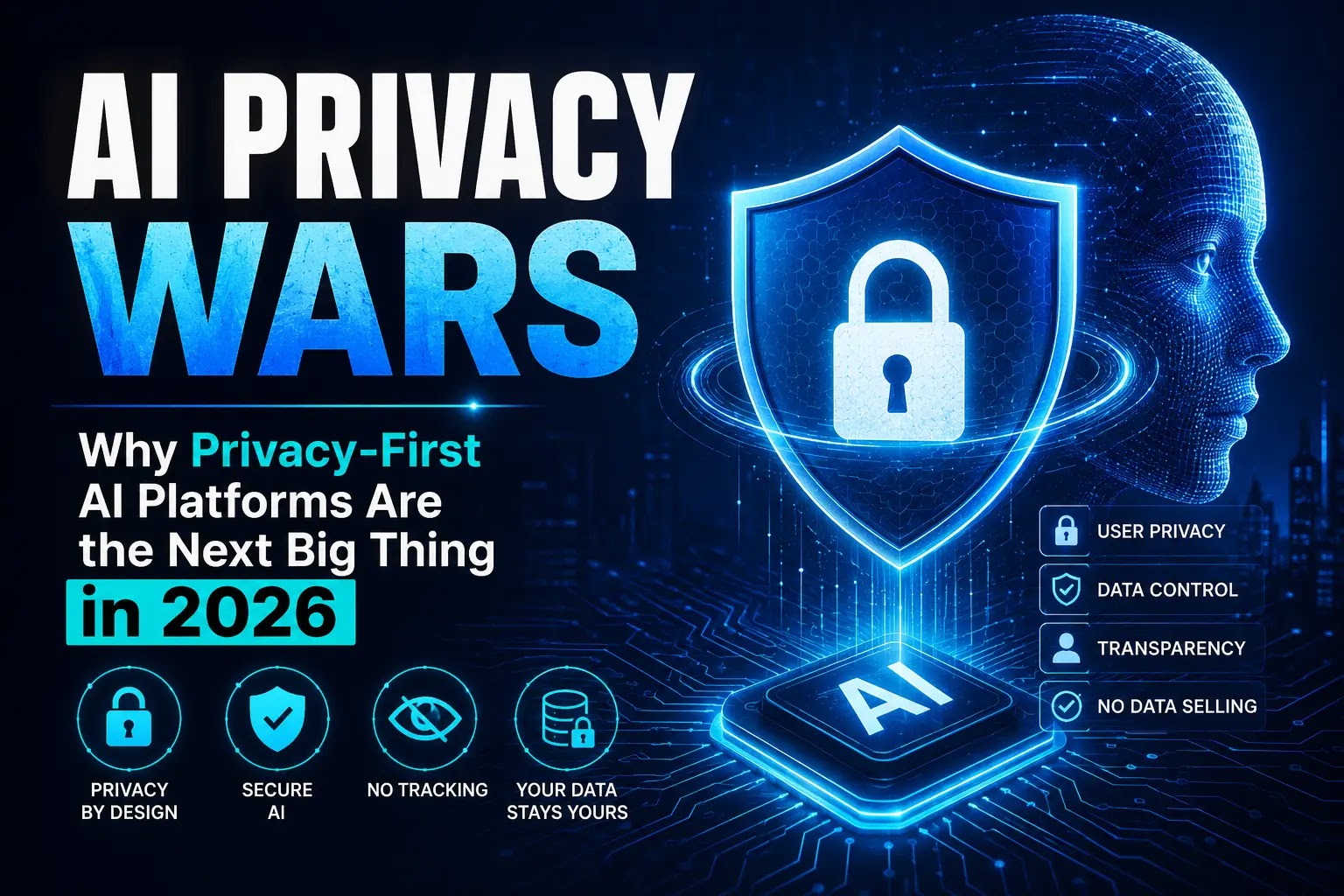
Every time you type a question into ChatGPT, Gemini, or Grok, you are handing over a piece of yourself — your ideas, your business strategies, your personal concerns — to some of the world’s most powerful corporations. For years, people accepted this as the price of using powerful AI. But in 2026, that trade-off is no longer acceptable to millions of users. A quiet revolution is happening in the AI industry, and it is called privacy-first AI.
From Proton’s Lumo to Venice AI, a new generation of platforms is proving that you do not have to choose between intelligence and privacy. These platforms are growing fast, attracting serious investment, and are fast becoming the default choice for professionals, businesses, and privacy-conscious users across the globe.
What Is Privacy-First AI?
Privacy-first AI refers to artificial intelligence platforms and chatbots that are architecturally designed to protect user data. Unlike mainstream AI tools that collect conversation data, use it to train future models, or share it with third parties, privacy-first AI platforms operate under strict data minimization principles.
The core features that define a privacy-first AI platform include:
- Zero-access encryption: Your data is encrypted in a way that even the platform itself cannot read it.
- No training on user data: Conversations are never used to train or improve the AI model.
- No server-side logging: Session histories are not stored on the provider’s servers.
- No third-party sharing: Your data is never sold or shared with advertisers, partners, or governments.
- Data sovereignty: Many privacy AI tools operate servers in privacy-friendly jurisdictions like Switzerland or the EU.
A major independent analysis published in early 2026 found that ChatGPT, Claude on the free tier, and Gemini all train on user data by default — requiring users to manually opt out. Only 7 of the 15 major AI chat platforms analyzed offer genuine end-to-end encryption.
Why Privacy-First AI Is Exploding in 2026
Several major forces have converged in 2026 to make AI privacy a mainstream concern rather than a niche worry.
1. The EU AI Act Is Now Fully in Force
The European Union’s AI Act has moved from compliance preparation to active enforcement in 2026. Businesses operating in Europe — or serving European customers — are now legally required to demonstrate responsible AI use, including how user data is handled. Tools like ChatGPT Free and DeepSeek have been flagged as non-compliant for business use under GDPR, while privacy-first platforms are becoming the only safe enterprise option.
2. High-Profile AI Data Scandals
2025 and early 2026 saw multiple high-profile cases of AI platforms exposing or mishandling sensitive user data. From accidental conversation leaks to investigations by data protection authorities, public trust in mainstream AI tools has eroded significantly. Users are now actively searching for alternatives that cannot be compromised — because the data simply does not exist on the provider’s servers to begin with.
3. The Rise of AI in Professional Work
As AI has moved from a curiosity to a daily work tool, the stakes of using insecure platforms have risen dramatically. Lawyers, doctors, financial advisors, HR professionals, and executives are now routinely using AI to draft documents, analyze data, and think through sensitive decisions. Feeding confidential client or company information into a platform that trains on that data is not just a privacy risk — it is a professional liability. Privacy-first AI removes this risk entirely.
4. Global AI Usage Has Crossed 1 Billion Weekly Users
AI chat usage surpassed 1 billion weekly active users globally in 2026. As AI reaches this scale, regulators, journalists, and the general public are scrutinizing data practices with unprecedented intensity. The sheer volume of personal and professional data flowing through AI platforms has made privacy a top-tier global concern — not just a tech industry debate.
The Leading Privacy-First AI Platforms in 2026
Several platforms are leading the privacy-first AI movement, each with a distinct approach.
Proton Lumo 2.0
Proton, the company behind the world’s most popular privacy email service Proton Mail, launched its AI chatbot Lumo in 2025. In June 2026, Lumo received a major upgrade adding image recognition, image generation, and a powerful new “thinking mode” for complex queries. Lumo 2.0 responds up to 76% faster than its previous version. Its zero-access encryption architecture ensures data is encrypted in transit and at rest — even Proton employees cannot see conversation contents. Available in free and paid tiers (Plus at $12.99/month and Professional).
Venice AI
Venice AI recently achieved unicorn status after a $65 million Series A funding round, validating the massive market demand for private AI. Venice runs AI models in secure enclaves, meaning your prompts and responses never leave a secure environment. It is particularly popular with creative professionals, developers, and privacy advocates who need high-performance AI without data exposure.
Brave Leo
Built into the Brave browser, Brave Leo is a privacy-first AI assistant that processes queries without sending identifying information to servers. It uses a proxy system to ensure that even the AI model provider cannot see who is asking the question. Brave Leo ranks among the top three most private AI tools available in 2026, making it an excellent choice for everyday users who want AI assistance without browser-level tracking.
DuckDuckGo AI Chat
DuckDuckGo AI Chat routes your queries through their servers anonymously, strips metadata, and prevents the underlying AI models (which include GPT-4o and Claude) from associating your conversations with your identity. Chats are not used for training and are deleted after a short period — combining the power of leading AI models with the privacy philosophy DuckDuckGo has built its entire brand on.
Kagi Assistant and Maple AI
Kagi Assistant, from the makers of the Kagi private search engine, provides a private interface to major AI models with a strong track record of privacy advocacy. Maple AI offers end-to-end encrypted chat with zero logging and auditable open-source code — making it arguably the most technically rigorous privacy-focused option available for users who want the highest possible guarantee.
Privacy-First AI for Businesses: The Compliance Angle
For businesses, the decision to use privacy-first AI is increasingly not just ethical — it is a legal and financial imperative. Here is what organizations need to consider:
- Data Processing Agreements (DPAs): Under GDPR and the EU AI Act, businesses need a valid DPA with any AI tool that processes personal data. Privacy-first platforms like Proton Lumo explicitly offer GDPR-compliant DPAs, while many mainstream tools have questionable DPA terms.
- Employee and Client Data: Using a standard AI tool to process employee performance data, legal documents, or client financial records creates serious compliance exposure. Privacy-first AI eliminates the risk of inadvertent data leakage.
- Intellectual Property Protection: When employees use mainstream AI tools to develop new products or strategies, those ideas could become part of training data and potentially surface in competitors’ AI outputs. Privacy-first AI ensures your IP stays yours.
- Industry-Specific Compliance: Healthcare (HIPAA), finance (SOC 2, PCI-DSS), and legal sectors have strict rules about data handling. Privacy-first AI platforms designed for these sectors enable AI adoption without compliance breaches.
How to Choose the Right Privacy-First AI Platform
Not all privacy AI tools are created equal. When evaluating a platform, ask these five key questions:
- Is end-to-end encryption implemented? Basic TLS encryption only protects data in transit — it can still be read by the provider on their servers. True privacy requires encryption at rest as well.
- Is the privacy policy independently audited? Platforms like Proton have undergone independent security audits. Look for third-party verification, not just marketing claims.
- Where are the servers located? EU-based servers provide stronger legal protections than US-based ones, especially for European users and GDPR compliance.
- What AI models power the platform? Open-source models provide more transparency than proprietary black-box models about what the AI does with your data.
- What is the business model? If a platform is free with no premium tier, ask how it is funded. Privacy and advertising-based revenue models are fundamentally incompatible.
The Future: Privacy as a Competitive Advantage
The AI privacy wars of 2026 represent a fundamental shift in how AI products are built and sold. For years, the dominant AI business model was built on data collection: the more you use it, the more it learns, and the more valuable your data becomes to the provider. Privacy-first AI inverts this model entirely — the product is privacy itself, and users pay for it directly.
As AI regulation tightens globally, mainstream platforms are already feeling the pressure to clean up their data practices. The EU AI Act, similar legislation emerging in Asia and Latin America, and growing enforcement by data protection authorities are creating a regulatory environment where privacy-first AI is not the exception — it is the future standard.
Businesses that adopt privacy-first AI tools now will be ahead of the compliance curve. Users who switch now will never have to worry about their most sensitive conversations being mined, misused, or leaked. In a world where data is power, choosing a platform that gives that power back to you is not just a tech preference — it is a statement about the kind of digital future you want to build.
Conclusion
Privacy-first AI is no longer a niche preference — it is rapidly becoming the smart, responsible, and legally required choice for individuals and businesses worldwide. As mainstream AI platforms face growing regulatory scrutiny and public distrust, platforms like Proton Lumo, Venice AI, Brave Leo, and DuckDuckGo AI Chat are proving that powerful AI and true data privacy can coexist. Whether you are a solo professional protecting client confidentiality or a business navigating GDPR compliance, making the switch to privacy-first AI in 2026 is one of the most forward-thinking decisions you can make. The future of AI is private — and that future is already here.
Before we answer some frequently asked questions, you may also find these guides helpful:
AI Regulation in 2026: What the New Global AI Laws Mean for Businesses and Everyday Users
Ambient Intelligence: The Invisible Tech Revolution Changing How the World Works in 2026
Frequently Asked Questions (FAQ)
What is privacy in AI?
Privacy in AI refers to protecting personal and sensitive information that AI systems collect, process, or store. It ensures that user data is handled securely, used responsibly, and shared only with proper consent.
How can I protect my privacy from AI?
You can protect your privacy by avoiding sharing sensitive personal information with AI tools, using strong passwords, enabling two-factor authentication, reviewing privacy settings, and choosing trusted AI services with transparent privacy policies.
Can AI access your personal information?
AI can only access personal information that you choose to provide or that an application is authorized to collect. Reputable AI services follow privacy policies and security measures to protect user data, but you should avoid sharing confidential information unless necessary.
Which AI is most private?
The most private AI depends on how it is deployed. Self-hosted or on-device AI models generally offer the highest level of privacy because your data remains under your control. Enterprise AI solutions with strong security features also provide enhanced privacy protections.
Are AI chats private?
AI chats are generally private, but privacy depends on the platform you use. Some AI providers may store conversations to improve their services, while others offer settings that allow users to disable chat history or training. Always review the provider’s privacy policy before sharing sensitive information.
What shouldn’t you tell ChatGPT?
You should avoid sharing passwords, bank account details, credit card numbers, government-issued identification numbers, confidential business information, medical records, and any other sensitive personal data unless you fully trust the platform and understand how your information is used.
What not to ask AI?
Avoid asking AI to generate illegal content, disclose private information about others, provide harmful instructions, or process highly confidential personal or business data. Use AI responsibly and verify important information before acting on it.
How to keep ChatGPT private?
To keep ChatGPT more private, avoid sharing sensitive information, disable chat history or training features if available, regularly review your privacy settings, use strong account security, and log out of shared or public devices after each session.
Can people see my ChatGPT?
No, other people cannot see your ChatGPT conversations unless you choose to share them or use a shared account or device. However, always protect your account with a strong password and enable two-factor authentication to prevent unauthorized access.