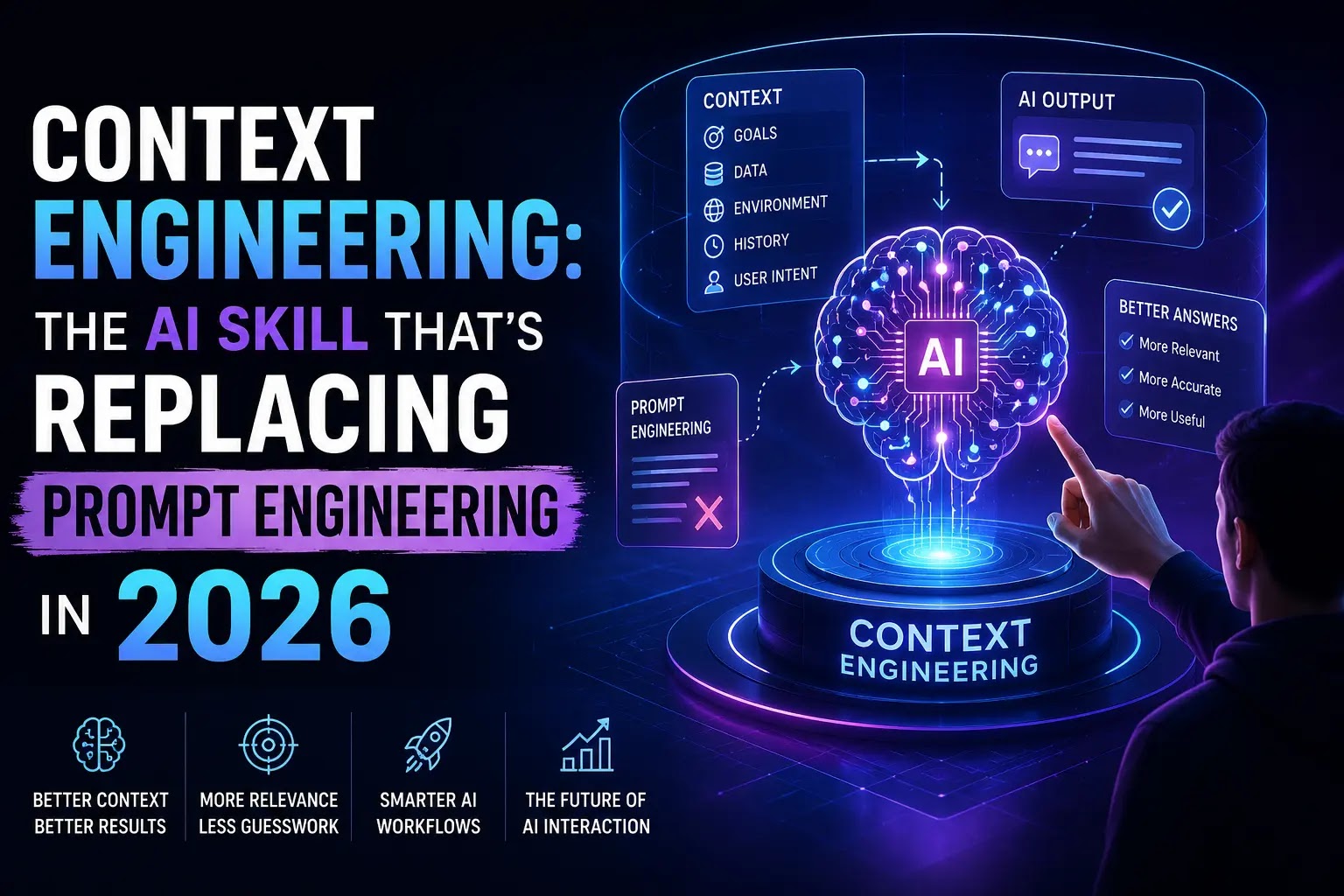
Context engineering is quickly becoming one of the most important AI skills of 2026. For a while, people focused almost entirely on writing better prompts, but modern AI systems have become much more powerful, much more connected, and much more dependent on the quality of the information around them.
That shift matters because the best results no longer come from clever wording alone. They come from designing the full information environment the model sees: instructions, knowledge, memory, tools, and live state.
In simple terms, prompt engineering asked, “How do I ask the model the right way?” Context engineering asks, “What should the model know, remember, and access before it answers?” That difference is why the conversation around AI work has changed so quickly in 2026.
What Context Engineering Really Means
Context engineering is the discipline of shaping everything an AI system sees before it generates an answer. It includes the system prompt, retrieved documents, conversation history, tool outputs, memory, and any live data the model needs to act correctly.
This matters because modern models can handle far more information than earlier versions. As context windows grew dramatically, the real challenge shifted from “How do I fit something into the prompt?” to “How do I organize the right information so the model uses it well?”
That is why context engineering is becoming more valuable than traditional prompt tricks. A well-designed context pipeline can give the model the right business rules, the right documents, the right recent events, and the right tool access without forcing users to manually rewrite the prompt every time.
Why Prompts Hit a Ceiling
Prompt engineering still has value, but it has a ceiling. Once the model understands the task, tiny changes in wording stop producing major improvements, especially in production systems where reliability matters more than clever phrasing.
A simple prompt can produce a decent answer in a single chat. But real-world AI workflows need more than that. They need current company data, recent conversation history, tool outputs, and rules that prevent the model from guessing when it should retrieve or act.
This is where people often get stuck. They keep polishing the text of the prompt while the real problem is missing context, stale context, or badly organized context. In production, those problems matter much more than whether the prompt says “act as an expert” or “think step by step.”
The 5-Layer Stack
A useful way to think about context engineering is as a stack. The top layer is the instruction prompt, but below that are the pieces that actually make the system reliable: knowledge retrieval, tools, memory, and live state.
- Instructions: the system and user instructions that define behavior.
- Knowledge: documents, databases, or RAG retrieval.
- Tools: APIs, apps, and connectors.
- Memory: what the system remembers across sessions.
- Live state: the current situation, task, and recent updates.
This stack is why context engineering is bigger than prompt engineering. A prompt is only one layer of the system, while the rest determines whether the AI gives a good answer, a grounded answer, or a useful action.
Why 2026 Changed Everything
The biggest reason context engineering is booming in 2026 is that AI systems are no longer just chatbots. They are becoming agentic systems that read, search, remember, and act across multiple tools.
That means the model needs the right context before it can do useful work. If it is helping with a report, it may need company documents, recent metrics, and a workflow that can send output to Slack, email, or a CRM. If it is helping with content, it may need research sources, internal style guidelines, and a publishing target.
This is why many AI builders now talk about context architecture rather than prompt writing. The winning systems are designed to reduce hallucinations, improve consistency, and make the AI useful across many tasks instead of just one chat session.
How Context Helps AI Output
A good context system improves accuracy, relevance, and repeatability. It helps the model answer from the right source instead of relying on memory or guesswork.
For example, if you ask an AI assistant to help with a customer issue, the prompt alone may not be enough. But if the system has access to the customer’s ticket history, the latest policy document, and a support workflow, the answer becomes much more useful.
That same principle applies to blog writing. If the AI has your SEO guidelines, topic brief, target audience, and recent article history, it can produce something much closer to publish-ready work. In other words, good context turns AI from a clever text generator into a dependable workflow engine.
Who Should Learn It
Context engineering is valuable for AI builders, automation specialists, product teams, content teams, and anyone designing AI workflows that need to work reliably in the real world. It is especially useful if you are building agent-based systems or tools that connect to apps and databases.
It is also becoming a practical career advantage. People who understand how to structure context, retrieval, memory, and tool use are better prepared for AI engineering, automation, and product roles than people who only know how to write stronger prompts.
That does not mean prompt writing is useless. It means prompt writing is becoming a smaller part of a larger system design skill. The professionals who combine both will have the strongest edge.
Context vs Prompt Engineering
Prompt engineering and context engineering are related, but they solve different problems. Prompt engineering focuses on the instruction you give the model, while context engineering focuses on the environment the model uses to interpret that instruction.
A prompt engineer might refine tone, role, or response format. A context engineer would also decide what documents to inject, what memory to retain, what tools to call, and what live state to include. That is why context engineering is better suited to modern AI systems that need more than a one-shot answer.
Think of it this way: prompt engineering is asking a smart assistant a good question. Context engineering is giving that assistant the right files, the right history, the right tools, and the right permissions before the question is asked. That is the bigger skill in 2026.
Common Mistakes
One common mistake is stuffing too much irrelevant information into the context window. More context is not always better if it creates noise, contradiction, or confusion.
Another mistake is treating retrieval as an afterthought. If your knowledge layer returns weak or outdated information, the model will still produce weak answers, even if the prompt is well written. A third mistake is failing to manage memory and live state, which can make the AI act inconsistently across tasks.
The best systems keep context clean, current, and task-specific. They add only the information needed, in the right order, and with the right tool access. That is what separates a demo from a production-grade AI system.
How To Start Learning
Start with the basics: understand how prompts, retrieval, tools, and memory work together. Then build small workflows that use documents, APIs, or connectors instead of relying on chat alone.
- Learn how to write clear system and user instructions.
- Add a retrieval layer from documents or a knowledge base.
- Connect one tool, such as email or a database.
- Add memory or conversation history.
- Test how the output changes as the context becomes more structured.
Once you can do that, you are no longer just “prompting” an AI. You are designing a system that can work across real tasks and real users.
Why Businesses Care
Businesses care about context engineering because it reduces errors and improves consistency. A model that knows the right policy, the right customer, and the right action is more useful than one that gives a polished but unreliable answer.
It also improves scalability. Instead of rewriting prompts for every use case, teams can build reusable context pipelines that feed the model what it needs on demand. That saves time, improves quality, and makes AI automation easier to maintain.
For this reason, context engineering is becoming a core skill in AI product development, automation workflows, and enterprise AI adoption. It is not just a trend; it is becoming the infrastructure behind useful AI.
Conclusion
Prompt engineering is not dead, but it is no longer the main event. In 2026, the bigger win comes from context engineering: designing the full information environment that allows AI systems to think, retrieve, remember, and act more reliably.
If you want better AI results, stop obsessing over a perfect sentence and start building a better context stack. That is where the real leverage is now.
Before we answer some frequently asked questions, you may also find these guides helpful:
AI Privacy Wars: Why Privacy-First AI Platforms Are the Next Big Thing in 2026
AI Regulation in 2026: What the New Global AI Laws Mean for Businesses and Everyday Users
Frequently Asked Questions
What is a context engineer?
A context engineer is a professional who designs and organizes the information, instructions, examples, and data given to an AI model so it can understand a task and produce accurate, relevant, and consistent responses.
What are the 4 pillars of context engineering?
The four pillars of context engineering are clear task definition, relevant context, well-defined constraints, and continuous feedback. These elements help AI systems understand requests better and generate high-quality results.
What is an example of context engineering?
A simple example of context engineering is providing an AI with the topic, target audience, writing style, SEO keywords, and desired format before asking it to write a blog post. This additional context helps the AI create more useful and accurate content.
What are the 5 levels of context?
The five levels of context include the current request, previous conversation, user preferences, external knowledge, and long-term memory. Together, they help AI understand user intent and provide more personalized responses.
Where can I learn context engineering?
You can learn context engineering through AI documentation, online courses, YouTube tutorials, developer blogs, and hands-on practice with tools like ChatGPT, Claude, Gemini, LangChain, and AI agent frameworks. Building real-world AI projects is one of the best ways to improve your skills.
How much do context engineers make?
Context engineers are in high demand, and salaries vary based on experience, location, and company. In many countries, skilled context engineers earn competitive salaries because they help organizations build more reliable and intelligent AI applications.
What are the steps in context engineering?
Context engineering typically involves defining the task, gathering relevant information, setting clear instructions and constraints, providing examples when needed, testing the AI’s output, and refining the context until the desired results are achieved.
What is context engineering vs prompt engineering?
Prompt engineering focuses on writing effective prompts to guide an AI model. Context engineering is a broader approach that includes prompts, memory, retrieved knowledge, examples, external data, tools, and workflow design. As AI systems become more advanced, context engineering plays a bigger role in improving their accuracy and performance.