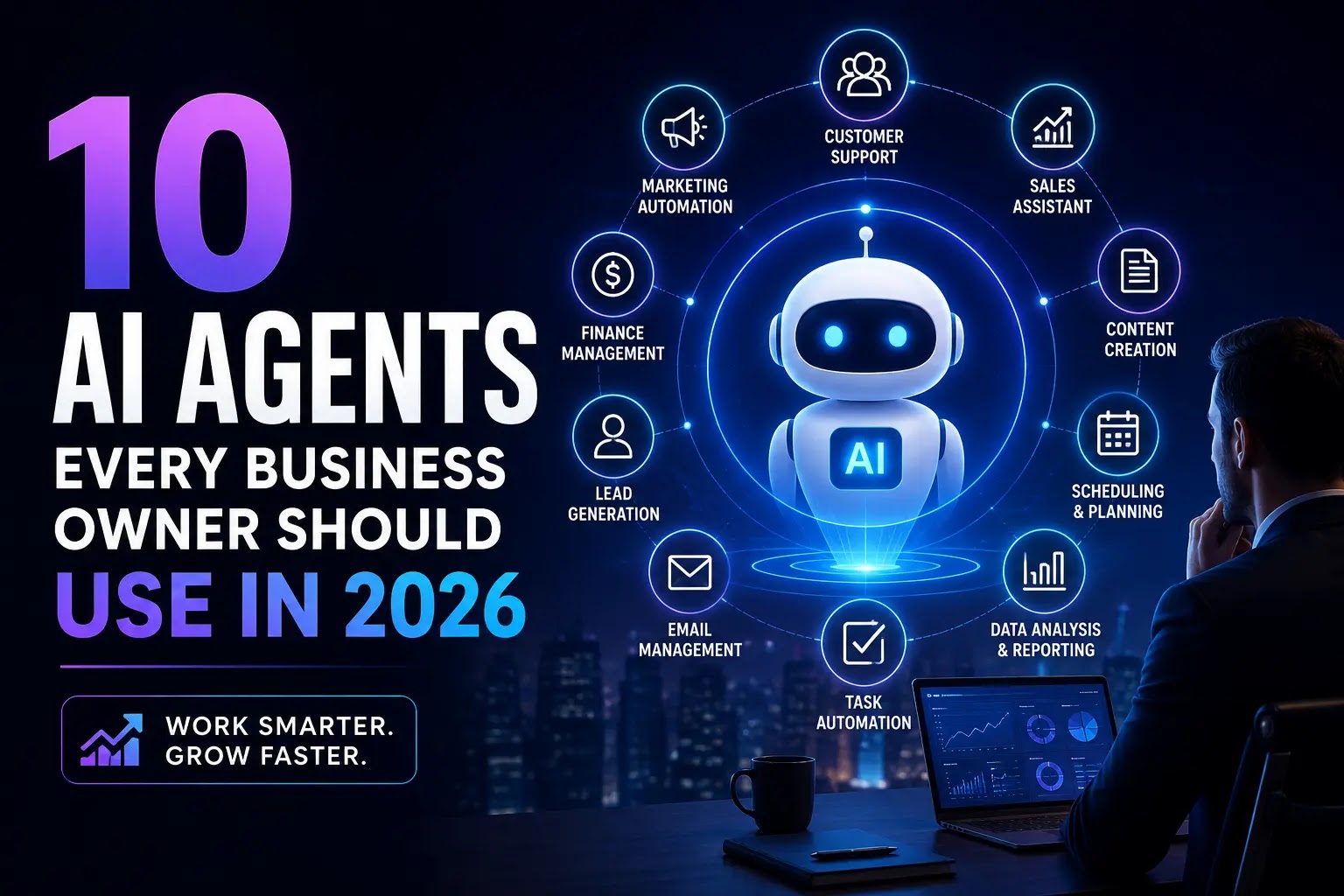
In 2026, running a business without using AI Agents For Business is like running a marathon barefoot — technically possible, but painfully inefficient. AI agents are no longer futuristic concepts. They are autonomous systems that observe, decide, and act across your business workflows — 24/7, without burnout, without bias, and without coffee breaks.
Whether you’re a solo founder in Mumbai, a startup in Bengaluru, or a growing SME in Delhi, AI agents can replace repetitive tasks, accelerate decisions, and multiply your output. The question is no longer should you use AI agents — it’s which ones should you deploy first.
In this guide, we break down the 10 AI Agents Every Business Owner Needs in 2026 — with real use cases, recommended tools, and ROI insights to help you pick the right ones for your business.
What Is an AI Agent, Which 10 Best AI Agents For Business
An AI agent is a software system powered by artificial intelligence that can autonomously perceive its environment, make decisions, and take actions to achieve a goal — without requiring constant human input. Unlike traditional chatbots that respond to queries, AI agents execute multi-step workflows, connect to multiple tools, and continuously improve based on feedback.
Think of them as your most tireless digital employees — always on, always optimizing.
1. Customer Support AI Agent
Customer support is the most common and highest-ROI AI agent deployment for any business. A customer support AI agent handles FAQs, resolves complaints, escalates complex issues, and even performs tone analysis to prioritize frustrated customers — 24/7.
Best Tools: Intercom Fin, Zendesk AI, Freshdesk Freddy AI
Use Case: An e-commerce brand deployed an Intercom Fin agent and reduced support ticket resolution time by 65% within 30 days.
Why You Need It: Indian consumers expect instant responses. A support AI agent ensures no customer waits — day or night, on WhatsApp, email, or your website chat.
2. Sales Outreach & Lead Generation AI Agent
This agent identifies your ideal customers, researches them online, personalizes outreach messages, sends emails or LinkedIn messages, and follows up based on engagement — all on autopilot.
Best Tools: Clay, Apollo AI, Salesforce Agentforce 2.0
Use Case: B2B startups using Clay + AI outreach report 3x more qualified leads with 50% less sales team effort.
Why You Need It: Manual prospecting is dead. AI agents can research 1,000 leads in the time your human SDR researches 10 — with better personalization.
3. Marketing & Content AI Agent
This agent runs your entire content engine — planning blog posts, writing social media captions, repurposing videos into articles, generating ad copy, and even A/B testing content performance — all autonomously.
Best Tools: Jasper AI, HubSpot AI, NoimosAI, CrewAI (for custom multi-agent content workflows)
Use Case: Small businesses using AI content agents publish 10x more content with 70% less human effort.
Why You Need It: Content is king — but only if published consistently. An AI content agent ensures you never run out of ideas or miss a publishing deadline.
4. Finance & Accounting AI Agent
A finance AI agent tracks your revenue, expenses, subscriptions, and cash flow in real time. It generates forecasts, detects financial anomalies, automates invoice processing, and answers questions like “Can we afford to hire a developer next month?”
Best Tools: Oracle Miracle Agent, SAP Joule, Vic.ai, Botkeeper
Use Case: A retail chain using a finance AI agent identified ₹12 lakh in duplicate vendor payments within the first month of deployment.
Why You Need It: Financial clarity drives business confidence. This agent prevents costly errors and helps you make data-driven money decisions fast.
5. HR & Recruitment AI Agent
From screening resumes to scheduling interviews, onboarding new employees, and even managing training paths — the HR AI agent handles the full employee lifecycle with minimal human involvement.
Best Tools: HireVue, Paradox (Olivia), Microsoft Copilot for HR
Use Case: A tech startup reduced time-to-hire from 45 days to 12 days using a recruitment AI agent that screened 500+ applications in under 2 hours.
Why You Need It: Hiring is time-consuming and expensive. AI agents cut recruitment costs by up to 40% while improving candidate quality.
6. Market Research & Competitive Intelligence AI Agent
This agent acts as a 24/7 research analyst — monitoring competitor websites, tracking industry news, analyzing customer sentiment on social media, and delivering weekly competitive intelligence reports directly to you.
Best Tools: Crayon, Klue, Perplexity AI (Research Mode), Custom GPT agents
Use Case: A D2C brand used a competitive intelligence agent to identify a competitor’s pricing change 48 hours before the market reacted — and adjusted strategy in time.
Why You Need It: Information is competitive advantage. An agent that tracks the market while you focus on execution gives you a massive strategic edge.
7. Workflow Automation AI Agent
This is your digital operations manager. It connects your tools (CRM, Slack, Gmail, Sheets, project management), automates repetitive cross-platform tasks, and ensures business processes run smoothly without human intervention.
Best Tools: n8n, Zapier AI Agents, Make (Integromat), Microsoft Copilot Studio
Use Case: A consulting firm automated 17 manual internal workflows using n8n — saving 30+ hours per week of operational overhead.
Why You Need It: Most business inefficiencies hide in manual, repetitive workflows. An automation agent eliminates this waste permanently.
8. Legal & Compliance AI Agent
A legal AI agent reviews contracts, flags risky clauses, tracks GST and regulatory compliance deadlines, and keeps your documentation in order. While it doesn’t replace a lawyer, it prevents expensive oversights.
Best Tools: Harvey AI, Spellbook, LegalOn
Use Case: A SaaS startup used Harvey AI to review a 50-page vendor contract in 8 minutes — identifying three liability clauses that their lawyer later confirmed were risky.
Why You Need It: Legal issues can shut down businesses. This agent acts as a first-line defense, catching problems before they become costly lawsuits.
9. E-Commerce & Personalization AI Agent
This agent analyzes customer behavior, purchase history, and browsing patterns to deliver hyper-personalized product recommendations, dynamic pricing, and targeted promotional offers — in real time.
Best Tools: Salesforce Einstein, Dynamic Yield, Nosto, Shopify AI
Use Case: An online fashion brand using personalization AI agents saw a 34% increase in average order value within 60 days of deployment.
Why You Need It: Personalization at scale is impossible for humans — but trivial for AI. This agent turns every customer visit into a tailored shopping experience.
10. Strategy & Decision-Making AI Agent
The most underestimated agent on this list. A strategy AI agent helps you think through complex decisions by simulating business scenarios, evaluating trade-offs, challenging your assumptions, and identifying blind spots. It doesn’t decide for you — it sharpens your thinking.
Best Tools: ChatGPT (with custom instructions), Claude 3.5 by Anthropic, Gemini Advanced, Microsoft Copilot Vision Agents
Use Case: A founder used Claude to simulate three market expansion scenarios before deciding which city to launch in — saving 3 months of manual research.
Why You Need It: Every business decision has downstream consequences. An AI strategy agent helps you think 10 steps ahead — before you commit time, money, and resources.
How to Choose the Right AI Agent for Your Business
Before deploying any agent, ask yourself:
- What’s your biggest time drain? Start with the function consuming the most manual hours.
- What’s your risk tolerance? Customer-facing agents need more oversight than internal tools.
- What tools are you already using? Choose agents that integrate natively with your existing stack.
- What’s your budget? Many powerful agents (like n8n, AutoGPT, CrewAI) are open-source or low-cost.
For most Indian business owners in 2026, the recommended starting stack is: Customer Support Agent + Workflow Automation Agent + Content Agent. This trio alone can save 20+ hours per week and reduce operational costs by 30–50%.
The ROI Reality: What AI Agents Actually Deliver
| AI Agent | Average Time Saved/Week | Estimated Cost Reduction |
|---|---|---|
| Customer Support | 15–20 hrs | 40–60% |
| Sales Outreach | 10–15 hrs | 30–50% |
| Content Marketing | 8–12 hrs | 50–70% |
| Finance & Accounting | 5–8 hrs | 25–40% |
| HR & Recruitment | 10–15 hrs | 30–45% |
| Workflow Automation | 20–30 hrs | 40–60% |
Conclusion: The Competitive Divide Is Growing
In 2026, there are two types of business owners: those who use AI agents to multiply their output, and those who watch their competitors pull ahead. The 10 AI agents covered in this guide aren’t luxuries — they’re the new baseline for competitive business operations.
You don’t need to deploy all 10 at once. Start with the one that solves your biggest pain point today. Measure the impact. Then scale. The compounding effect of multiple AI agents working together in your business is genuinely transformational — and it’s available to every business owner in India right now, regardless of size or technical background.
The future of business isn’t just AI-powered. It’s AI-agent-run.
Stay tuned to RINDAX Trends for more deep dives into the AI tools, trends, and strategies shaping business in 2026.
Before we answer some frequently asked questions, you may also find these guides helpful:
AI Agents for Lead Generation: How Autonomous Systems Are Rewiring B2B Sales
How AI Agents Automate Customer Support: The Complete Guide
Frequently Asked Questions (FAQs)
What is an AI agent for business?
An AI agent for business is an autonomous software system that perceives data from its environment, makes decisions using AI models, and takes action across tools and workflows — without requiring human input for every step. Unlike basic chatbots, AI agents execute multi-step tasks, connect to multiple platforms, and adapt to new situations. In 2026, they are used for customer support, sales, marketing, finance, HR, and strategic decision-making.
Are AI agents safe for small businesses in India?
Yes, AI agents are generally safe for small businesses in India when deployed through reputable platforms like Microsoft Copilot, Salesforce Agentforce, or Intercom. However, choose agents with data privacy compliance, configure proper human escalation paths, and avoid relying on AI agents for high-stakes legal or financial decisions without human review.
How much do AI agents cost for a small business?
AI agent costs in 2026 vary widely. Open-source options like n8n, AutoGPT, and CrewAI are free to self-host. SaaS-based agents like Intercom Fin start around $29–$99/month. Enterprise solutions like Salesforce Agentforce cost ₹50,000–₹5,00,000+ per year. For most Indian SMEs, a starter AI agent stack costs ₹3,000–₹15,000/month and delivers ROI within 30–60 days.
Can AI agents replace human employees?
AI agents can replace specific repetitive tasks but are not yet capable of fully replacing employees who require judgment, empathy, or relationship management. The best approach is augmentation — using AI agents to handle 80% of routine work so your human team can focus on the 20% that truly requires human intelligence.
Which AI agent is best for Indian e-commerce businesses?
For Indian e-commerce businesses, the top AI agents are Intercom Fin for 24/7 multilingual customer support, Shopify AI/Nosto for personalized recommendations, Clay for B2B lead generation, and n8n/Zapier AI for automating order processing workflows. Starting with a customer support agent delivers the fastest ROI.
What is the difference between an AI agent and a chatbot?
A traditional chatbot follows a predefined script and fails outside its decision tree. An AI agent understands context, makes decisions, executes multi-step tasks across platforms, and learns from every interaction. While a chatbot answers “Where is my order?” with a canned response, an AI agent checks your order system, identifies the issue, offers a refund if eligible, and updates the CRM — automatically.
How do I implement an AI agent without a tech team?
You don’t need a tech team in 2026. Platforms like Zapier AI Agents, Make (Integromat), and Microsoft Copilot Studio offer no-code interfaces. Intercom Fin can be deployed in under 2 hours with zero coding. Start small — pick one agent for your biggest pain point, test internally, then go live.
Can AI agents work in Hindi or regional Indian languages?
Yes! In 2026, ChatGPT (GPT-4o), Google Gemini, and Microsoft Copilot have strong multilingual support including Hindi, Tamil, Telugu, Marathi, and Bengali. Freshdesk Freddy AI and Intercom Fin can be configured to respond in regional Indian languages — making them powerful for Tier 2 and Tier 3 city markets.
What is the biggest mistake when deploying AI agents?
The biggest mistake is trying to automate everything at once. Deploy one high-impact agent first (usually customer support or workflow automation), measure results over 30–60 days, optimize configurations, then scale. Always maintain a human escalation path — never let an AI agent be the final decision-maker for high-stakes issues.
10. Will AI agents become more powerful in the next 2–3 years?
Absolutely. By 2028, experts predict multi-agent systems where dozens of specialized AI agents collaborate to run entire business divisions will be mainstream for SMEs. Voice AI agents will handle complex phone-based customer service, and computer-use agents will navigate software interfaces just like human employees. Businesses building AI agent literacy today will have a significant competitive advantage.