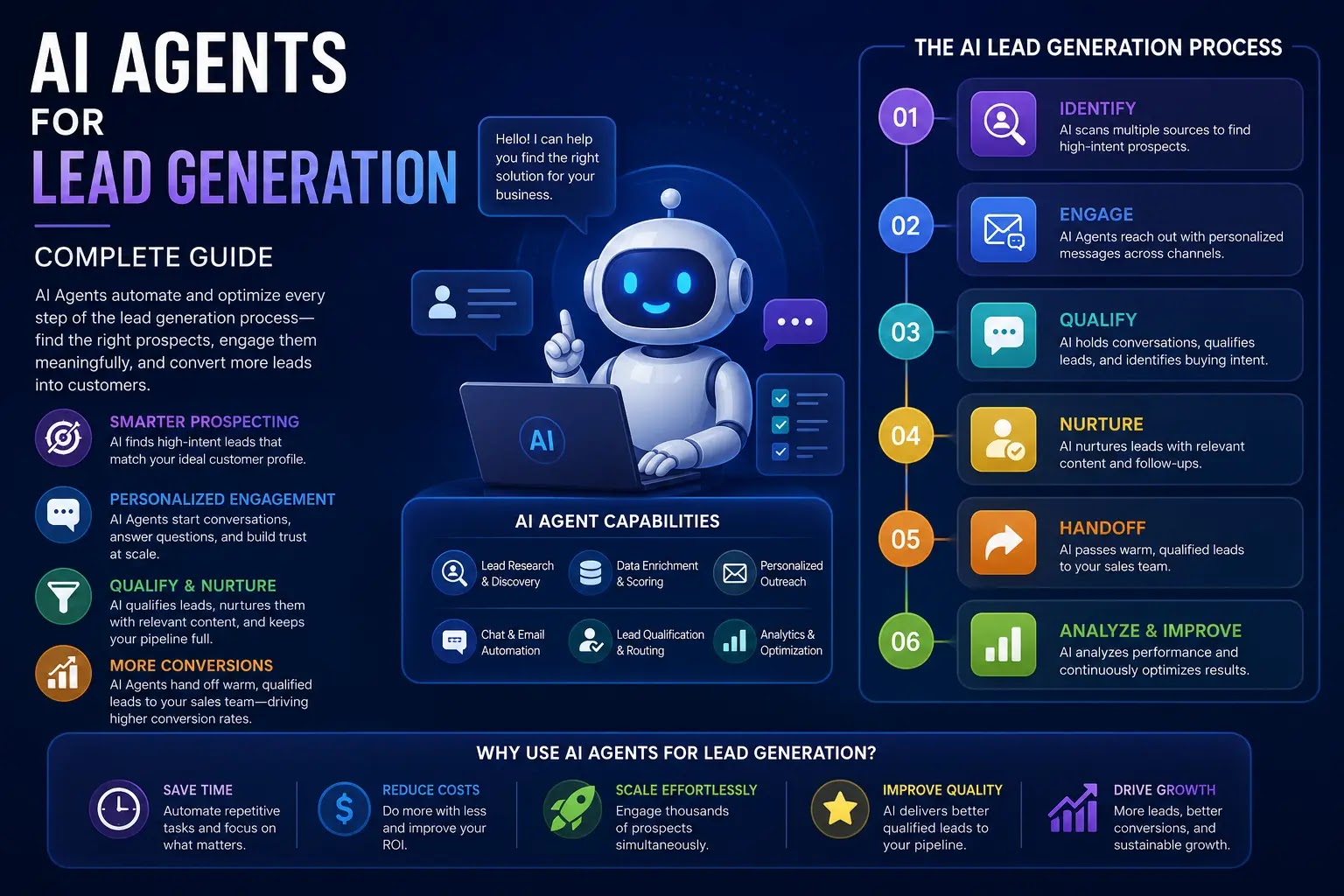
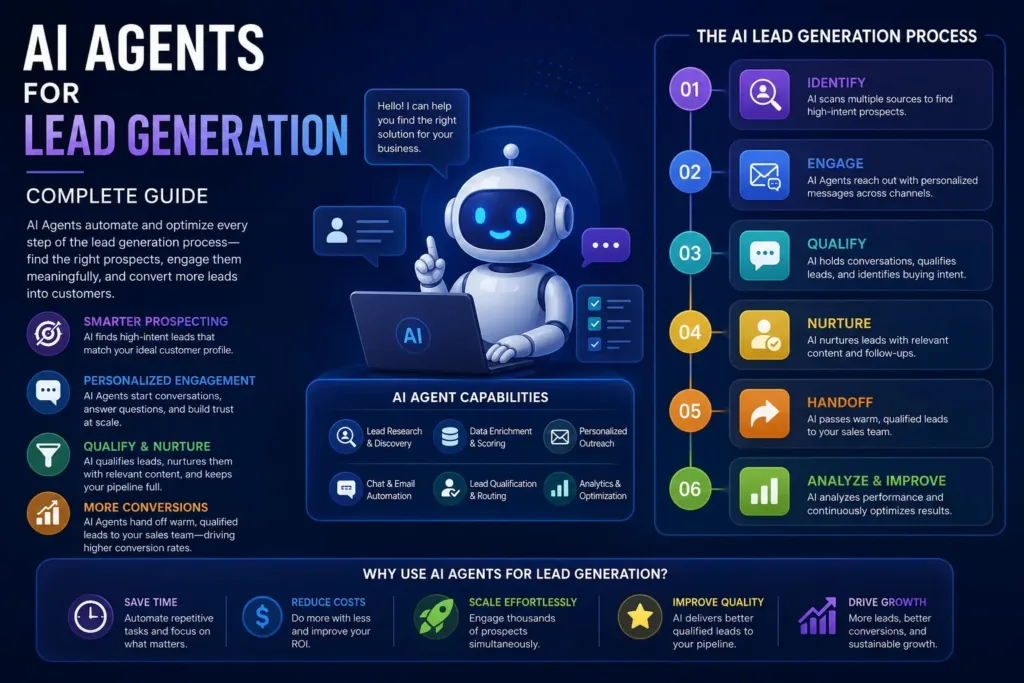
AI Agents for B2B Lead Generation are transforming how B2B companies find, qualify, and convert prospects in 2026 by automating repetitive sales tasks while keeping humans focused on high-value conversations. Instead of relying on manual research, generic email blasts, and slow follow-ups, modern teams use autonomous and semi-autonomous AI agents to identify in‑market accounts, personalise outreach, and respond to leads in real time. These systems are not magic, but when implemented thoughtfully on top of good data and clear processes, they can significantly increase the number of qualified opportunities entering your pipeline.
What Are B2B Lead Generation AI?
AI agents for lead generation are software systems that can autonomously perform tasks across the sales funnel, such as finding prospects, qualifying them, engaging in conversations, and routing hot leads to human reps, with minimal human input once configured.
Unlike traditional automation that follows rigid if–then rules, modern AI agents use machine learning and large language models to make decisions in context—deciding whom to contact, what to say, and when to follow up based on live data.
Why AI Agents Are Exploding in B2B Lead Generation in 2026
In 2026, B2B buying cycles are longer, more complex, and more digital than ever, which makes manual prospecting and generic outreach increasingly ineffective and expensive.
Teams that adopt AI-powered prospecting, scoring, and outreach are seeing more sales-ready leads and lower customer acquisition costs compared with traditional manual workflows.
Key Drivers Behind the Trend
- Speed-to-lead expectations: Prospects expect near-instant answers; AI agents can respond 24/7 on chat, email, and voice, capturing leads that would otherwise bounce.
- Data overload: There is too much intent, firmographic, and behavioural data for humans to analyse; AI agents excel at scanning thousands of signals to surface high-intent accounts.
- Personalisation at scale: AI can generate highly personalised emails, messages, and scripts based on each prospect’s context at a scale that manual teams cannot match.
- Cost and efficiency pressure: Teams are asked to do more with smaller budgets, and AI agents automate low-value tasks so humans focus on closing deals.
Types of AI Agents Used for Lead Generation
Different AI agents specialise in different parts of the lead generation funnel, and a modern stack often combines several types into one integrated system.
1. Prospecting and Data Enrichment Agents
These agents search the web, databases, and platforms like LinkedIn to find companies and contacts that match your ideal customer profile (ICP), then enrich them with firmographic and technographic data.
They can pull details such as company size, industry, tech stack, recent funding, and buying signals, and then score accounts based on how closely they match your ICP.
2. Outreach and Personalisation Agents
Outreach agents generate and send personalised messages across email, LinkedIn, and other channels, using data about each prospect to adjust tone, angle, and value proposition.
They can test multiple variants, learn which messages perform best, and optimise campaigns over time, often integrating directly with sequencing tools and CRMs.
3. Conversational Qualification Agents (Chat and Voice)
Conversational agents live on your website, landing pages, WhatsApp, or phone lines and engage visitors in natural language, asking qualifying questions and capturing contact details.
They can detect intent in real time—such as demo requests or pricing questions—and route hot leads to a human rep or automatically book meetings on a calendar.
4. Lead Scoring and Routing Agents
These agents analyse behavioural data (page views, email opens, replies, webinar attendance) and firmographic data to assign scores and decide which leads go to sales, which go to nurture, and which are unqualified.
They constantly update scores as new data arrives, ensuring sales teams work on the highest-priority prospects instead of manually inspecting every record.
5. Post-Meeting and Nurture Agents
Post-meeting agents summarise calls, extract next steps, update CRMs, and trigger follow-up sequences without reps having to type detailed notes.
Nurture agents keep in touch with leads who are not ready to buy yet, sending relevant content and re-engaging them when buying signals appear, such as new funding or product launches.
How AI Agents Actually Work in a Lead Generation Workflow
Although tools and architectures differ, most AI-led lead generation systems follow a similar end-to-end flow from data to meeting booked.
Step 1: Define an AI-Ready Ideal Customer Profile
The first step is to define an ICP using real data from your best customers, not just intuition, so that agents can recognise high-value prospects.
Modern platforms analyse closed-won deals, firmographics, product usage, and sales cycle data to build a precise ICP model that can be reused across prospecting, scoring, and outreach agents.
Step 2: Source and Enrich Prospects Automatically
Prospecting agents pull contact and account data from multiple sources—databases, social networks, company websites, and intent platforms—and then enrich each record with contextual data.
They can detect buying signals such as new funding, hiring spikes, product launches, and tech stack changes, which makes lists much closer to real in-market demand instead of static directories.
Step 3: Launch Personalised, Multi-Channel Outreach
Outreach agents use your ICP and enrichment data to generate tailored sequences for different segments, adjusting copy based on role, industry, and pain points.
They coordinate touches across email, LinkedIn, chat, and sometimes voice, and test different subject lines, hooks, and offers to learn which combinations deliver the best reply and meeting rates.
Step 4: Qualify Leads with Conversational AI
When prospects reply or land on your site, conversational agents ask structured questions about budget, timeline, decision process, and use case to determine fit and readiness to buy.
Based on their responses, the agent can either schedule a call with a sales rep, route them into a nurture journey, or provide self-serve resources while capturing their details for future outreach.
Step 5: Score, Route, and Handover to Sales
Lead scoring agents combine behavioural signals (opens, clicks, visits, replies) with qualification data from conversations to compute a dynamic score for each prospect.
When the score crosses a threshold, the agent updates the CRM, assigns the lead to the right rep or team, and pushes a concise summary so the salesperson can enter the call fully briefed.
Step 6: Close the Loop with Analytics and Optimisation
Modern AI systems continuously learn from outcomes—meetings booked, opportunities created, deals won and lost—to refine targeting, messaging, and scoring rules.
This feedback loop allows the whole lead generation engine to get more efficient over time, rather than remaining static like traditional one-off campaigns.
Benefits of Using AI Agents for Lead Generation
When implemented correctly, AI agents can transform both the volume and quality of leads, and free up reps to spend more time selling instead of doing manual admin work.
- Higher conversion rates: AI-driven targeting and scoring ensure that more of your outreach hits in-market, high-intent buyers instead of cold or unqualified contacts.
- Lower cost per lead: Automating research, personalisation, and follow-up reduces the labour cost per lead and improves return on ad spend and outbound programs.
- Faster response times: Conversational agents respond instantly to inbound interest, which is one of the strongest predictors of win rates in B2B sales.
- Consistent follow-up: AI never forgets to follow up; it can run multi-touch sequences over weeks without getting tired or distracted.
- Deeper insights: Analytics from AI workflows reveal which channels, messages, and segments generate the best pipeline, guiding better strategic decisions.
Risks, Limitations, and Common Mistakes
Despite the hype, AI agents are not magic, and rushed implementations can create more noise than value if they are not designed thoughtfully.
The most successful teams treat AI agents as specialised collaborators that support reps, not complete replacements for human judgment and relationship-building.
- Poor ICP and data foundations: If your ICP is vague or your data is messy, AI will accelerate the wrong actions at scale, producing low-quality leads.
- Over-automation of messaging: Fully automated scripts without human review can feel generic or spammy and harm brand reputation.
- Ignoring compliance and privacy: AI-driven scraping and outreach must respect consent, spam laws, and data protection regulations.
- Weak human handoff: If AI books meetings without giving reps context, conversations feel disjointed and close rates suffer.
How to Get Started with AI Agents for Lead Generation
For most teams, the best approach is to start with one or two high-impact use cases, prove value, and then expand into more advanced agentic workflows.
Step 1: Start with a Single Channel or Segment
Pick one segment (for example, a specific industry or region) and one primary channel (such as outbound email or website chat) where you want AI support first.
This focus makes it easier to measure impact, tune prompts and playbooks, and avoid overwhelming your team with too many changes at once.
Step 2: Choose Tools that Integrate with Your CRM
AI agents create the most value when they are tightly integrated with your CRM and marketing automation platform, so data flows seamlessly between systems.
Look for tools that provide native connectors for platforms like HubSpot, Salesforce, or Zoho, and that allow you to configure scoring and routing rules without writing code.
Step 3: Design Your Qualification Playbook
Before deploying conversational agents, define your qualification criteria (such as BANT or a similar framework) and turn these into a friendly sequence of questions.
Train your agents on your offers, pricing guidelines, and objection-handling approaches, and involve sales reps in reviewing transcripts and improving scripts.
Step 4: Set Guardrails and Human Oversight
Set policies for what AI agents can and cannot do—for example, they may schedule meetings and answer FAQs but should not make pricing guarantees without human approval.
Review early conversations and campaigns regularly, and create a simple escalation path so a human can take over whenever a conversation becomes complex or high-stakes.
Step 5: Measure What Matters
Define success metrics such as meetings booked, pipeline created, conversion rate from lead to opportunity, response times, and cost per qualified lead before and after AI deployment.
Use these metrics to decide where to expand AI usage, which playbooks to double down on, and where human intervention adds the most value.
Before we answer some frequently asked questions, you may also find these guides helpful:
How AI Agents Automate Customer Support: The Complete Guide
Best AI Agents for Small Businesses: Top Tools, Use Cases, and How to Choose
Frequently Asked Questions (FAQ)
What is B2B lead generation AI?
B2B lead generation AI uses artificial intelligence to identify, qualify, and engage potential business customers. It automates tasks such as prospect research, lead scoring, personalized outreach, and follow-ups, helping sales teams generate more qualified leads efficiently.
How does AI improve B2B lead generation?
AI improves B2B lead generation by analyzing customer data, identifying high-quality prospects, automating outreach, personalizing messages, and predicting which leads are most likely to convert into customers.
What are the best AI tools for B2B lead generation?
Popular AI tools for B2B lead generation include ChatGPT, Apollo.io, Clay, HubSpot AI, Salesforce Agentforce, ZoomInfo, and LinkedIn Sales Navigator with AI features. The best tool depends on your business size and sales process.
Can AI generate B2B leads automatically?
Yes, AI can automatically generate B2B leads by finding potential customers, collecting contact information, qualifying prospects, sending personalized emails, and scheduling meetings through automated workflows.
Is AI better than traditional lead generation?
AI is often more efficient than traditional lead generation because it automates repetitive tasks, analyzes large amounts of data quickly, improves targeting accuracy, and allows sales teams to focus on closing deals rather than manual prospecting.
Can AI personalize B2B sales outreach?
Yes, AI can personalize emails, LinkedIn messages, and follow-up campaigns by analyzing customer behavior, company information, and previous interactions. Personalized outreach often improves response and conversion rates.
How does AI qualify B2B leads?
AI qualifies leads by evaluating factors such as company size, industry, job title, buying intent, website activity, engagement history, and other business data to identify prospects that are more likely to become customers.
Is AI lead generation suitable for small businesses?
Yes, AI lead generation is suitable for businesses of all sizes. Small businesses can use AI to automate prospecting, reduce marketing costs, improve lead quality, and compete more effectively with larger companies.
Can AI integrate with CRM systems?
Yes, most AI lead generation tools integrate with CRM platforms such as HubSpot, Salesforce, Zoho CRM, and Microsoft Dynamics. This allows businesses to automatically update customer records and manage sales pipelines.
What are the benefits of AI in B2B lead generation?
AI helps businesses save time, reduce manual work, improve lead quality, increase sales productivity, personalize customer interactions, automate follow-ups, and boost conversion rates through data-driven insights.
Can ChatGPT generate B2B leads?
Yes, ChatGPT can support B2B lead generation by creating personalized outreach emails, writing LinkedIn messages, qualifying prospects, generating sales content, and assisting sales teams. When integrated with automation tools, it can streamline many parts of the lead generation process.
How do AI agents generate B2B leads?
AI agents generate B2B leads by researching prospects, collecting business information, qualifying leads, sending personalized messages, scheduling meetings, and updating CRM systems automatically. They can operate continuously with minimal human intervention.
Can n8n automate B2B lead generation?
Yes, n8n can automate B2B lead generation by connecting AI models with CRM systems, email platforms, LinkedIn, web scraping tools, and databases. Businesses can build workflows that collect leads, qualify prospects, send follow-ups, and manage the entire sales pipeline automatically.
What industries benefit most from AI lead generation?
AI lead generation is widely used in SaaS, IT services, digital marketing, consulting, manufacturing, finance, healthcare, real estate, logistics, and B2B e-commerce. Any business that relies on sales outreach can benefit from AI-powered lead generation.