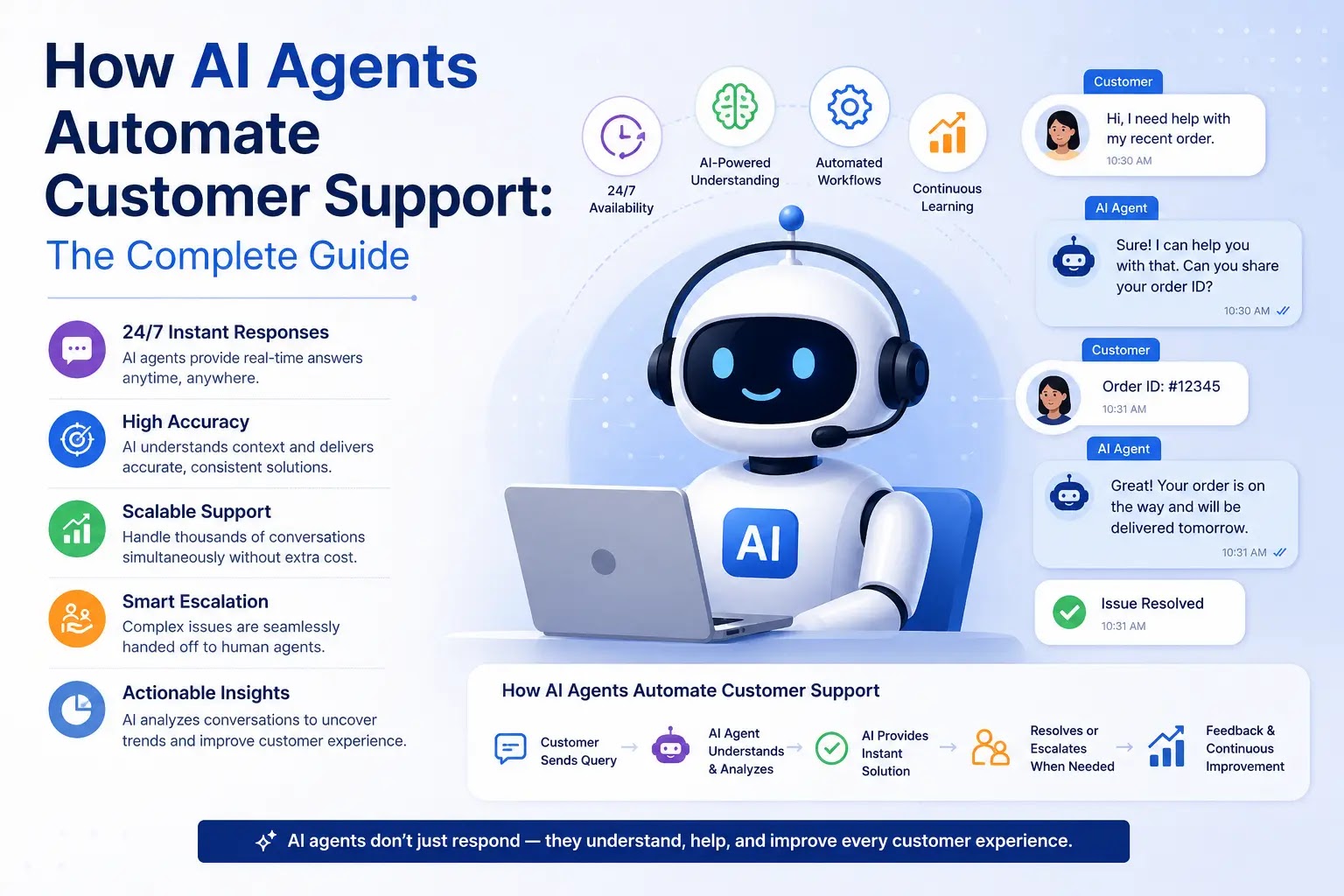
Customer support has undergone a seismic transformation in 2026. Gone are the days of long hold times, repetitive scripted chatbots, and frustrated customers waiting hours for a simple answer. Today, AI Agents for Customer Support work in multi-step tasks, resolving complex queries, and even proactively fixing problems before the customer notices them.
According to recent data, AI agents now handle 55–70% of tier-1 support tickets without any human involvement, cutting escalation handle time by 35–45%. For Indian businesses especially, this shift represents a massive competitive advantage — and it’s happening right now, across every industry from e-commerce to BFSI to SaaS.
In this guide, we’ll break down exactly how AI agents automate customer support, what makes them different from old-school chatbots, the real benefits for Indian businesses in 2026, and the top tools driving this revolution.
What Are AI Agents for Customer Support?
AI agents are autonomous software systems that can understand, reason, act, and follow up — all without a human stepping in. Unlike traditional rule-based chatbots that follow a rigid decision tree, modern AI agents use:
- Natural Language Processing (NLP) — to understand what the customer is really asking
- Large Language Models (LLMs) — to generate accurate, contextual responses
- System Integrations — to connect with CRMs, ERPs, billing platforms, and logistics tools
- Multi-Turn Conversation Management — to handle complex, back-and-forth interactions
- Autonomous Orchestration — to hand off tasks between specialized agents if needed
The result is a support agent that doesn’t just answer questions — it takes action. It can check an order status, process a refund, reset a password, rebook a shipment, and send a follow-up confirmation — all within a single conversation.
How AI Agents Automate Customer Support: Step by Step
Here is a real-world example of how an AI agent handles a customer support workflow end-to-end:
- Customer sends a message — via WhatsApp, email, live chat, or voice call.
- AI classifies intent — the agent identifies whether it’s a refund request, order issue, technical problem, or account query.
- Agent retrieves context — it pulls the customer’s order history, account status, and past interactions from the CRM.
- Agent takes action — it checks refund eligibility, initiates the return in the OMS, and updates the ticket.
- Confirmation is sent — the customer receives an instant confirmation message.
- Escalation if needed — if the issue is too complex, the agent hands off to a human with full context and a suggested resolution, so the customer never has to repeat themselves.
This entire process — which used to take 4–6 minutes per ticket and require human intervention — now happens in under 30 seconds, automatically.
Key Use Cases: Where AI Agents Excel in 2026
1. E-Commerce & Order Management
Indian e-commerce platforms use AI agents to handle L1 support — order tracking, return requests, exchange queries, and basic FAQs. An agent can pull order details from Shopify, check return eligibility, initiate the return, and send confirmation without a human touching it — saving 4–6 minutes per ticket.
2. BFSI (Banking, Financial Services & Insurance)
In the BFSI sector, AI agents monitor live transactions, detect failed payments, apply temporary grace extensions, and proactively reach out to customers with a one-click fix — often before the user is even aware of the issue. Indian BPO hubs use Multi-Agent Systems (MAS) to maintain stateful conversations across channels.
3. SaaS & Tech Support
For SaaS companies, AI agents handle password resets, VPN troubleshooting, subscription changes, billing updates, and appointment scheduling — automating the most repetitive, high-volume tickets so human agents can focus on complex, high-value issues.
4. HR & Internal IT Support
Enterprises are deploying AI agents for internal helpdesks — handling IT requests, onboarding queries, payroll FAQs, and policy lookups. This reduces the load on HR and IT teams significantly.
5. Logistics & Delivery
AI agents connected to India’s logistics platforms can detect delivery anomalies in real time, autonomously initiate re-shipments, and offer loyalty credits — all before a human agent is even notified.
The Real Benefits of AI-Powered Customer Support
The business case for AI agent adoption in customer support is undeniable. Here’s what companies are actually achieving in 2026:
- ✅ 60–70% reduction in response time — customers get answers in seconds, not hours
- ✅ 40% fewer human-handled tickets — your support team focuses on complex, meaningful work
- ✅ 24/7 availability — AI agents never sleep, never take breaks, and never call in sick
- ✅ 20% CSAT improvement — faster resolutions mean happier customers
- ✅ 15% reduction in service costs — especially significant for Indian BPOs
- ✅ Consistent quality — no bad days, no mood swings, no variation in response quality
- ✅ Scalability — handle 10,000 concurrent tickets as easily as 10, during peak sale seasons
AI Agents vs. Traditional Chatbots: What’s the Difference?
| Feature | Traditional Chatbot | AI Agent (2026) |
|---|---|---|
| Logic | Rule-based, if-then trees | Reasoning + context-aware |
| Conversations | Single-turn, scripted | Multi-turn, dynamic |
| Actions | Answers only | Takes real actions (refunds, bookings) |
| System Integration | Limited or none | CRM, ERP, billing, logistics |
| Escalation | Drops the context | Hands off with full context + summary |
| Learning | Static, requires manual updates | Continuously learns from interactions |
| Proactivity | Reactive only | Proactive — resolves before customer asks |
Top AI Agent Tools for Customer Support in 2026
- Zendesk AI Agents — industry-leading, works across voice, email, and messaging
- Kore.ai — enterprise-grade with strong CRM and ITSM integration
- Intercom Fin AI — popular with SaaS companies for its clean UX and high resolution rates
- Freshdesk Freddy AI — great for Indian SMBs; affordable and easy to deploy
- IBM watsonx Assistant — enterprise solution with strong data privacy and compliance
- Zoho SalesIQ — perfect for Indian startups and SMEs; integrates natively with Zoho CRM
- Gleap AI — growing adoption for product-led companies needing in-app support automation
AI Customer Support in India: The 2026 Opportunity
India is uniquely positioned to lead the AI customer support revolution. With the IndiaAI Mission subsidizing GPU compute at ₹65/hour, Indian BPOs and startups are building proprietary Small Language Models (SLMs) trained on localized retail, BFSI, and logistics data. This “Cognitive Load Shift” means 90% of the effort to solve a support query is now handled by AI, while human agents provide the emotional resolution — what the industry calls “Tech and Touch” synergy.
The metrics speak for themselves: Indian e-commerce and BFSI hubs using agentic AI report 20% CSAT gains and 15% service cost reductions in 2026. The industry has also moved from “First Contact Resolution” (FCR) to “LTV Velocity”, measuring how quickly an AI-human hybrid team can preserve customer lifetime value.
How to Implement AI Agents for Your Business: A Practical Roadmap
- Audit your current support tickets — Identify the top 20 recurring ticket types. These are your automation targets.
- Choose the right AI platform — Based on your size, budget, and existing tech stack.
- Integrate your knowledge base — Feed the AI agent your FAQs, product documentation, and policy documents.
- Connect to your systems — CRM, order management, billing, and logistics systems for real action-taking.
- Set escalation rules — Define clearly when and how the AI should hand off to human agents.
- Run a pilot — Start with one channel (e.g., WhatsApp or email) and one ticket category before full rollout.
- Monitor and iterate — Track resolution rates, CSAT scores, and escalation rates. Use this data to retrain and improve the agent.
Conclusion
AI agents are no longer a futuristic concept — they are the backbone of world-class customer support in 2026. From resolving refund requests in seconds to proactively fixing delivery issues before customers notice, these intelligent systems are reshaping how businesses build customer trust and loyalty.
For Indian businesses, the opportunity is massive. With affordable infrastructure, a tech-savvy workforce, and tools like Freshdesk, Zoho, and Kore.ai tailored for the Indian market, there has never been a better time to automate your customer support with AI agents. The question is no longer “Should we adopt AI in customer support?” — it’s “How fast can we deploy it?”
Before we answer some frequently asked questions, you may also find these guides helpful:
Best AI Agents for Small Businesses: Top Tools, Use Cases, and How to Choose
AI Agent Trends in India: How Autonomous AI Is Changing Business Workflows in 2026
Frequently Asked Questions (FAQs)
How do AI agents automate customer support?
AI agents automate customer support by using Natural Language Processing (NLP) and Large Language Models (LLMs) to understand customer queries, integrate with backend systems like CRMs and billing platforms to take real actions (refunds, order tracking, etc.), and manage multi-turn conversations end-to-end — all without human involvement.
What is the difference between an AI chatbot and an AI agent?
A traditional chatbot follows scripted, rule-based decision trees and can only answer questions. An AI agent can reason, take action (like processing a refund or rescheduling a delivery), maintain conversation context across multiple turns, and proactively resolve issues before the customer even raises them.
Can AI agents completely replace human customer support agents?
Not entirely — and that’s by design. In 2026, the best support operations use a hybrid model. AI agents handle 55–70% of routine tier-1 tickets, while human agents focus on complex, emotionally sensitive, or high-value cases. The human role has evolved from “ticket resolver” to “Customer Advocate.”
How much does it cost to implement AI customer support for a small business in India?
Costs vary widely. Entry-level tools like Freshdesk Freddy AI or Zoho SalesIQ start from ₹999–₹2,999/month for SMBs. Enterprise solutions like IBM watsonx or Kore.ai are priced on custom contracts. Thanks to India’s subsidized GPU compute (₹65/hour via IndiaAI Mission), building custom AI agents has also become more affordable than ever.
What types of customer queries can AI agents handle?
AI agents in 2026 can handle: order tracking and updates, return and refund requests, password resets, billing queries and payment issues, subscription management, appointment scheduling, basic technical troubleshooting, FAQ responses, shipping and logistics updates, and account verification — among many others.
How do AI agents handle complex or sensitive customer issues?
When a query exceeds the AI agent’s capability or involves sensitive topics (like financial disputes or legal complaints), the agent automatically escalates to a human agent — but passes along a full conversation summary, sentiment analysis, customer history, and a suggested resolution, so the human agent can step in seamlessly.
Are AI customer support agents safe for BFSI (banking and finance) use?
Yes — leading enterprise AI platforms are PCI-DSS 4.0.1 and DPDP 2026 compliant for Indian businesses. They use tokenized authentication, encrypted data transfer, and role-based access controls to ensure customer financial data is always protected.
What metrics should I track to measure AI customer support ROI?
Key metrics include: First Contact Resolution (FCR) rate, Average Handle Time (AHT), ticket deflection rate, Customer Satisfaction Score (CSAT), cost per ticket, escalation rate, and in 2026’s advanced frameworks — “LTV Velocity” (how quickly the AI-human team preserves customer lifetime value).
Can AI agents work on WhatsApp for Indian businesses?
Absolutely. WhatsApp Business API integration is one of the most popular AI agent deployment channels in India in 2026. AI agents can handle full customer support conversations — including order lookups, refunds, and appointment bookings — directly inside WhatsApp, which has over 500 million users in India.
What is Agentic AI in customer support, and how is it different from regular AI?
Agentic AI refers to AI systems that can autonomously plan and execute multi-step workflows without human instructions at each step. In customer support, this means an AI agent can detect a delivery delay, check the logistics API, initiate a re-shipment, apply a loyalty credit, and notify the customer — all as a single autonomous workflow.