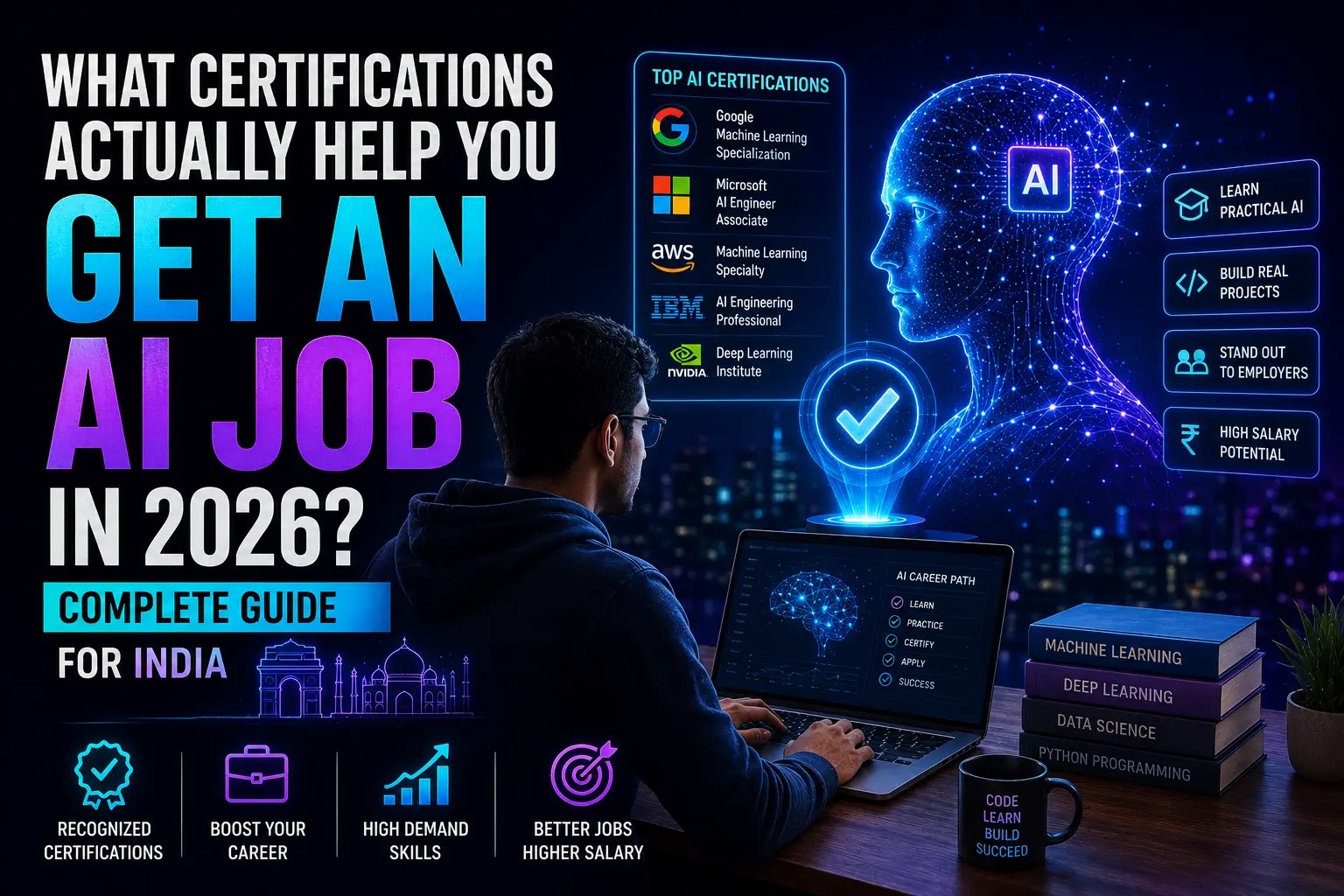
Every month, thousands of Indians finish an online AI certification and then wonder — why am I still not getting calls? The internet is flooded with courses claiming to make you “AI-ready,” but not all certifications are created equal. Some open doors. Most just fill up your LinkedIn profile.
This guide cuts through the noise. Whether you’re a fresher in Mumbai, an IT professional in Bengaluru, or a career-switcher from any Tier-2 city, here’s exactly which AI certifications actually matter in 2026 — and which ones you can skip.
Why Certifications Matter (But Aren’t Everything)
India’s AI job market is on fire. According to a 2026 report by foundit (formerly Monster APAC & ME), AI hiring is projected to grow 32% year-on-year, reaching nearly 3.8 lakh roles. Generative AI and LLM skills alone saw a 60% year-on-year demand spike.
But here’s the honest truth: certifications rank #4 in what employers actually care about, behind hands-on projects, technical skills, and real work experience. So why bother? Because a credible certification from Google, Microsoft, or IBM signals to a recruiter that you’ve covered the fundamentals — and it helps your resume survive the first filter.
Think of certifications as your entry ticket, not your golden pass.
Top AI Certifications That Actually Help in 2026
Here’s a breakdown of the certifications that consistently show up in Indian hiring discussions, placement reports, and recruiter feedback:
1. Google Professional Machine Learning Engineer
Offered by Google Cloud, this is one of the most respected ML certifications for working professionals. It covers Vertex AI, model monitoring, feature engineering, and GCP ML tools. Cost is around ₹16,500 (~$200). Best for: Backend engineers and data analysts targeting cloud ML roles.
2. DeepLearning.AI Specializations (Coursera – Andrew Ng)
This is arguably the best value-for-money certification series available globally. Andrew Ng’s courses on Deep Learning, NLP, MLOps, and LLMs are recognised by almost every AI recruiter in India. Available on Coursera for ~₹4,000/month with financial aid options. Best for: Freshers and anyone building strong foundational AI knowledge.
3. IBM AI Engineering Professional Certificate
Hosted on Coursera and backed by IBM, this certificate covers ML algorithms, deep learning, Python, and model deployment. It’s beginner-to-intermediate friendly and structured well for non-CS backgrounds. Best for: Career switchers entering AI from non-technical fields.
4. Microsoft Azure AI Engineer (AI-102)
With Microsoft Azure dominating enterprise India, the AI-102 certification has strong relevance in IT services companies like TCS, Infosys, and Wipro. It covers Azure Cognitive Services, Computer Vision, NLP, and Bot Service. Cost is approximately ₹13,700 (~$165). Best for: IT professionals already working in Azure environments.
5. AWS Machine Learning Specialty
If you’re targeting AWS cloud roles or working with startups on AWS infrastructure, this advanced certification is valuable. It covers SageMaker, data engineering, and ML deployment pipelines. Cost is around ₹25,000 (~$300). Best for: Experienced engineers moving into cloud-based ML engineering.
6. TensorFlow Developer Certificate
Offered by Google, this hands-on certificate validates your ability to build ML models using TensorFlow. It’s particularly respected for roles involving computer vision, NLP, and neural network design. Best for: Developers who want to demonstrate coding-level ML skills.
Certifications That Are NOT Worth Your Time
Not every certification delivers ROI. Here are some you should approach with caution:
- Generic “AI Fundamentals” courses from no-name platforms — recruiters can’t verify the credibility
- Outdated ML certifications from 2019–2021 that don’t cover LLMs, GenAI, or modern MLOps
- Bootcamp-only certifications that aren’t backed by a recognised tech company or university
- Over-stacking certifications without any real project to back them — 5 certificates with zero GitHub projects raises red flags
Certifications vs. Projects: What Do Indian Recruiters Actually Look At?
Based on recruiter patterns and LinkedIn data from India’s 2026 job market, here’s the real order of priority:
- Hands-on GitHub projects with real datasets and deployed models
- Technical skills demonstrated in coding rounds (Python, SQL, ML frameworks)
- Internships or freelance AI work — even small projects on Upwork count
- Certifications from reputed providers (Google, Microsoft, IBM, DeepLearning.AI)
- Academic degrees in Computer Science, Statistics, or Mathematics
A person with zero certifications but 3 deployed ML projects on GitHub will almost always get shortlisted over someone with 4 certifications and no practical work.
Which Certification Should YOU Start With?
The right certification depends on where you are right now:
- Complete beginner with no coding background? → Start with IBM AI Engineering (Coursera) or DeepLearning.AI’s AI For Everyone
- Python developer wanting to move into ML? → Go for DeepLearning.AI Deep Learning Specialization
- Working in IT/cloud (Azure/AWS)? → Get Microsoft AI-102 or AWS ML Specialty
- Targeting product or data-heavy roles? → Google Professional ML Engineer is your best bet
- Fresher wanting fast employability? → TensorFlow Developer Certificate + 2 GitHub projects
How Long Does It Take to Get Certified?
Most quality AI certifications take between 2 to 6 months of consistent study (10–15 hours/week). Here’s a rough breakdown:
- DeepLearning.AI Specializations: 3–4 months
- IBM AI Engineering: 4–6 months
- Google Professional ML Engineer: 3–5 months (requires prior ML experience)
- Microsoft Azure AI-102: 2–3 months
- TensorFlow Developer Certificate: 2–3 months
The India Advantage: Financial Aid and Affordable Access
Most of these certifications are available at reduced prices or even free for Indian learners through:
- Coursera’s Financial Aid — apply and get courses for free
- Google’s scholarship programs for cloud certifications
- NASSCOM FutureSkills Prime — India’s national upskilling platform with subsidised AI courses
- NPTEL — Free IIT-taught AI and ML courses with proctored exams
- LinkedIn Learning — free with many bank and library memberships
You do not need to spend ₹1–2 lakh on a bootcamp to get a credible AI certification. The best learning content is accessible for under ₹5,000 total.
Your AI Certification Roadmap Starts Today
The AI job market in India is one of the most exciting opportunities of this decade — and the barrier to entry has never been lower. You don’t need an IIT degree, a ₹2 lakh bootcamp, or years of experience to get started. What you need is the right certification, a couple of solid projects, and the discipline to keep building.
Pick one certification that matches where you are today. Spend the next 2–3 months earning it. Then immediately channel that knowledge into a real project you can show on GitHub. That combination — credential plus proof of work — is what gets you shortlisted in 2026. The best time to start was last year. The second best time is right now.
Before we answer some frequently asked questions, you may also find these guides helpful:
What Skills Do I Need to Start a Career in AI? Complete Guide for 2026
Data Scientist vs AI Engineer in 2026: Which Career Path Should You Choose?
Frequently Asked Questions
Which certification is best in AI?
The best AI certification depends on your career goals. Popular options include Google AI Essentials, Microsoft AI Engineer Associate, IBM AI Engineering Professional Certificate, DeepLearning.AI courses, AWS Certified Machine Learning, and the OpenAI Academy learning resources.
Are there any legitimate AI certifications?
Yes, many reputable organizations offer AI certifications. Certifications from Google, Microsoft, IBM, AWS, Coursera, DeepLearning.AI, NVIDIA, and LinkedIn Learning are widely recognized and respected by employers.
Is it worth getting a certificate in AI?
Yes, an AI certification can improve your knowledge, strengthen your resume, and demonstrate your commitment to learning. However, combining certifications with hands-on projects and practical experience provides the greatest career advantage.
What is the AI job salary?
AI salaries vary by role, location, and experience. Professionals such as AI engineers, machine learning engineers, and data scientists generally earn competitive salaries because AI skills are in high demand across many industries.
Which course is best for AI in India?
Popular AI courses in India include Google AI Essentials, IBM AI Professional Certificate, Microsoft AI courses, DeepLearning.AI programs, IIT online certifications, and Coursera AI specializations. The best choice depends on your learning goals and experience level.
Can I learn AI without coding?
Yes, beginners can learn AI concepts without coding by using no-code AI platforms and learning prompt engineering. However, programming skills such as Python become valuable for building advanced AI applications and machine learning models.
Which AI certification is best for beginners?
Google AI Essentials, Microsoft AI Fundamentals (AI-900), IBM AI Foundations, and the DeepLearning.AI Generative AI courses are excellent choices for beginners because they require little or no prior AI experience.
Are free AI certifications worth it?
Yes, free AI certifications can help you build foundational knowledge and demonstrate your interest in AI. They are especially useful for beginners, although paid certifications often provide more in-depth training and recognized credentials.
Which AI certification has the highest salary potential?
Advanced certifications in machine learning, cloud AI, and generative AI from providers such as AWS, Microsoft, Google Cloud, and IBM are often associated with higher-paying AI roles, especially when combined with practical experience.
Do AI certifications help you get a job?
Yes, AI certifications can improve your job prospects by validating your knowledge and helping your resume stand out. Employers also look for practical projects, portfolios, problem-solving skills, and relevant work experience.
What skills should I learn before AI?
Before learning AI, it is helpful to understand Python programming, basic mathematics, statistics, data analysis, and logical problem-solving. These skills make advanced AI concepts easier to understand.
How long does it take to complete an AI certification?
Most beginner AI certifications can be completed within a few weeks, while advanced professional certifications may take several months depending on the course content and your study schedule.
Which AI certification is best for working professionals?
Working professionals often choose flexible online certifications such as Google AI Essentials, Microsoft AI Engineer Associate, IBM AI Professional Certificate, AWS Machine Learning, or Coursera AI Specializations because they can be completed alongside a full-time job.