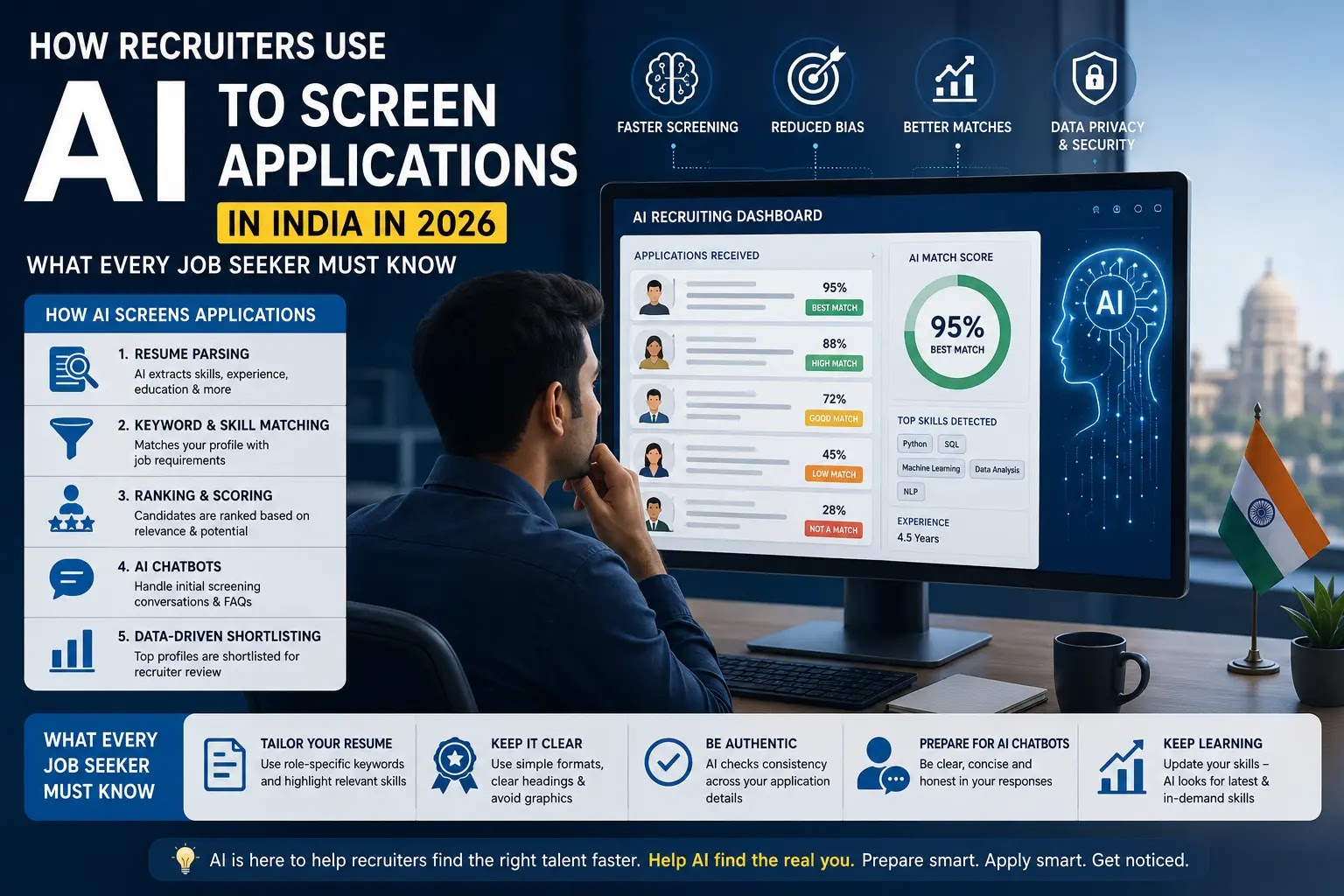
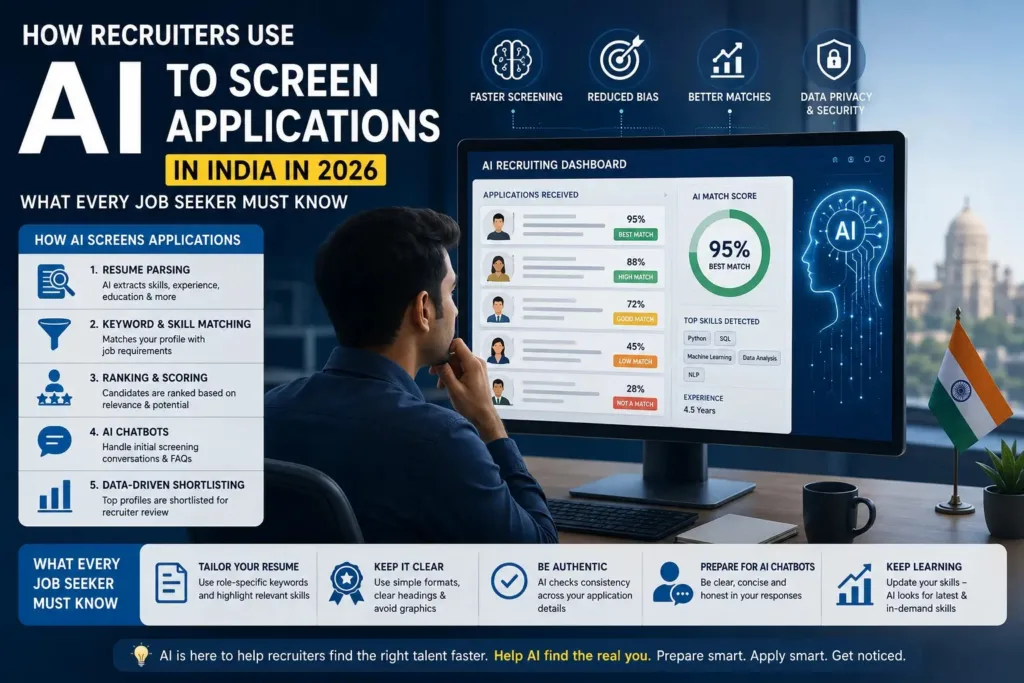
If you applied for a job recently in India and never heard back — even though you felt fully qualified — there’s a strong chance an AI system filtered your resume before any human ever read it. In 2026, AI-powered recruitment is no longer a futuristic concept in India. It is the standard operating procedure at thousands of companies, from MNC giants like Wipro and TCS to fast-growing startups on Naukri and LinkedIn recruiters Use AI.
Understanding how this AI screening works is not just helpful — it is essential for every Indian job seeker today. In this guide, we break down exactly what happens behind the scenes when you hit “Apply,” and what you must do differently to get noticed.
What Is AI Resume Screening?
AI resume screening refers to the use of machine learning and natural language processing (NLP) tools to automatically evaluate, rank, and filter job applications — without any human involvement in the initial stage. These systems, commonly known as Applicant Tracking Systems (ATS), parse your resume, extract keywords, score your profile against the job description, and decide whether you move forward.
In India, major platforms have deeply embedded AI into their hiring pipelines. Naukri’s proprietary Resume Management System (RMS) uses an AI scoring layer that ranks your profile’s visibility in recruiter searches. If your resume doesn’t score high enough, recruiters simply won’t see it — no matter how impressive your real-world experience is.
How Does AI Actually Read Your Resume?
Modern ATS systems don’t just scan for keywords. They analyse:
- Keyword relevance — Does your resume contain the same terminology as the job description?
- Skills matching — Are the specific hard and soft skills listed in the JD present in your application?
- Work history continuity — Are there unexplained gaps or illogical career progression?
- Formatting compliance — Is your resume in a machine-readable format (no tables, graphics, or unusual fonts)?
- Semantic analysis — Advanced tools like Textkernel go beyond keyword matching to understand the meaning and context of your experience.
How Indian Companies Are Using AI for Hiring in 2026
A recent LinkedIn study found that among Indian recruiters already using AI, 71% say it has helped them discover candidates they would otherwise have missed, while 80% say it makes assessing candidate skills easier. More strikingly, over 76% believe AI is already significantly speeding up their hiring process — and adoption is only accelerating.
Here’s how different stages of recruitment have been transformed by AI in India in 2026:
1. Automated Resume Shortlisting
AI tools automatically score and rank hundreds or thousands of resumes within seconds. Platforms like Manatal, SmartRecruiters, and HireBeat are widely used by Indian HR teams. They match resumes against job descriptions and generate a shortlist — meaning if your resume doesn’t hit a certain threshold score, it never reaches a recruiter’s inbox.
2. AI-Powered Pre-Screening Interviews
AI video and chatbot tools now conduct initial screening rounds before any human interviewer is involved. Candidates answer pre-set questions, and the AI assesses tone, vocabulary, confidence, and keyword alignment in their answers. This is increasingly common in IT, BPO, and banking sectors in India.
3. Skills-Based Assessment Tools
There’s a major structural shift in Indian hiring — from evaluating educational pedigree and past job titles to demonstrated skills and real capability. AI tools like SkillPool evaluate resumes based on competency rather than traditional qualifications — a game-changer for candidates from tier-2 cities or non-premium institutions.
4. LinkedIn’s AI Hiring Assistant
LinkedIn’s Hiring Assistant — now used by companies like Wipro, Siemens, and Expedia — has shown remarkable results. Early adopters report reviewing 62% fewer profiles while saving more than four hours per role, and seeing a 69% improvement in InMail acceptance rates. This means fewer but far higher-quality candidates are being shortlisted — and your profile must be one of them.
5. Naukri’s AI Profile Scoring
Naukri, India’s largest job portal, uses a proprietary AI scoring system that directly determines how visible your profile is to recruiters. Profiles with complete information, regularly updated content, the right skill keywords, and relevant certifications rank significantly higher — and get seen by far more recruiters.
The Shocking Hidden Risk: AI May Be Rejecting You Unfairly
It’s not all efficient and fair. A 2026 analysis of AI resume screening in India revealed that poorly calibrated AI systems are silently rejecting 35 to 45 percent of candidates who would have actually been excellent hires. If your resume is formatted incorrectly, uses different terminology than the JD, or lacks specific keywords — you become completely invisible to recruiters.
This is precisely why many Indian job seekers have started using ChatGPT and other AI tools to optimise their resumes specifically for ATS systems — essentially fighting AI with AI. Over 31% of Indian job seekers already use AI tools to draft resumes and cover letters as of early 2026, a number growing rapidly.
How to Beat AI Resume Screening in India in 2026
Now that you understand the system, here’s how to work it in your favour:
✅ Mirror the Job Description Language Exactly
Read the job posting carefully and use the exact phrases and keywords the employer uses — never paraphrase. If the JD says “data visualisation,” don’t write “data display.” ATS systems often cannot connect synonyms, especially in simpler implementations widely used in India.
✅ Use ATS-Friendly Resume Formatting
- Use standard fonts only: Arial, Calibri, or Times New Roman
- Avoid tables, columns, text boxes, headers/footers, and images
- Use standard section headings: Work Experience, Education, Skills
- Submit in .docx or PDF format as specified in the job posting
✅ Quantify All Your Achievements
AI systems increasingly look for measurable impact. Write “Increased sales by 32% in Q3 2025” rather than “Responsible for sales growth.” Numbers stand out to both AI parsers and the human reviewers who follow.
✅ Optimise Your Naukri and LinkedIn Profiles
In India, your Naukri profile score directly affects how often recruiters discover you. Keep it 100% updated, use skill endorsements, add certifications from platforms like Google, Microsoft, or Coursera. On LinkedIn, ensure your headline and summary contain the exact keywords most used in your target job descriptions.
✅ Customise Every Single Application
Never send the same resume to 50 different companies. Use ChatGPT or similar tools to tailor your resume and cover letter for each specific role. A customised application has a dramatically higher chance of clearing AI screening than a generic one.
✅ Use ChatGPT to Fight AI With AI
Here’s a simple prompt you can use right now:
“Here is a job description: [paste JD]. Here is my resume: [paste resume]. Rewrite my resume bullets to match the keywords and skills in this JD, keeping it honest and specific to my real experience.”
This single prompt can dramatically improve your ATS pass rate within minutes.
What Indian Recruiters Actually Want After AI Shortlisting
Despite all the automation, skilled Indian recruiters still deeply value authenticity. After AI has done the initial filter, here’s what top hiring managers in India are looking for in 2026:
- Evidence of real, measurable impact in past roles — not just responsibilities
- Consistency between your resume, LinkedIn profile, and what you say in interviews
- Clear written and verbal communication skills
- Demonstrated adaptability and digital/AI literacy — the most in-demand quality in 2026
- A genuine personal story — something no AI tool can fabricate for you
Industries in India Using AI Recruitment the Most in 2026
If you’re applying in any of these sectors, AI screening is almost guaranteed:
- Information Technology (IT/ITES) — Nearly universal ATS adoption across TCS, Infosys, Wipro, HCL
- Banking & Financial Services (BFSI) — AI screening for high-volume entry-level and analyst roles
- E-commerce & Startups — Platforms like Flipkart, Meesho, and Zomato use AI heavily for scale hiring
- BPO & Customer Service — AI video interviews are standard for initial rounds
- Consulting & Professional Services — Deloitte, EY, KPMG use AI-assisted shortlisting for campus and lateral hiring
Conclusion
The Indian job market in 2026 has fundamentally changed. AI is no longer just a tool used by job seekers — it is the first gatekeeper every application must pass through. Understanding how ATS systems score your resume, how Naukri ranks your profile, and how LinkedIn’s Hiring Assistant shortlists candidates is no longer optional knowledge. It is the baseline requirement for any serious job seeker in India today.
The good news is that this knowledge puts you in control. When you know what the machine is looking for, you can optimise for it — using tools like ChatGPT to tailor your resume, match keywords precisely, and present your real experience in the strongest possible way. At the same time, never forget that AI only gets you to the door. What gets you the job is still deeply human — your authentic story, your real achievements, and your ability to connect with the person sitting across the table.
Start treating your job search like a two-stage game: win the AI round first, then win the human round. Master both, and your chances of landing the right role in India’s competitive 2026 job market will improve dramatically.
Frequently Asked Questions (FAQ)
How do you pass AI resume screening?
To pass AI resume screening, tailor your resume to the job description, include relevant keywords, use a simple ATS-friendly format, highlight measurable achievements, and avoid graphics or complex layouts that ATS software may not read correctly.
What does AI resume screening look for?
AI resume screening looks for relevant skills, work experience, education, certifications, job titles, keywords, and qualifications that match the employer’s job requirements. It also evaluates resume structure and ATS compatibility.
Is it better to opt out of AI resume screening?
In most cases, no. Many employers use AI as part of their hiring process, and opting out may reduce your chances of being considered. Instead, focus on creating an ATS-friendly resume that performs well in automated screening.
Can ATS detect a ChatGPT-written resume?
ATS systems are designed to read resume content, not identify whether it was written using ChatGPT. However, recruiters may notice resumes that contain generic language or lack personalization. Always edit AI-generated content to reflect your real experience.
Is a 70% ATS score good?
Yes, a 70% ATS score is generally considered good. However, aiming for 80% or higher by matching the job description and including relevant keywords can improve your chances of passing the initial screening.
Do employers check if your resume is AI-generated?
Some employers use AI detection tools, but most focus on the quality, accuracy, and relevance of your resume rather than whether AI helped write it. Honest, personalized, and accurate content remains the most important factor.
Will my CV pass ATS?
Your CV is more likely to pass ATS if it uses a clean layout, standard headings, relevant keywords, and a readable file format such as PDF or DOCX. Tailoring your resume for each job also improves ATS compatibility.
What is the 7-second rule in a resume?
The 7-second rule suggests that recruiters often spend only a few seconds reviewing a resume before deciding whether to continue reading. A clear layout, strong summary, and relevant achievements help make a positive first impression.
Do companies reject AI-generated resumes?
Companies usually do not reject resumes simply because AI helped create them. However, resumes that are generic, inaccurate, or poorly matched to the job description are more likely to be rejected during screening.
How to avoid AI resume rejection?
To reduce the risk of AI resume rejection, customize your resume for each application, include job-specific keywords, use an ATS-friendly format, quantify your achievements, and proofread carefully to eliminate errors.
What is AI resume screening?
AI resume screening is the use of artificial intelligence to automatically analyze resumes, identify qualified candidates, rank applicants, and help recruiters reduce manual screening time.
How accurate is AI resume screening?
AI resume screening can be highly accurate when trained on quality data and clear job requirements. However, human recruiters still review shortlisted candidates to assess soft skills and overall fit.
Can AI reject your resume automatically?
Yes, AI-powered ATS systems can automatically filter out resumes that do not meet minimum job requirements, lack important keywords, or fail to match the qualifications specified in the job posting.
How can I make my resume ATS-friendly?
Create an ATS-friendly resume by using standard section headings, a simple layout, relevant keywords, bullet points, readable fonts, and avoiding tables, images, text boxes, or excessive graphics.
What keywords should I include in my resume?
Include keywords taken directly from the job description, such as required skills, certifications, programming languages, software tools, job titles, and industry-specific terms that match your qualifications.
Is an ATS-friendly resume important in 2026?
Yes, ATS-friendly resumes are more important than ever because many employers use AI and applicant tracking systems to screen candidates before a human recruiter reviews applications.
Can AI help improve my resume?
Yes, AI tools can help improve resumes by suggesting stronger wording, optimizing keywords, checking grammar, enhancing formatting, and tailoring content to specific job descriptions. However, always review the final version to ensure it accurately reflects your experience.
Also Read: