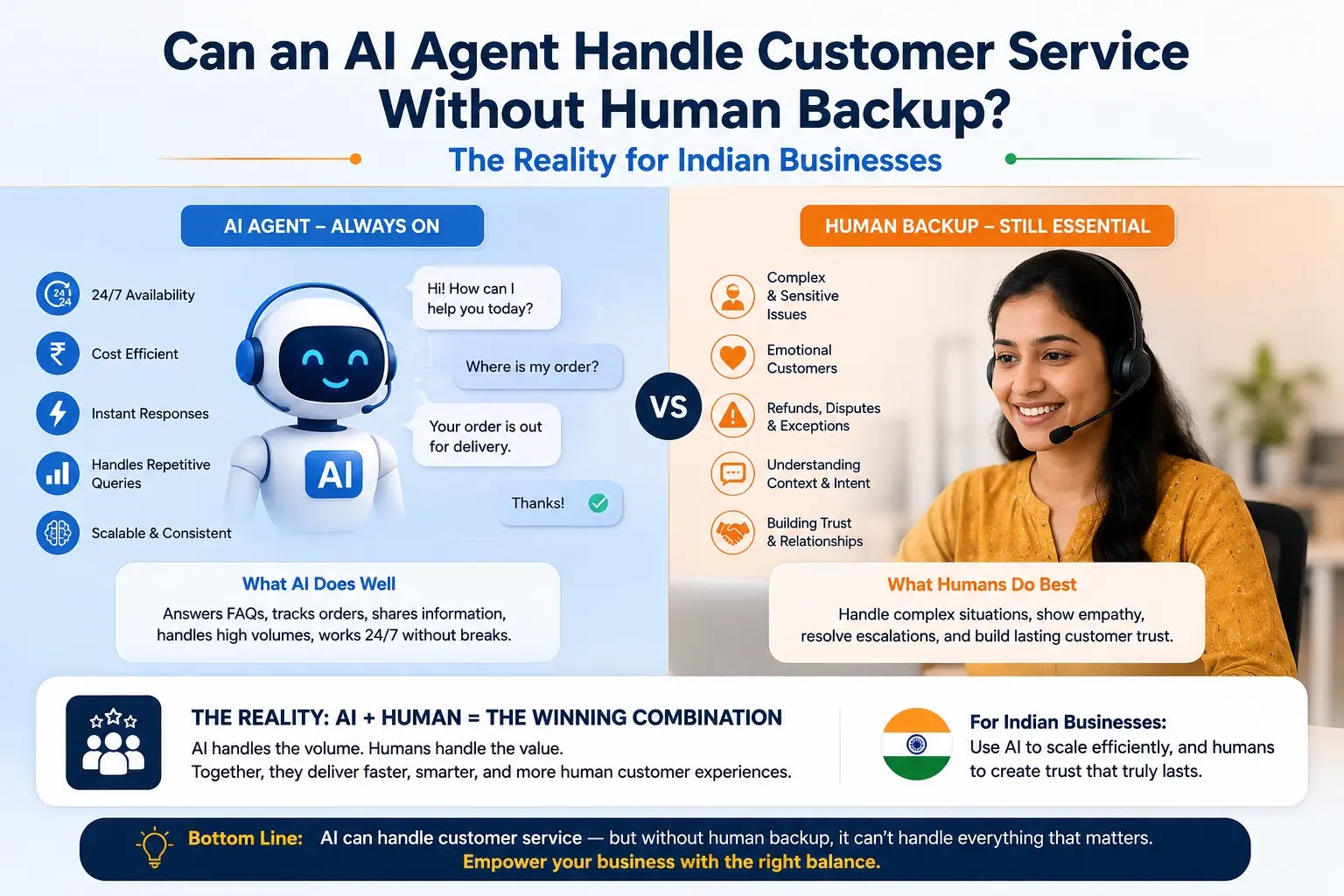
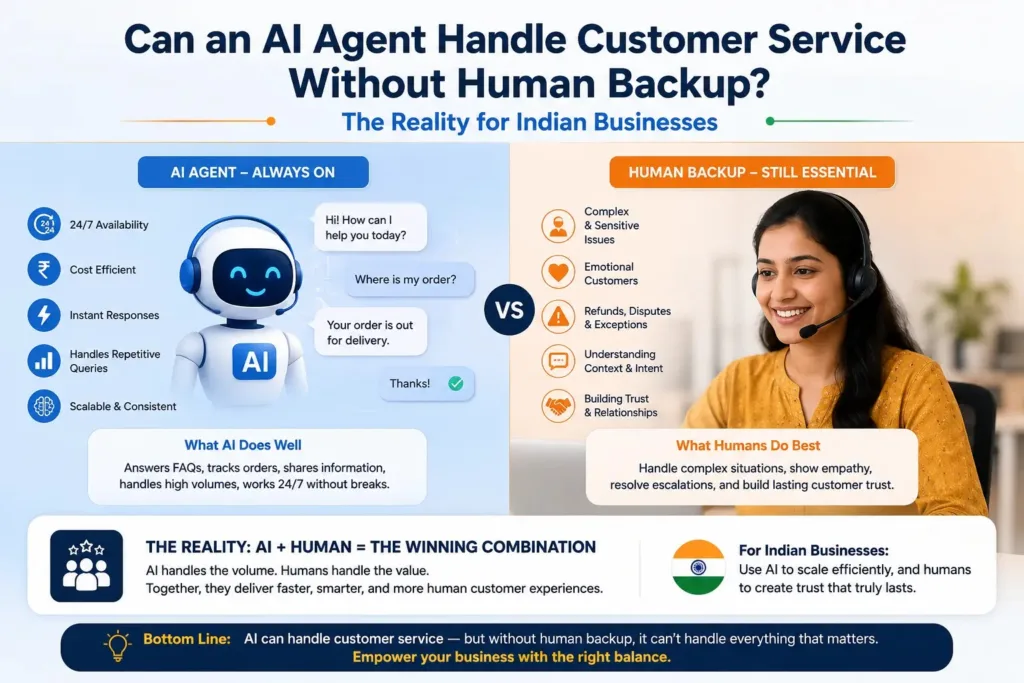
Every business owner in India is asking some version of the same question right now: can we use an AI Customer Service Agents ? Whether you run a D2C brand in Bengaluru, a logistics company in Delhi, or an IT services firm in Pune, the idea is tempting — a tireless digital agent answering every query, resolving every complaint, and keeping customers satisfied 24 hours a day, 365 days a year. No salaries, no sick days, no training cycles. Just results.
But the honest answer is more nuanced than the sales pitches suggest. In 2026, AI agents for customer service have made a genuine leap forward — they can autonomously resolve 60–80% of routine customer interactions without any human involvement, a number that was below 30% just two years ago. The remaining 20–40%? That still needs a human, and getting the balance right is what separates businesses that succeed with AI customer service from those that damage their reputation trying.
This guide breaks down exactly what AI agents can handle independently, where they still need human support, what it actually costs to implement in India, and how to set one up that works reliably from day one.
Why AI Agents in 2026 Are Nothing Like the Chatbots You Remember
If your reference point for “AI Agents for Handle Customer Service” is the frustrating rule-based chatbot that kept saying “I’m sorry, I didn’t understand that” in 2022, you need to reset your mental model entirely. Those systems were essentially fancy decision trees — useful for routing calls, useless for actually resolving anything.
Modern AI agents in 2026 are built on large language models and agentic frameworks that allow them to reason, retrieve live data, and take real actions. They can pull up a customer’s order history from your OMS, check real-time logistics data, initiate a refund in your payment system, update CRM records, send follow-up emails, and schedule callbacks — all within a single conversation. They support Hindi, Tamil, Telugu, Bengali, Marathi, Kannada, and other Indian languages with meaningfully high accuracy. And they get better over time as they process more interactions from your specific business context.
The key distinction: old chatbots could only talk. New AI agents can act.
AI Agents for Handle Customer Service Their Own
Here is where AI agents genuinely deliver in customer service — tasks they can own from start to finish, without any human stepping in:
Order Tracking and Real-Time Status Updates
A customer sends a WhatsApp message: “Where is my order?” Within seconds, the AI agent queries your logistics integration, pulls the live delivery status, and replies with a precise update including expected delivery time. This is the single highest-volume query for most Indian e-commerce and D2C businesses, and AI handles it flawlessly.
Returns, Exchanges, and Refund Processing
AI agents can check return eligibility against your policy, initiate the return in your order management system, generate a return shipping label, and send the customer a WhatsApp or email confirmation — end to end, without human involvement. Indian e-commerce brands using this automation report saving 4–6 minutes per return ticket, which adds up to hundreds of hours monthly at scale.
FAQ, Policy, and Product Information Queries
“Do you deliver to Assam?” “What is your cancellation window?” “Does this product have a warranty?” These questions — which account for a significant chunk of all support volume — are answered instantly, consistently, and accurately by AI agents trained on your product catalog and policy documents.
Appointment Scheduling and Callback Booking
AI agents integrated with your calendar can offer available slots, confirm bookings, and send reminders — automatically. This works well for service businesses, clinics, educational institutes, and any company that handles consultation bookings.
Billing, Invoice, and Payment Queries
Common billing questions, GST invoice resending, payment confirmation follow-ups, and subscription status queries are fully within AI agents’ autonomous capability when connected to your billing system.
First-Level Complaint Logging
Even when an issue is too complex for immediate resolution, AI agents can collect all relevant details from the customer, create a structured ticket in your helpdesk, and give the customer an acknowledgment with a realistic resolution timeline — all without a human getting involved at the initial intake stage.
Where Human Backup Remains Non-Negotiable in 2026
Any vendor claiming 100% autonomous AI customer service is overselling. Here are the situations where removing human backup would be a costly mistake:
Emotionally Charged and High-Distress Situations
When a customer is genuinely distraught — a damaged wedding order, a medical billing error, a lost luggage situation — the gap between AI de-escalation and human empathy becomes very visible. AI can identify negative sentiment and escalate immediately, but the resolution conversation should happen with a human agent who can read the emotional context and respond accordingly.
Legal, Compliance, and High-Value Financial Decisions
Contract disputes, insurance claim disputes, large financial transactions, or any interaction that could have regulatory implications should always involve a human. In India’s regulatory environment in 2026, AI agents making autonomous decisions in these areas creates both legal risk and customer trust issues.
Unprecedented or Novel Situations
AI agents excel at handling patterns they’ve been trained on. A product recall affecting thousands of customers, a payment gateway failure causing mass order issues, or a new type of fraud attempt — these situations require human judgment, institutional authority, and the ability to improvise. AI can alert and triage, but humans must lead the response.
Strategic Customer Relationships
Your top 5–10% of customers — who often drive 40–60% of revenue in B2B contexts — should have named human contacts for their most important interactions. AI can handle routine queries even for VIP customers, but the relationship-critical moments require the human touch that justifies the premium they’re paying.
The Hybrid Model: How Successful Indian Businesses Structure This in 2026
The most effective implementations across India are not pure AI or pure human — they’re intelligently layered hybrid systems. The structure that works consistently looks like this:
- Tier 1 (AI autonomous, 60–75% of all queries): Routine, information-seeking, transactional interactions. AI handles end-to-end with no human in the loop.
- Tier 2 (AI-assisted handoff, 15–20%): AI identifies complexity early, gathers full context from the customer, creates a detailed handoff note, and routes to the appropriate human agent — who walks in fully briefed.
- Tier 3 (Human-led, 10–15%): Complex, emotional, high-value, or legally sensitive situations handled entirely by experienced team members.
A mid-sized retail brand in India that implemented this model went from a team of 9 customer support agents to 3 — not through layoffs, but by redeploying 6 people to outbound sales, retention calls, and quality assurance roles. AI handles the volume; humans handle what actually requires intelligence and empathy.
Real Cost Benchmarks for Indian Businesses in 2026
Cost is where most Indian business owners get surprised — both pleasantly and unpleasantly. Here is what actual implementation looks like:
- SaaS platform costs: ₹3,000–₹25,000/month depending on volume, channels, and features (Freshdesk Freddy AI, Zoho SalesIQ with AI, Intercom Fin)
- Custom API-based builds: ₹5,000–₹15,000/month in API usage costs + ₹50,000–₹2,00,000 one-time development and integration cost
- India-specific platforms (UnleashX, Rezo.ai): ₹8,000–₹30,000/month, designed for Indian languages and WhatsApp-first interactions
- Break-even timeline: Typically 3–6 months for businesses handling 500+ customer interactions per month
- ROI at scale: Businesses handling 5,000+ monthly interactions commonly report 40–60% reduction in support costs within the first year
The key variable is integration complexity. A business already using Freshdesk or Zoho can be live in 1–2 weeks at minimal cost. A business with custom-built OMS, proprietary CRM, and multiple sales channels needs 6–12 weeks and significant development investment to build a reliable integration layer.
How to Set Up an AI Customer Service Agents: A Step-by-Step Guide for Indian Businesses
Step 1: Audit Your Support Volume Before Anything Else
Pull 3 months of support ticket data. Categorize every query type. Identify your top 20 query categories and what percentage of total volume they represent. This single exercise tells you exactly how much an AI agent can realistically automate — and prevents you from over-investing or under-estimating scope.
Step 2: Choose Your Platform Based on Your Stack, Not the Marketing
The best AI customer service platform is the one that integrates cleanly with your existing OMS, CRM, and communication channels. For businesses on WhatsApp-first, India-specific platforms like UnleashX or Rezo.ai offer out-of-the-box support for 12+ Indian languages and native WhatsApp Business API integration. For businesses in the Zoho or Freshworks ecosystem, the AI features built into those platforms are often the lowest-friction starting point.
Step 3: Build Your Knowledge Base Properly
Feed your AI agent your complete product catalog, all historical support tickets (redacted for PII), your refund and return policies, shipping timelines, escalation protocols, and any business-specific rules. Quality of training data is the single biggest predictor of AI agent accuracy in the first 90 days.
Step 4: Run in Shadow Mode for 3–4 Weeks
Before autonomous operation, run the AI in shadow mode — it generates responses but a human reviews them before sending. This surfaces gaps, edge cases, and tone issues quickly and safely, without any customer ever seeing a bad AI response.
Step 5: Define Your Escalation Triggers Precisely
Set non-negotiable escalation triggers: specific keywords (“legal notice,” “consumer court,” “media”), customer sentiment score below a set threshold, VIP customer tags, transaction values above a defined amount, or any mention of health, safety, or fraud. These triggers should route instantly to a human — no AI autonomy in these situations.
Step 6: Measure and Iterate Weekly in the First Quarter
Track CSAT scores, first-contact resolution rates, escalation rates by category, and average handling time weekly. Most platforms allow you to flag incorrect AI responses for retraining. The first 90 days of active monitoring is when your AI agent improves the most — don’t skip this phase.
Before we answer some frequently asked questions, you may also find these guides helpful:
What’s the Interview Process Like at OpenAI? Complete Guide for 2026
How to Avoid Bias in AI-Powered Hiring Decisions in 2026: A Complete Guide for Indian Recruiters
Frequently Asked Questions (FAQ)
What are AI agents in customer service?
AI customer service agents are intelligent software programs that use artificial intelligence to answer customer questions, resolve issues, process requests, and automate support tasks. They provide fast, accurate, and personalized assistance across chat, email, voice, and messaging platforms.
What is an AI agent for customer service calls?
An AI agent for customer service calls is a voice-powered virtual assistant that understands spoken language, answers customer inquiries, routes calls, schedules appointments, and completes routine tasks without requiring a human representative.
What are the top 5 AI agents?
Some of the leading AI agents are ChatGPT, Google Gemini, Anthropic Claude, Microsoft Copilot, and Salesforce Agentforce. These AI agents are widely used for customer support, business automation, content creation, and enterprise productivity.
Can AI handle customer service?
Yes, AI can handle many customer service tasks, including answering frequently asked questions, tracking orders, processing returns, scheduling appointments, and resolving common issues. Human agents can focus on more complex or sensitive customer requests.
Who are the big 4 AI agents?
The four leading AI agent platforms are ChatGPT, Google Gemini, Anthropic Claude, and Microsoft Copilot. They provide advanced AI capabilities for customer support, automation, business operations, and productivity.
What is the best AI tool for customer service?
The best AI tool depends on your business needs. ChatGPT is excellent for conversational support, Zendesk AI enhances help desk operations, Salesforce Agentforce supports enterprise service teams, Intercom AI automates customer conversations, and Google Gemini integrates well with Google Workspace.
How do AI customer service agents work?
AI customer service agents use natural language processing, machine learning, and business data to understand customer requests, generate accurate responses, and complete tasks such as checking orders, updating accounts, or creating support tickets automatically.
What are the benefits of AI customer service agents?
AI customer service agents provide 24/7 support, reduce response times, lower operational costs, improve customer satisfaction, automate repetitive tasks, and allow human agents to focus on more complex customer issues.
Can AI customer service agents answer customer queries 24/7?
Yes, AI customer service agents can provide round-the-clock support by answering common questions, resolving routine issues, tracking orders, and assisting customers at any time without waiting for business hours.
Can AI customer service agents integrate with CRM systems?
Yes, AI customer service agents can integrate with CRM platforms such as Salesforce, HubSpot, Zoho CRM, and Microsoft Dynamics. This allows them to access customer information, personalize conversations, and automatically update customer records.
Can AI customer service agents speak multiple languages?
Yes, many AI customer service agents support multiple languages, enabling businesses to provide customer support to users around the world while maintaining consistent service quality.
Are AI customer service agents secure?
Yes, AI customer service agents can be secure when implemented with proper authentication, encryption, role-based access controls, and compliance with data privacy regulations such as GDPR and other applicable laws.
Can small businesses use AI customer service agents?
Yes, AI customer service agents are suitable for businesses of all sizes. Small businesses can use them to automate customer support, reduce workload, improve response times, and provide professional service without hiring large support teams.