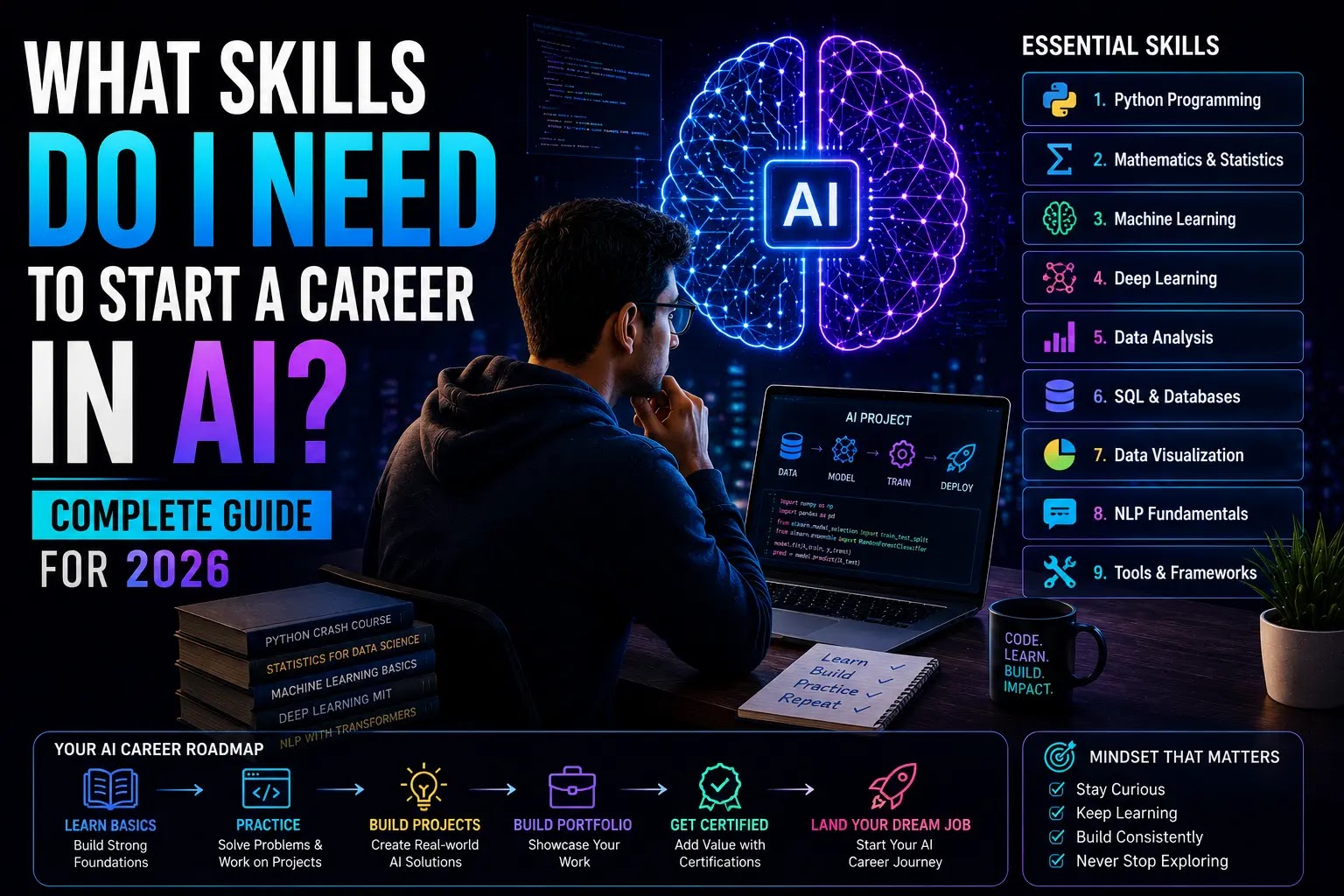
Every week in India, thousands of freshers, software developers, and career switchers ask the same question: what are AI Job Skills required to Start a Career in AI? With over 1 million AI jobs expected in India by 2026 and a documented 51% demand-supply gap in AI talent, the opportunity is real — but so is the confusion about where to begin. This guide cuts through the noise and gives you a clear, practical answer based on what Indian companies are actually hiring for right now.
Whether you’re a college student eyeing your first tech role, a developer looking to pivot, or a professional from a completely different field, this guide covers everything: core skills, salary expectations, the easiest entry points, and how long it realistically takes to land your first AI job in India.
The Core AI Job Skills to Start a Career in AI
Starting an AI career in India in 2026 doesn’t require a PhD or a decade of experience. It requires the right technical foundation, a project portfolio, and consistency. Here are the six essential skill areas:
1. Python Programming
Python is the backbone of AI and Machine Learning. You need more than basic syntax — you need fluency with libraries like NumPy, Pandas, Scikit-learn, TensorFlow, and PyTorch. Python + ML framework expertise alone adds a ₹5–8 LPA salary premium over regular developers in India. If you can only learn one thing first, make it Python.
2. Machine Learning Fundamentals
Understanding how ML algorithms work — regression, classification, clustering, neural networks — is non-negotiable. You should be able to build and evaluate models from scratch, not just run pre-written code. Focus on understanding the “why” behind each algorithm, not just the syntax.
3. Data Skills — SQL and Statistics
Every AI model runs on data. You need SQL for querying databases, basic statistics (mean, standard deviation, probability, distributions) for interpreting results, and data wrangling skills for cleaning messy real-world datasets. Data engineering skills add a 45% salary premium when combined with AI expertise.
4. Generative AI and Large Language Models (LLMs)
This is the fastest-growing area in AI hiring right now. NLP and LLM specialist roles have grown by 170% in India in the last 12 months. You should understand prompt engineering, fine-tuning LLMs, building RAG (Retrieval Augmented Generation) systems, and working with APIs like OpenAI, Claude, or Gemini.
5. Cloud Platforms
AWS dominates in India, followed by Google Cloud and Azure. Deploying ML models on the cloud, using managed AI services (like AWS SageMaker or Vertex AI), and understanding basic MLOps pipelines are becoming baseline requirements even for mid-level roles. One cloud certification significantly improves your job prospects.
6. AI Ethics and Responsible AI
A rare but rapidly growing skill area. As companies deploy AI in customer-facing products, they need professionals who understand bias detection, fairness audits, model explainability, and compliance with India’s Digital Personal Data Protection (DPDP) Act. AI Ethics Compliance roles are growing at 80% year-on-year with salaries up to ₹45 LPA.
How Much Do AI Engineers Make in India in 2026?
AI is among the highest-paying career tracks in Indian tech right now, with salaries growing 15–20% annually. Here’s a breakdown by experience level:
- Entry Level (0–2 years): ₹6–12 LPA — Junior AI Engineer, ML Associate, Data Analyst with AI tools
- Mid Level (2–5 years): ₹15–30 LPA — AI Engineer, ML Engineer, Data Scientist, Prompt Engineer
- Senior Level (5+ years): ₹30–60 LPA — Senior AI Engineer, AI Lead, Principal ML Engineer
- Global Remote / Senior Research: India-equivalent of ₹60–80 LPA
Bengaluru is the top-paying city, offering a +25% premium over the national average, followed by Hyderabad (+15%) and Pune (+10%). For context, career earnings can climb from about ₹7 LPA at entry level to ₹30 LPA or more within five years, often with performance bonuses and equity. The window to get in at a competitive salary is right now.
Is Machine Learning a Good Career Choice in 2026?
Absolutely yes. Machine Learning is not just a good career — it’s one of the most strategically sound choices in Indian tech right now. Consider these facts:
- ML Engineer roles command ₹8–12 LPA at entry level, rising to ₹30–55 LPA at senior level
- India’s AI/ML market is growing at 40%+ annually with a documented 51% demand-supply gap
- The skills transfer across every sector — finance, healthcare, e-commerce, manufacturing, agritech
- Companies like TCS, Infosys, Wipro, Flipkart, Swiggy, Zomato, and hundreds of funded startups are in active AI hiring mode
- India’s AI market is expected to hit $17 billion by 2027 (NASSCOM) — and job creation follows investment
The skills gap is real. For every two AI jobs open in India, only one qualified candidate exists. That’s not a crisis — that’s an opportunity for anyone willing to build the right skills now.
What’s the Difference Between AI Jobs and ML Jobs?
The terms “AI” and “ML” are often used interchangeably in job postings, but there are meaningful distinctions in scope and required skills:
| Dimension | AI Jobs | ML Jobs |
|---|---|---|
| Scope | Broad — includes robotics, NLP, vision, LLMs, strategy | Focused — building, training, and deploying statistical models |
| Common Roles | AI Engineer, AI Product Manager, AI Researcher, LLM Developer | ML Engineer, Data Scientist, MLOps Engineer |
| Key Skills | System design, LLMs, Python, cloud architecture, business strategy | Python, TensorFlow/PyTorch, statistics, SQL, feature engineering |
| Salary Range (Senior) | ₹25–60 LPA+ | ₹30–55 LPA+ |
| PhD Required? | Only for AI Research Scientist roles | Rarely required in India |
In practice, most Indian product companies use “AI Engineer” and “ML Engineer” somewhat interchangeably. The real differentiator is domain specialization: are you working on NLP, Computer Vision, Generative AI, or classical ML pipelines?
How Long Does It Take to Get an AI Job?
With a focused plan, most people can land their first AI job within 6–12 months. Here’s a realistic, tested roadmap based on what Indian hiring managers actually look for:
- Months 1–2: Master Python fundamentals + basic statistics and probability
- Months 3–4: Learn core ML concepts — supervised learning, unsupervised learning, neural networks
- Month 5: Pick one specialization area — Computer Vision, NLP, or Generative AI — and go deep
- Month 6: Build 3–5 portfolio projects, publish on GitHub, get on Kaggle, start applying
If you come from a software development or data analysis background, this timeline can compress to 3–4 months. The single most important accelerator is building real projects that solve real problems — not collecting certificates.
What AI Jobs Don’t Require a PhD?
The vast majority of AI jobs in India do not require a PhD. A PhD is primarily needed for pure Research Scientist roles at organizations like Google DeepMind, Microsoft Research, or IIT AI labs. Every other major AI role hires on skills and projects:
- ML Engineer — ₹8–55 LPA depending on experience, B.Tech/B.E. is standard
- Generative AI / LLM Engineer — ₹10–60 LPA, highest growth role in 2026
- MLOps Engineer — ₹8–50 LPA, combines DevOps + ML skills
- Data Scientist — ₹6–50 LPA, one of the most common entry points
- Prompt Engineer — ₹20–50 LPA, even freshers are breaking in
- AI Product Manager — ₹28–45 LPA, no coding required but needs ML understanding
- AI Testing Engineer — ₹18–30 LPA, excellent low-barrier entry role
Which AI Jobs Are Easiest to Get Into?
If you’re starting from scratch with no AI background, these five roles have the lowest barriers to entry in 2026 — and all are genuinely in demand:
- Prompt Engineer: High demand, entry-level roles available across startups and product companies, no deep coding required. Salaries start at ₹20 LPA for good candidates.
- AI Testing / QA Engineer: Test automation knowledge + basic Python is enough to start at ₹10–18 LPA. AI testing is an underrated entry point.
- Data Analyst with AI Tools: If you know Excel and SQL, add Python and AI-assisted analytics to cross over into AI-adjacent roles at ₹8–15 LPA.
- AI Content Specialist / AI Marketing: Use GenAI tools for content writing, image generation, and video production. This is growing fast in e-commerce and media companies.
- Junior ML Engineer: With 3–5 well-documented GitHub projects and basic ML skills, many Indian startups will hire freshers at ₹6–12 LPA and train them on the job.
How Do I Switch to an AI Career from Another Field?
Career switching into AI is one of the most common transitions in Indian tech right now — and the good news is that your existing domain knowledge is actually an asset, not a liability. Here’s how different professionals can make the switch:
- Software Developers: Learn ML frameworks (TensorFlow or PyTorch), build 3–5 ML projects on GitHub, and target ML Engineer or LLM Developer roles. Realistic transition time: 3–6 months.
- Data Analysts: Add Python ML libraries (Scikit-learn, Pandas) and build at least two predictive models. Target Data Scientist or Junior ML Engineer roles. Transition time: 4–6 months.
- Finance / Healthcare / Manufacturing Professionals: Target AI Product Manager or AI Consultant roles where domain expertise + basic AI understanding makes you far more valuable than a pure AI engineer without context.
- Non-Tech Professionals: Start with Prompt Engineering, AI Marketing, or AEO (Answer Engine Optimization). Build a portfolio of AI-generated projects and get hired at the intersection of your existing skills + AI tools.
The golden rule for career switching: combine your existing expertise with AI, rather than trying to restart from zero. A doctor who understands medical AI has more leverage than a fresh ML graduate without clinical context.
Are AI Jobs Actually In Demand?
Yes — dramatically so. If you’ve heard that “AI will take jobs,” the more accurate statement right now is that AI is creating more specialized jobs than it eliminates, especially in India. Here’s what the data shows:
- Over 1 million AI jobs expected in India by 2026, with only ~3.37 lakh qualified candidates available
- AI/ML developer roles have increased by 170% in job postings on Naukri and LinkedIn India
- AI Agents Developer postings are up 110% year-on-year
- Multimodal AI Engineer demand spiked 95% in 2025–26
- India’s AI market is projected to reach $17 billion by 2027 (NASSCOM)
- Every major Indian IT company — TCS, Infosys, Wipro, HCL — has publicly committed to hiring thousands of AI-specialized engineers in 2026
How Much AI Experience Do You Need for Your First Job?
This is the best news for anyone starting out: you don’t need years of industry experience to land your first AI job in India. What hiring managers at startups and mid-size product companies actually look for in freshers:
- 3–5 strong ML projects on GitHub — this single thing replaces 1–2 years of “experience” in most evaluations
- Proficiency in Python and at least one ML framework (TensorFlow or PyTorch)
- Demonstrated understanding of one AI domain — NLP, Computer Vision, or GenAI
- A cloud or ML certification is a bonus signal, not a requirement
- Kaggle rankings and open-source contributions are powerful differentiators
Entry-level AI roles in India start at ₹6–12 LPA for 0–2 years experience. The talent gap means that freshers with solid portfolios are being actively recruited — you don’t need to wait for “years of experience” before applying. Start building now, and start applying with your first real project done.
Final Thoughts: Your AI Career Starts Today
The AI job market in India in 2026 is unlike anything the tech industry has seen before. A 51% talent gap, 1 million+ open roles, and salaries growing 15–20% annually — these aren’t projections anymore, they’re the present reality. The skills you need are learnable in 6 months with consistency. The projects that get you hired can be built on a laptop at home. The only thing that separates people who break into AI from those who don’t is action.
Pick one specialization — NLP, Computer Vision, or Generative AI. Spend 30–60 minutes a day building that skill. Ship real projects. This wave of AI opportunity in India is expected to last 5–10 years, just like the IT services boom of the early 2000s. The best time to get in was last year. The second best time is today.
Before we answer some frequently asked questions, you may also find these guides helpful:
10 AI Jobs That Indian Companies Are Desperately Hiring For in 2026
Agentic AI in India in 2026: How Autonomous AI Is Reshaping Work, Business and the Economy
Frequently Asked Questions (FAQ)
What skills do I need for AI jobs?
AI jobs typically require skills in Python programming, machine learning, mathematics, statistics, data analysis, SQL, cloud computing, and problem-solving. Knowledge of generative AI, prompt engineering, and AI automation tools is also becoming increasingly valuable.
Is AI a stressful career?
AI can be challenging because it involves continuous learning and solving complex problems. However, many professionals find it rewarding due to strong career growth, competitive salaries, and opportunities to work on innovative technologies.
Which 5 jobs will survive AI?
Jobs that require creativity, leadership, emotional intelligence, and hands-on expertise are expected to remain in demand. Examples include AI engineers, healthcare professionals, teachers, cybersecurity experts, and skilled trades.
Is AI a high-paying job?
Yes, AI is one of the highest-paying career fields. AI engineers, machine learning engineers, data scientists, and AI researchers often receive competitive salaries due to the growing demand for AI expertise.
Can I join AI after 12th?
Yes, you can start learning AI after completing 12th grade. Many students pursue degrees in computer science, artificial intelligence, or data science, while others begin with online AI courses and programming fundamentals.
What are the most important AI skills in 2026?
The most valuable AI skills include Python, machine learning, generative AI, prompt engineering, large language models (LLMs), AI agents, data analysis, cloud computing, MLOps, and AI automation using platforms like n8n.
Can I get an AI job without coding?
Yes, some AI-related roles such as prompt engineering, AI content strategy, AI consulting, AI training, and no-code AI automation require little or no programming. However, coding skills open up more career opportunities.
Which programming language is best for AI?
Python is the most widely used programming language for AI because of its powerful libraries such as TensorFlow, PyTorch, Scikit-learn, and Hugging Face.
Do AI jobs require a degree?
No, many employers value practical skills, certifications, and project experience over formal degrees. A strong portfolio, GitHub projects, and AI certifications can significantly improve your chances of getting hired.
What soft skills are important for AI careers?
AI professionals benefit from communication, critical thinking, teamwork, creativity, adaptability, problem-solving, and continuous learning. These skills complement technical expertise and are highly valued by employers.
Which AI skills are most in demand by employers?
Employers are actively seeking professionals with skills in generative AI, machine learning, AI agents, LLMs, cloud AI services, prompt engineering, computer vision, NLP, MLOps, and workflow automation.
How long does it take to learn AI skills?
You can learn AI fundamentals within three to six months through consistent practice. Becoming job-ready typically takes six to twelve months, depending on your background, learning pace, and hands-on project experience.