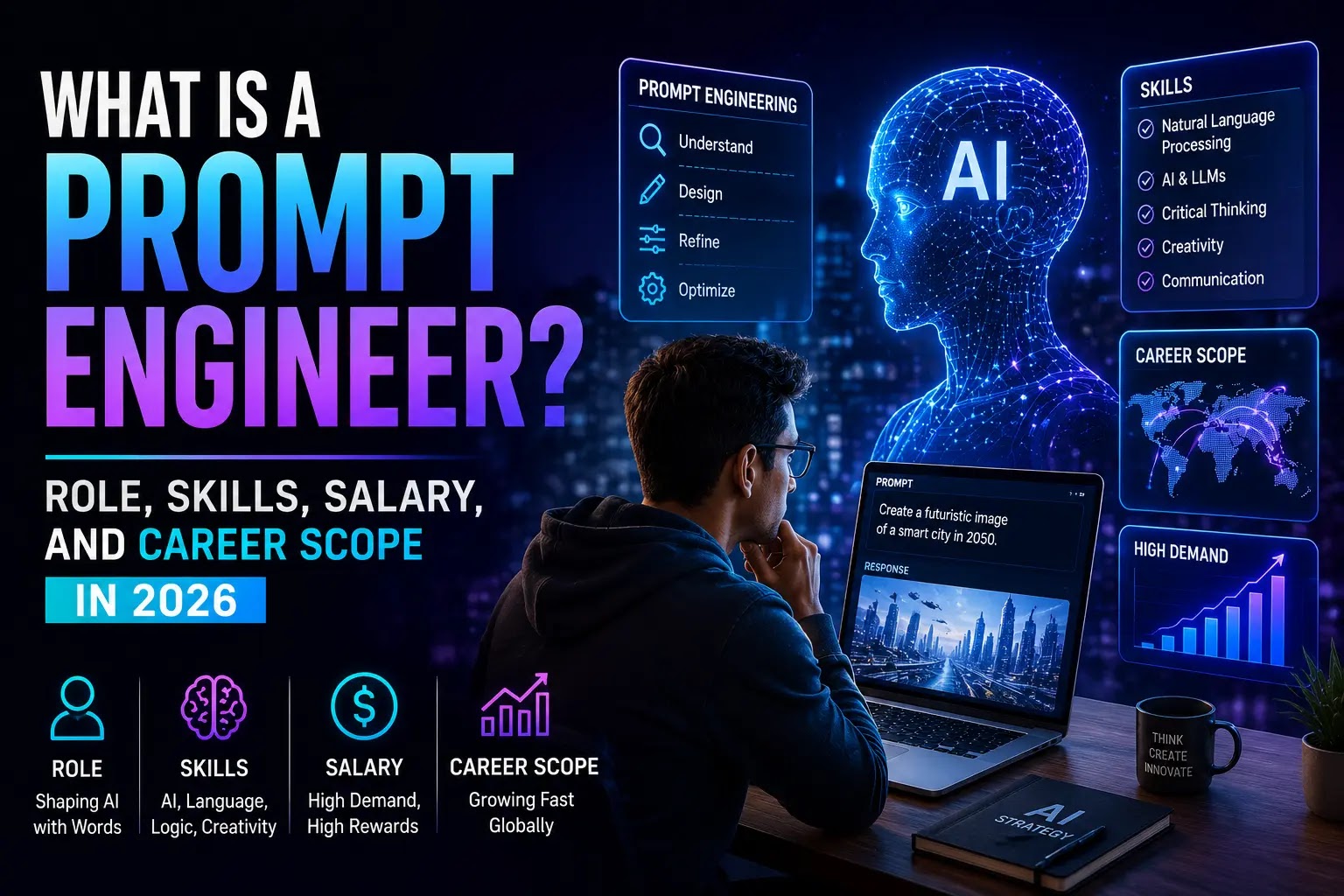
A few years ago, “prompt engineer” would have sounded like a made-up job title. Today, it is one of the most searched career terms on LinkedIn, Naukri, and Google — and companies are actively paying competitive salaries to hire people who are exceptionally good at it. But what does a prompt engineer actually do all day? And is this a real, lasting career or just a temporary trend riding the AI hype wave?
The honest answer is that prompt engineering has evolved far beyond simply “writing better questions to ChatGPT.” In 2026, prompt engineers work at the intersection of language, logic, and AI systems. They design the instructions that make large language models (LLMs) behave reliably, safely, and usefully in production environments. From building customer service bots to powering internal enterprise tools, the work of a prompt engineer directly determines whether an AI product succeeds or fails in the real world.
If you have been curious about this role — whether to pursue it as a career, understand what your team needs, or simply make sense of a job posting — this guide breaks down everything you need to know about what prompt engineers do, the skills required, how much they earn, and what the career path looks like in 2026.
What Is a Prompt Engineer?
A prompt engineer is a professional who designs, tests, refines, and optimises the inputs given to AI language models to produce accurate, consistent, and useful outputs. Think of it this way: an LLM like GPT-4o, Claude 3.5, or Gemini 1.5 Pro is an incredibly powerful engine. A prompt engineer is the person who knows exactly how to operate that engine — what fuel to use, what settings to adjust, and what to do when it produces unexpected results.
The role sits at the boundary between technical and creative work. It requires understanding how LLMs process language, what causes them to hallucinate or go off-track, and how to structure instructions so the model behaves predictably across thousands of different user inputs — not just in a single test.
What Do Prompt Engineers Actually Do at Work?
The day-to-day responsibilities of a prompt engineer vary depending on the company and the AI product they are building. However, most prompt engineering roles share a core set of tasks:
Designing System Prompts and Instruction Sets
The system prompt is the foundational instruction given to an LLM before any user interaction begins. Prompt engineers craft these carefully to define the AI’s persona, boundaries, tone, and behaviour. A poorly written system prompt leads to inconsistent, off-brand, or unsafe AI responses. A well-designed one makes the AI feel reliable and purposeful.
Building and Testing Prompt Templates
For most business applications, the AI does not receive a single one-off question — it handles thousands of variations of similar inputs. Prompt engineers build templates with variables (like customer name, product type, or query category) and test them systematically to ensure the output quality stays consistent across all variations.
Evaluating and Reducing Hallucinations
LLMs can confidently produce incorrect information — a phenomenon called hallucination. A major part of prompt engineering involves identifying when and why this happens for a specific use case, and restructuring the prompt or adding retrieval mechanisms (like RAG — Retrieval-Augmented Generation) to ground the model’s responses in verified facts.
Prompt Chaining and Workflow Design
Complex AI tasks often require multiple steps. Prompt engineers design chains of prompts — where the output of one step becomes the input to the next — to handle multi-step reasoning tasks, document summarisation pipelines, code generation workflows, and more. Tools like LangChain, LlamaIndex, and CrewAI are commonly used here.
A/B Testing and Iteration
Prompt engineering is empirical work. Professionals in this role regularly run A/B tests on different prompt versions, measure output quality using automated and human evaluation metrics, and iterate based on results. The goal is to find the prompt strategy that performs best at scale.
Collaborating with Product and Engineering Teams
Prompt engineers rarely work in isolation. They work closely with product managers to understand what the AI feature needs to do, with software engineers to integrate prompts into the codebase, and with QA testers to identify edge cases. Communication and documentation skills matter as much as technical skill in this role.
Documentation and Prompt Version Control
Good prompt engineers treat prompts like code — they version control them, document what each prompt is designed to do, track changes, and maintain a library of reusable prompt patterns. This is especially important in enterprise settings where multiple teams use the same AI infrastructure.
Key Skills Required to Become a Prompt Engineer
The skills required depend on whether you are targeting a technical or non-technical prompt engineering role. Here is a breakdown:
Core Skills (Required for All Prompt Engineering Roles)
- Deep familiarity with LLMs: Understand how models like GPT-4o, Claude, Gemini, Llama 3, and Mistral work — including concepts like tokenisation, context windows, temperature, top-p sampling, and system vs user vs assistant roles
- Prompt design techniques: Zero-shot, few-shot, chain-of-thought, tree-of-thought, ReAct prompting, role prompting, and structured output prompting
- Evaluation and testing mindset: Ability to systematically measure prompt quality, identify failure modes, and iterate based on data
- Strong writing and language skills: Prompts are language — clarity, precision, and structure in writing directly translate to better AI outputs
- Critical thinking: Ability to diagnose why an AI output went wrong and reason about how to fix it
Technical Skills (For Engineering-Facing Roles)
- Python programming: Required for building prompt pipelines, calling APIs, and processing outputs programmatically
- OpenAI API / Anthropic API / Gemini API: Hands-on experience with making API calls, handling streaming responses, and managing rate limits
- LangChain or LlamaIndex: The primary frameworks for building complex prompt workflows and RAG systems
- Vector databases: Pinecone, Chroma, or Weaviate — used for grounding LLM responses in external knowledge
- Basic understanding of fine-tuning: Knowing when a problem requires fine-tuning vs better prompting is a valuable skill
Prompt Engineer Salary in India and Globally (2026)
Prompt engineering is one of the better-compensated AI roles available in 2026, particularly because the supply of skilled practitioners is still relatively low compared to demand.
Salary in India
- Entry-level (0–2 years): ₹6 LPA – ₹12 LPA
- Mid-level (2–4 years): ₹12 LPA – ₹22 LPA
- Senior (4+ years): ₹22 LPA – ₹40 LPA+
- At top product companies (Microsoft, Google, Anthropic India teams): ₹40 LPA – ₹80 LPA+
Salary Globally (Remote Roles Open to Indian Candidates)
- USA: $90,000 – $175,000 per year
- UK: £55,000 – £110,000 per year
- Remote-first AI startups: $60,000 – $120,000 per year (many are open to India-based candidates)
Salaries are higher at AI-native companies (Anthropic, Cohere, Mistral, Scale AI) compared to traditional IT service firms. In India, startups like Sarvam AI, Krutrim, and Gnani.ai are offering competitive packages to attract prompt engineering talent.
Types of Companies That Hire Prompt Engineers
Prompt engineering roles exist across a wide spectrum of industries and company types in 2026:
- AI-native product companies: OpenAI, Anthropic, Cohere, Mistral AI, Sarvam AI — building the foundational models and AI platforms
- Big Tech AI divisions: Google DeepMind, Microsoft AI, Meta AI, Amazon AWS AI — integrating LLMs into large-scale products
- Enterprise software companies: Salesforce, SAP, Oracle, Zoho, Freshworks — adding AI features to existing SaaS products
- IT services and consulting: TCS, Infosys, Wipro, Accenture India — building AI solutions for enterprise clients
- Healthcare AI startups: Building clinical documentation, diagnostic support, and patient communication tools powered by LLMs
- Edtech companies: Building AI tutors, personalised learning systems, and automated content generation pipelines
- Fintech companies: Building AI-powered financial advisory, fraud detection explanation systems, and customer support bots
Career Path for Prompt Engineers in 2026
Prompt engineering is a young discipline, but career paths are beginning to take shape. Here is what progression typically looks like:
- Junior Prompt Engineer / AI Content Specialist: Entry point — focuses on building and testing prompts for specific use cases under guidance
- Prompt Engineer: Independently designs prompt systems, runs evaluations, and collaborates with product teams
- Senior Prompt Engineer / LLM Engineer: Leads prompt architecture for complex AI products; may manage junior team members
- AI Product Manager: Transitions into product ownership of AI features, combining prompt expertise with product strategy
- AI Research Engineer: Moves into a more research-focused role exploring new prompting techniques, evaluation frameworks, and model behaviour
- Head of AI / AI Architect: Senior leadership role overseeing the entire AI stack, including prompt systems, infrastructure, and model selection
Is Prompt Engineering a Long-Term Career or a Passing Trend?
This is the most common question people ask before committing to prompt engineering as a career path. The honest answer is nuanced. The specific title “prompt engineer” may evolve — future models may become better at self-prompting, reducing the need for manual prompt optimisation in some tasks. However, the underlying skill — the ability to communicate precisely with AI systems, evaluate their outputs, and design reliable AI workflows — is a fundamentally valuable capability that will remain relevant regardless of what the job title is called.
The professionals who treat prompt engineering as a gateway into the broader world of LLM application development — learning Python, RAG systems, fine-tuning, and AI product design alongside their prompting skills — are the ones who will have the most durable and rewarding careers. Prompt engineering is best seen as the entry point into the AI field, not the final destination.
How to Get Started as a Prompt Engineer in India
- Step 1: Get hands-on with at least 3 major LLMs — ChatGPT (GPT-4o), Claude 3.5, and Gemini 1.5 Pro. Understand how each responds differently to the same prompt.
- Step 2: Complete DeepLearning.AI’s free “Prompt Engineering for Developers” course with Andrew Ng and Isa Fulford — the most respected practical introduction available.
- Step 3: Learn the OpenAI API and Anthropic API — build a simple project (a chatbot, a document summariser, a prompt testing tool) using Python.
- Step 4: Build a portfolio — document 3–5 prompt engineering projects on GitHub with clear README files explaining the problem, your approach, and the results.
- Step 5: Join the AI community — Hugging Face Discord, LangChain Discord, and Indian AI meetup communities on LinkedIn and Meetup.com.
- Step 6: Apply strategically — target AI-native startups, product companies, and IT firms with dedicated AI CoEs for your first role.
Conclusion
Prompt engineering is one of the most accessible yet genuinely impactful roles in the AI industry today. It does not require a PhD, a decade of programming experience, or a computer science degree from an IIT. It requires curiosity, precision, a deep interest in how AI systems think, and the discipline to test and iterate systematically. In 2026, as LLMs become embedded in every product and every industry, the professionals who can bridge the gap between human intent and AI capability will be among the most valuable people in any technology team. If you enjoy working with language, logic, and technology — prompt engineering might be exactly the career you have been looking for.
Before we answer some frequently asked questions, you may also find these guides helpful:
What Certifications Actually Help You Get an AI Job in 2026? Complete Guide for India
What Skills Do I Need to Start a Career in AI? Complete Guide for 2026
Frequently Asked Questions (FAQ)
What exactly does a prompt engineer do?
A prompt engineer designs, tests, and improves prompts that help AI models generate accurate, useful, and reliable responses. They optimize prompts for tasks such as content creation, coding, customer support, data analysis, and business automation.
What is a prompt engineer salary?
Prompt engineer salaries vary by country, experience, and employer. In the United States, experienced prompt engineers can earn high salaries, while in India, salaries depend on skills, AI knowledge, and industry demand. Professionals with AI, NLP, and automation expertise generally earn more.
Is it hard to become a prompt engineer?
No, becoming a prompt engineer is achievable with consistent learning. Understanding AI models, prompt design, problem-solving, and business use cases is more important than having an advanced programming background.
What skills do AI prompt engineers need?
Prompt engineers need skills in prompt writing, critical thinking, natural language processing, AI tools, problem-solving, communication, and testing AI responses. Basic knowledge of Python and automation platforms is also helpful.
Is AI prompt engineering a good career?
Yes, prompt engineering is a promising career for professionals working with AI. As businesses adopt generative AI, demand is growing for people who can create effective prompts and build AI-powered workflows.
How to become a prompt engineer in India?
To become a prompt engineer in India, learn generative AI fundamentals, practice writing prompts with tools like ChatGPT and Gemini, understand AI workflows, build a portfolio, and gain experience with automation platforms such as n8n or Make.
Are prompt engineers in high demand?
Yes, prompt engineers are in demand across industries including technology, healthcare, finance, education, marketing, and customer support as organizations integrate AI into their operations.
Do you need a degree to become a prompt engineer?
No, a degree is not mandatory. Many employers value practical AI experience, strong prompt-writing skills, problem-solving ability, and a portfolio of successful AI projects more than formal qualifications.
How long does it take to learn prompt engineering?
Most beginners can learn the basics of prompt engineering within a few weeks. Developing professional-level skills may take several months of regular practice with different AI models and real-world projects.
Should I learn prompt engineering in 2026?
Yes, learning prompt engineering in 2026 is valuable because AI is becoming a core part of business operations. However, combining prompt engineering with AI automation, AI agents, and workflow tools provides even better long-term career opportunities.
Can prompt engineers work remotely?
Yes, many prompt engineering jobs are remote because the work primarily involves creating, testing, and optimizing AI prompts using cloud-based AI platforms and collaboration tools.
Is coding required for prompt engineering?
No, coding is not always required. Many prompt engineering tasks focus on writing effective prompts. However, basic programming knowledge can help when integrating AI with applications and automation workflows.
Which AI tools do prompt engineers use?
Prompt engineers commonly use ChatGPT, Google Gemini, Claude, Microsoft Copilot, Perplexity AI, and automation platforms like n8n, Make, and Zapier to build and optimize AI-powered solutions.
What is the difference between prompt engineering and context engineering?
Prompt engineering focuses on creating effective instructions for AI models, while context engineering involves providing the AI with relevant information, memory, tools, and data so it can produce more accurate and reliable responses.
Can prompt engineering be automated?
Some prompt optimization can be automated using AI agents and workflows, but human expertise is still needed to design prompts, evaluate outputs, and improve AI performance for specific business needs.
Is prompt engineering a long-term career?
Prompt engineering is evolving into broader AI roles such as AI automation specialist, AI workflow engineer, AI consultant, and AI agent developer. Professionals who combine prompt engineering with AI tools and automation skills are likely to have better long-term career prospects.
What are the best prompt engineering courses?
Many learners start with courses from OpenAI, DeepLearning.AI, Google Cloud Skills Boost, Microsoft Learn, Coursera, Udemy, and LinkedIn Learning. The best course depends on your experience level and career goals.